About twelve families exist in Rwanda’s Volcanoes National Park and are completely habituated to nature, making them accessible to the general public (others are habituated solely for scientific study purposes). Each family is composed of a minimum of one Silverback, with the possibility of having up to four, in addition to multiple females and a group of young ones.
List Of Gorilla Families in Volcanoes National Park Rwanda
Gorilla families in Rwanda’s Volcanoes National Park include Susa, Sabinyo, Amahoro, Agashya, Kwitonda, Umubano, Kwisanga, Noheli, Hirwa, Bwenge, Karisimbi, Igisha, Muhoza, and Isimbi. Below is a brief overview of each group.
Susa Gorilla Family
Susa began in 1974 with an initial group of seven individuals and is among the groups that were researched by Dian Fossey from 1968 to 1985. The group adopted the name Susa, derived from the well-known water stream Susa.
In 2009, the Susa family initiated the splitting process, which has led to the formation of four distinct families today: Susa, Karisimbi, Isimbi, and Igisha.
Today, the Susa group consists of 19 individuals, led by the prominent silverback Impuzamahanga. This group includes 3 silverbacks, 5 adult females, 3 blackbacks, 2 subadults, 3 juveniles, and 3 infants.
The four subgroups of the former Susa family inhabit the slopes of the Karisimbi volcano, characterized by predominant bamboo vegetation. However, the group is accustomed to navigating the bamboo zone during the bamboo shoot season, as well as the higher altitude zone characterized by Hagenia and Hypericum, which is characterized by mixed herbaceous vegetation.
The group is typically regarded as moderately challenging to difficult for regular tourism purposes.
Sabinyo Familiy Of the Gorilla Families in Rwanda
- The group is comprised of 17 members. Sabyinyo is a readily accessible group overseen by the potent silverback Guhonda.
- This group is led by the silverback Gihishwamwotsi, who officially succeeded his predecessor.
- Following the leader’s departure from the organization in January 2020, Father Guhonda assumed responsibility.
- The transition of group leadership from the prominent silverback Guhonda to his son spanned over three years. During this period, Guhonda gradually increased his distance from the center of the group, ultimately departing with three gorillas, including his long-term female, Gukunda.
- The Sabyinyo group is situated near the edge of the park, which has resulted in the group exhibiting behavior that involves venturing into community farms of bamboo and eucalyptus.
- This group is regarded as easy to medium in accessibility for daily tourism use.
Amahoro Family of Gorilla Families in Rwanda
- The Amahoro gorilla family comprises 19 gorillas, under the leadership of the composed and approachable Ubumwe. It is often quite a difficult climb to get to Amahoro, but the effort is definitely worth it!
- The habituation process of the amahorofamily by gorilla trackers began in 1995 and reached full habituation between 2001 and 2002.
- Following the death of the dominant silverback in 2002, the group divided into two. The group that was led by Ubumwe retained the original name Amahoro, while the second group, which was led by the young silverback Charles, adopted the new name Umubbano.
Amahoro signifies peace, a name that aptly reflects the personality of the silverback, who exhibits a peaceful and tolerant nature towards the three younger silverbacks, thereby fostering unity within the family. - This group is situated on the eastern flank of Bisoke Volcano and frequently crosses the border into the Democratic Republic of the Congo.
- Today, the amahoro group consists of 21 individuals, which include 4 silverbacks, 8 adult females, 3 sub-adults, 2 black backs, 5 juveniles, and 7 infants.
- This group is categorized as simple to medium accessible for everyday gorilla trekking adventure.
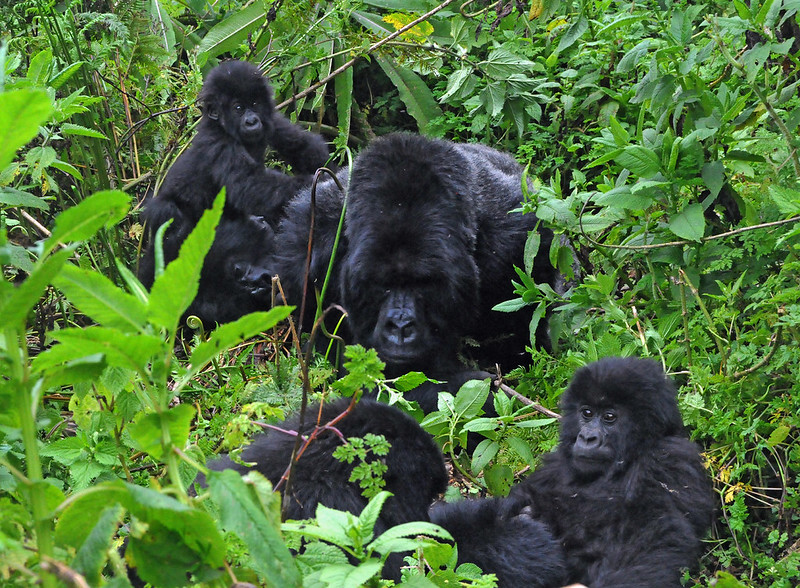
Agashya Family of Gorilla Families in Rwanda
- This group was established in the 1980s as group 13.
- The Agashya group is currently led by the dominant silverback Isano, who assumed leadership in May 2021 after taking over from his father, Agashya. The elder silverback had distanced himself from the group after several months of remaining at its outskirts.
- Agashya, signifying the act of making news or being special, certainly made headlines not only by assuming power from Nyakarima but also by uniting two families into a single group in 2002.
- The Agashya group is situated on the slope of the valley that lies between the Sabinyo and Bisoke volcanoes.
- The agasha group presently consists of 19 members, which include 2 silverbacks, 5 adult females, 1 blackback, 3 sub-adults, 4 juveniles, and 4 infants.The group is regarded as being easy to moderately accessible for everyday gorilla trekking safari in Rwanda.
Kwitonda Gorilla Family
- Kwitonda has been residing in Rwanda since 2004, having been originally habituated and monitored on the DRC side. Since 2004, the group that the park initially believed was crossing naturally on the Rwanda side for only a short time has established a permanent settlement.
- Kwitonda, the dominant silverback, passed away in 2012 due to natural causes, leaving Akarevuro and Kigoma, both subordinate silverbacks, to contend for leadership of the group. Akarevuro demonstrated respect for the group members and assumed full leadership of the group until May 2021.
- In May 2021, the Kwitonda group divided into two groups, with one group retaining 20 gorillas and Kigoma taking the other 20, marking an unusually peaceful separation. The Kwitonda family consists of 2 silverbacks, 8 adult females, 2 black backs, 3 juveniles, and 4 infants.
- The group is regarded as having easy to medium accessibility for daily tourism purposes.
Umubano Gorilla Family
- Umubano is a group of 13 individuals who separated from Amahoro under the leadership of Charles.
- Umubano group is a sibling group of Amahoro, established following the passing of the dominant silverback of Amahoro in 2002.
- The group was renamed in 2005 to Umubano, meaning harmony and cooperation. This name was proposed in recognition of the collaboration and cooperation necessary to ensure the sustainable conservation of gorillas. The communities and counties should acknowledge this fact and establish permanent mechanisms for regional cooperation to guarantee the sustainable protection and conservation of gorillas.
- The Umubano group is situated on the eastern side of the Bisoke volcano, extending towards the valley that connects the Bisoke and Sabyinyo volcanoes.
- The Umubano group consists of 14 members, which include 8 silverbacks, 2 adult females, 1 blackback, 2 sub-adults, and 1 infant.
- The Umubano family is among the groups situated nearest to the park’s boundary, and this proximity has resulted in the group developing the behavior of venturing outside the park to engage in community farming of bamboo and eucalyptus.
The group is regarded as ranging from easy to medium access for daily tourism purposes.
Kwisanga Gorilla Family
Kwisanga represents one of the latest additions to the gorilla groups within Volcanoes National Park. The group is under the leadership of Kigoma, who departed from the Kwitonda group along with 16 members.
Noheli Gorilla Family
Noheli consists of seven members, with the dominant silverback Noheli at to the throne. This group is the most recent and smallest habituated gorilla population at Volcanoes National Park. The group was established in 2021 when three females departed from Isimbi and Susa to unite with the solitary silverback, Noheli.
Hirwa Gorilla Family
- This group consists of 18 members and was established just recently, comprising individuals from former Group 13 and the Sabyinyo family. The leadership is provided by Munyinya.
- The Hirwa group was initially identified in the park on June 25, 2005, by a park guide during the tracking of the Sabyinyo group, which consisted of eight members.
- Following identification, the monitoring team confirmed that the dominant male is the same silverback, Munyinyat, who left the Susa group in 2002 after a poaching incident that resulted in the loss of four gorillas from his family.
In August 2019, the Hirwa family crossed to the Uganda side of the Virunga Massif and returned in April 2020. During that period in Uganda’s Mgahinga Gorilla National Park, the family lost seven individuals, including four who died from a suspected lightning shock. The dominant silverback was included among the deceased gorillas as the family returned, with the silverback Uburanga at the forefront. - The Hirwa group is situated on the slopes of the Sabyinyo volcano.
The group has expanded to a total of 13 gorillas, comprising 1 silverback, 2 adult females, 2 blackbacks, 4 subadults, 1 juvenile, and 3 infants.
The group is regarded as having accessibility ranging from easy to medium for daily tourism purposes.
Bwenge Family of Gorilla Families in Rwanda
The Bwenge gorilla family consists of 11 members, with Bwenge at their head. Trekking Bwenge requires navigating the Karisoke slopes with the support of a guide.
Karisimbi Gorilla Family
- The Karisimbi group was established in 2009 following a division from the Susa group.The separation process became permanent on August 20, 2009, following two months of attempts to split, which involved leaving for several days and returning temporarily.
- The group is under the leadership of Nyagaangaga, who has held the position of second in dominance to the silverback of the Susa group since 2007, following the death of the Ukwakane silverback. The new family adopted the name Karisimbi, inspired by the highest volcano of the Virunga massif, which stands at 4,507 meters, where they roamed.
Tensions among the silverbacks of the newly formed group, particularly Nyagakanga, Kampade, and Getty, led to the establishment of another group from Karisimbi, which was named Isimbi. - Karisimbi consists of 10 individuals, which include 6 silverbacks, 1 adult female, 1 blackback, 1 sub-adult female, and 1 juvenile.
- Karisimbi has recently established itself as a cross-border group, spanning the Volcanoes National Park and the Mikeno sector on the DRC side of Virunga National Park.Considering his movements, the group cannot be deemed reliable for daily tourism purposes.
Igisha Gorilla Family
- The Igisha group comprises 34 members, led by Igisha. The group was established in 2014, originating from Susa B. Igisha, and is recognized as one of the largest gorilla groups at Volcanoes National Park.
- Igisha group is the most recent family, established on November 30th, 2014, comprising former members of the Susa group. It is led by Igisha, the dominant silverback.
- Igisha, the silverback, moved with 23 individuals and established the group that was subsequently named Igisha in his honor.
- The Igisha family is located on the western slope of the Karisimbi volcano, characterized by a predominance of bamboo vegetation. Nevertheless, the group is accustomed to blending the bamboo zone during the bamboo shoot season with the higher altitude zone of hagenia and hypericum, which is characterized by mixed herbaceous vegetation.
- The Igisha group currently consists of 33 individuals, including 1 dominant silverback, 4 silverbacks, 10 adult females, 1 blackback, 5 subadults, 4 juveniles, and 8 infants.
- The group is typically regarded as medium to difficult to reach for everyday tourism purposes.
Muhoza Gorilla Family
- Muhoza was established in 2015.
- In October 2014, the dominant silverback Marambo departed from his natal group, Kwitonda, and spent approximately one year as a solitary silverback.
Marambo established the group in September 2015, incorporating two females from the Agashya family and one from the Hirwa family.He consistently takes the initiative to engage with other groups to increase the number of females. - The Muhoza group is situated on the slope of the Sabyinyo volcano, extending towards the valley that lies between the Sabyinyo and Bisoke volcanoes.
- The current composition of this group includes 19 gorillas, comprising 1 silverback, 8 adult females, 1 subadult, 2 juveniles, and 7 infants.
Isimbi Gorilla Family
- The Isimbi group is under the leadership of the prominent silverback, Muturengere.The Isimbi group was established following the division of the Karisimbi group, which occurred on April 10, 2012.
- Muturengere assumed leadership of the group following the passing of Getty Silverback. In December 2013.He received assistance from a prominent female member of the group, who later departed.
- The Isimbi family is located on the western slope of the Karisimbi volcano, characterized by bamboo vegetation.However, the group is well accustomed to navigating the bamboo zone during the bamboo shoot season, as well as the higher altitude zone characterized by Hagenia and Hypericum, which is dominated by a mix of herbaceous vegetation.
- The current composition of the group consists of 16 individuals, including 1 silverback, 4 adult females, 4 sub-adult females, 3 juveniles, and 4 infants.
- The group is generally regarded as moderately challenging to difficult for regular tourism purposes.