A 4-day Rwenzori Trek to Margherita Peak (5,109m) via the Central Circuit Trail is an extraordinarily demanding Rwenzori trekking Expedition. This short 4 days Rwenzori trekking to Margherita Peak is intended solely for experienced, high-altitude Rwenzori trekkers in exceptional physical condition. Hike up Margherita Peak (5,109m) within 4 days via the Central Circuit trail. The shortest guided trek to Uganda’s highest peak in Africa. Comprehensive itinerary, Packing List, and costs.
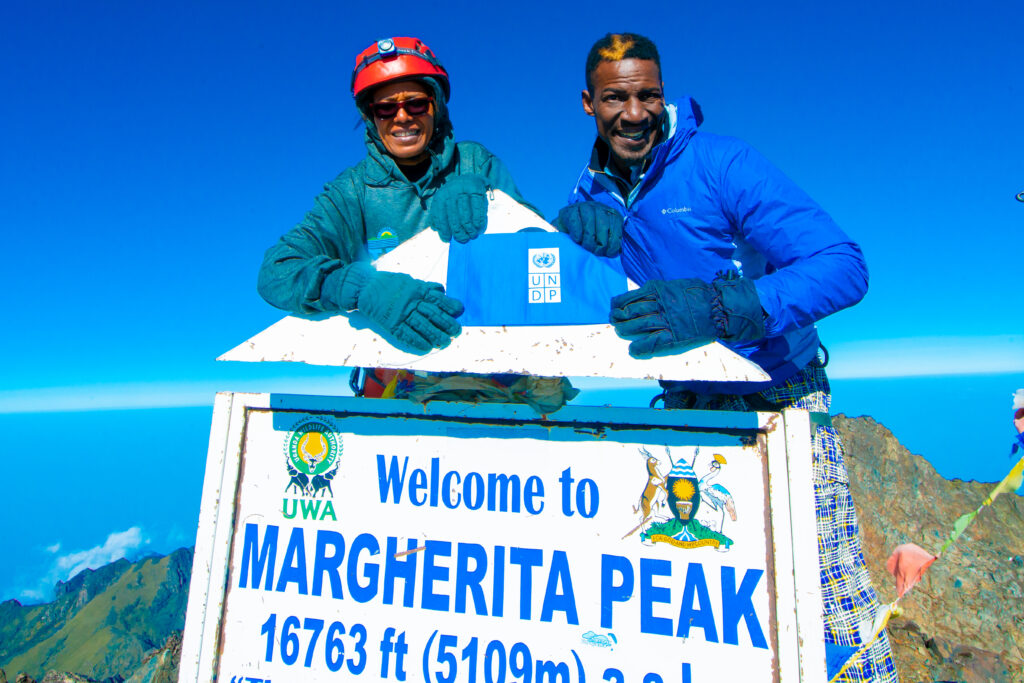 The 4-Day Rwenzori Trek to Margherita Peak provides a fast ascent through the Central Circuit trail. Hike Margherita Peak in under 4 days on this expedited Rwenzori Mountains expedition over the Central Circuit trail. This short Rwenzori trek to Margherita peak expedition is intended for seasoned hikers pursuing a demanding summit hike.
Usually, it takes 6–7 days to trek the Rwenzori Mountains to Margherita from the footslopes at Nyakalengija. This 4 days Rwenzori Trekking to Margherita Peak at 5109m cuts the Central Circuit route down to the shortest time possible without skipping any important parts. Anticipate lengthy hiking hours, significant elevation increases, glacier navigation, and limited recuperation periods. This four-day Rwenzori trek is unsuitable for First timers or anybody lacking previous high-altitude trekking expertise.
At 5,109 meters above sea level, Margherita Peak on Mount Stanley is not merely the highest point in Uganda. It is the third highest summit in Africa — after Kilimanjaro and Mount Kenya — and one of the most genuinely remote and biologically extraordinary high-altitude environments on the entire continent. Unlike those two volcanic giants, which are climbed by tens of thousands of people every year on well-trodden, commercially saturated routes, Margherita Peak is reached by fewer than a thousand climbers annually. The approach passes through five distinct vegetation zones — each one more surreal and more biologically improbable than the last — before arriving, on the final morning, at a glaciated summit ridge that requires crampons, ice axes, and fixed ropes to cross, and that rewards the effort with a 360-degree panorama across the Congo Basin, the East African Rift Valley, and the cloud-wrapped peaks of one of earth’s most extraordinary mountain ranges.
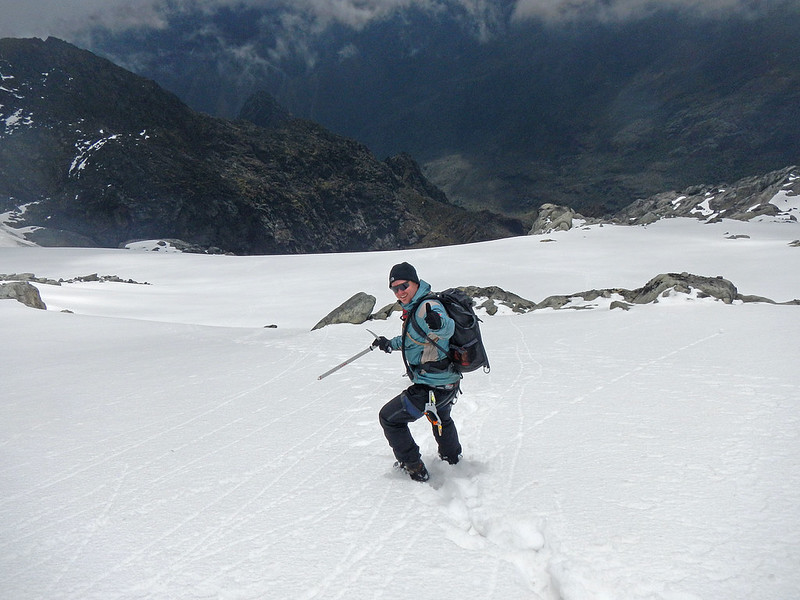
The 4-Day Rwenzori Trek to Margherita Peak via the Central Circuit trail is the fastest legitimate route to Uganda’s highest point. It is not for the casual walker or the first-time trekker. It is for the experienced mountaineers, the committed adventurer, the person who has stood on other summits and understood that what the Rwenzori Mountains offers — the combination of technical alpine terrain, an ecological journey through five vegetation zones, and the utter, indescribable strangeness of the mountain’s upper world — is categorically different from anything else that Africa can provide. The 4-day timeline is ambitious: each day involves a significant altitude gain, the acclimatization window is narrow, and the summit push on Day 4 begins before midnight in cold, dark, technically demanding conditions. It is also, for those who are properly prepared and properly guided, among the most extraordinary four days that any mountain on earth can offer.
At Gorilla Safaris, this expedition is arranged as a completely private, fully supported climb. Your certified mountain guide — experienced on the Central Circuit in every season and trained in alpine first aid — leads the full four days from the Nyakalengija trailhead to the Margherita summit and back. Your dedicated porter team carries all camp equipment and supplies. Your ascent profile, rest stops, and summit timing are calibrated specifically around your group’s fitness and acclimatization response. Nothing about this climb is left to improvisation. And everything about it — from the first step in the montane forest to the moment you stand on Africa’s third highest summit — is an experience that no other version of the Rwenzori can provide.
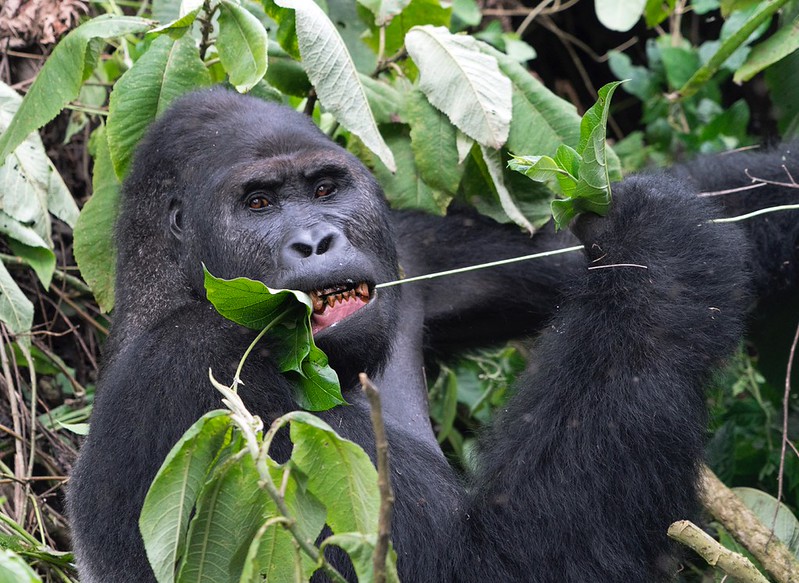
Many guests combine this four-day summit climb with gorilla trekking in Bwindi Impenetrable National Park — Uganda’s most celebrated wildlife encounter — to create one of the most extraordinary and most demanding week-long itineraries that East Africa offers. The logistics of combining both experiences are seamlessly managed by our team, with the Rwenzori summit climb typically following the Bwindi gorilla trek to allow the body’s cardiovascular system to benefit from the altitude exposure of Uganda’s highland terrain before the high-altitude push begins.
Important: The 4-Day Rwenzori Margherita Peak Trek requires prior high-altitude trekking experience, a genuine level of cardiovascular fitness, and a commitment to the physical demands of a compressed acclimatization schedule. The summit day involves glacier travel with crampons, ice axe, and fixed ropes on the Elena Glacier. This programme is not suitable for beginners, guests with heart or lung conditions, or those without previous high-altitude experience above 4,000 meters. All guests are required to confirm fitness and experience levels at booking. Medical clearance may be required.
Margherita Peak — Understanding What You Are Climbing
Africa’s Third Highest Summit
Margherita Peak stands at 5,109 metres above sea level on the summit ridge of Mount Stanley — the highest of the Rwenzori’s six major massifs and the mountain that dominates the Central Circuit’s upper terrain. The peak carries two additional named summits: Albert Peak at 5,087 m and Alexandra Peak at 5,091 m, making Mount Stanley one of the few mountains in Africa with three summits above 5,000 metres. Margherita itself was first climbed on June 18, 1906, by the Duke of Abruzzi — the Italian alpine explorer whose meticulous documentation of the first Central Circuit trail traverse remains one of the finest pieces of mountain literature ever produced about the Rwenzori.
The Rwenzori range carries the last remaining equatorial glaciers in Africa. The Elena Glacier on Mount Stanley, which must be crossed to reach the Margherita summit, has retreated by more than 80% over the past century and is projected — by current scientific modelling — to disappear entirely before 2050. Climbing Margherita Peak is not merely a mountaineering achievement. It is a witness to a geological and ecological phenomenon that is actively disappearing within our lifetimes. The glaciers that the Duke of Abruzzi photographed in 1906m, that Frederick Jackson and Henry Johnston documented before him, and that have been the defining visual signature of the Mountains of the Moon for as long as anyone has written about them, are going. The 4-day Rwenzori climb to Margherita is, among other things, a race against time.
The Six Rwenzori Massifs
The Rwenzori Range contains six Rwenzori Mountain, each carrying multiple named summits/Peaks. Understanding their relationship to the Central Circuit gives context to the 4 day Rwenzori trek to Margherita Peak. Mount Stanley (5,109 m) is the highest, its Margherita, Albert, and Alexandra peaks rising above the Elena and Coronation glaciers. Mount Speke (4,890 m) carries Vittorio Emanuele Peak, visible from the upper Circuit. Mount Baker (4,843 m) holds Edward Peak and the Freshfield Pass route. Mount Emin (4,798 m) with its Umberto and Kraepelin summits, Mount Gessi (4,715 m) with Bottego and Iolanda peaks, and Mount Luigi di Savoia (4,627 m) complete the range’s six major massifs. The four-day Central Circuit passes within sighting distance of most of these massifs, their permanent cloud cover occasionally lifting to reveal the scale of the range above the trekking zones.
The Five Vegetation Zones
The Central Circuit ascent to Margherita Peak passes through all five of the Rwenzori’s distinct vegetation zones — a vertical botanical journey that is, in terms of ecological diversity per metre of altitude gain, unmatched by any other mountain route in Africa. The lower montane forest (1,800–2,500 m) opens the first day: Podocarpus and Symphonia trees, orchids, ferns, and the endemic primates of the Albertine Rift. The bamboo zone (2,500–3,000 m) transitions the ascent from the closed canopy of the lower forest to the more open terrain above. The Hagenia-Hypericum woodland (3,000–3,800 m) — one of the Rwenzori’s most botanically distinctive zones, where gnarled Hagenia trees draped in old man’s beard lichen alternate with tall Hypericum in bloom — dominates Day 2 and the approach to John Matte Camp. The Erica heath (3,800–4,200 m) creates the sculptural, moss-saturated landscape of the upper circuit, with giant Erica trees giving way to open bog and heath. And finally, the afro-alpine zone (above 4,200 m) — where giant Senecio and giant Lobelia plants stand against a sky that seems closer and bluer than anything below — leads to the rocks and permanent ice of the summit zone.
Getting to Nyakalengija: The Central Circuit Trailhead
From Kampala or Entebbe
The Nyakalengija trailhead — gateway to the Central Circuit and the starting point for the 4-Day Rwenzori Trek to Margherita Peak — sits approximately 5 kilometers from Kasese town in western Uganda, roughly 370 kilometres west of Kampala on the main western highway. The road journey from Kampala or Entebbe takes five to six hours and passes through some of Uganda’s finest highland scenery: the Mbarara ranching country, the western rift escarpment, and the final approach to Kasese through the copper-belt foothills with the Rwenzori’s ridgelines growing overhead. Your dedicated Gorilla Safaris vehicle and driver make the full transfer in comfort, with a planned stop for lunch and refreshments en route. Most guests overnight in Kasese the night before the climb begins — arriving at the trailhead rested rather than road-weary.
Domestic Flight to Kasese
Uganda Airlines operates domestic flights from Entebbe International Airport to Kasese Aerodrome, reducing the transfer to under an hour. For guests with limited time — the 4-day Rwenzori trekking Margherita peak at 5109m is already compressed, and losing a full day to road travel on either side of the climb is a meaningful sacrifice — the domestic flight is a practical and comfortable alternative. Your dedicated vehicle meets the flight at Kasese and completes the short transfer to Nyakalengija. For guests combining the Margherita climb with a Rwanda gorilla trekking safari or a Bwindi gorilla trekking experience as a preceding chapter of their Uganda itinerary, the domestic flight from Entebbe preserves the momentum of a tightly managed private expedition.
4-Day Margherita Peak Trek — Itinerary at a Glance
Four days. Five vegetation zones. Africa’s third highest summit. The full narrative follows below.
- Day 1 — Nyakalengija to Nyabitaba Camp: Transfer from Kasese to Nyakalengija UWA headquarters | Permits and briefing | Trek through montane forest and bamboo | Overnight at Nyabitaba Camp (2,651 m)
- Day 2 — Nyabitaba to John Matte Camp: Full Central Circuit ascent day | Bigo Bog crossing | Hagenia-Hypericum forest | Giant Lobelia and Senecio zone | Overnight at John Matte Camp (3,414 m)
- Day 3 — John Matte to Elena Hut — Summit Night Begins: Upper Erica zone | Scott Elliott Pass approach | Elena Hut arrival (4,541 m) | Acclimatisation rest | Summit briefing | Overnight at Elena Hut — early summit start
- Day 4 — Summit Push: Margherita Peak (5,109 m) and Return to Nyakalengija: Pre-midnight departure from Elena Hut | Elena Glacier crossing with crampons and ice axe | Margherita Peak summit (5,109 m) | Descent to Nyabitaba and full return to Nyakalengija | Trekking certificate
Total Elevation Gain: Approximately 3,463 m from Nyakalengija to Margherita Peak
Total Distance: Approximately 58–65 km across all 4 days including ascent and full descent
Highest Point: Margherita Peak, 5,109 m — Africa’s third highest summit
Difficulty: Expert — requires prior high-altitude experience, alpine fitness, and technical gear for glacier crossing
Technical Requirements: Crampons, ice axe, harness for fixed rope — all provided by Gorilla Safaris as part of the guided programme
Day 1 — The Forest Begins: Nyakalengija to Nyabitaba Camp (2,651 m)
The Trailhead and the Last Hours of the World Below
The drive from Kasese to Nyakalengija takes forty-five minutes on a narrowing red-earth road that follows the Mubuku Valley as it closes, the Rwenzori’s ridgelines overhead pressing in with increasing authority on both sides. The Uganda Wildlife Authority headquarters at Nyakalengija is where the expedition formally begins: permits are checked and recorded, the ranger escort for the full four days is introduced, and the technical requirements of the summit push — crampons, ice axe, fixed ropes on the Elena Glacier — are confirmed and explained. Your private guide, who has stood on Margherita more times than can easily be counted, delivers the briefing with the particular combination of expertise and calm that an experienced summit guide brings to a technically serious objective. Then the log book is signed, the packs are shouldered, and the Mubuku River bridge is crossed.
The lower montane forest opens immediately — the canopy closing overhead with the familiar, sudden completeness of the Rwenzori’s first zone. This is the forest that every trekker on every Rwenzori trekking Expedition enters on Day 1, and it is no less extraordinary for being the expedition’s starting point. Giant Podocarpus trees, orchid-colonised trunks, the dense understorey of wild ginger and tree ferns, the cicadas at full sustained volume, and the blue monkeys in the canopy above the trail — all of this is present and vivid, and all of it will be missed on the return, when the descent passes through in a different direction and a different state of mind.
The Climb Through Forest and Bamboo
The trail climbs steadily through the lower forest, crossing multiple streams on log bridges, before passing through the bamboo zone — that transitional world of hollow percussion and filtered green-gold light where the character of the mountain shifts from enclosed forest to something more open and more vertical. For the 4-Day Rwenzori trek to Margherita Peak, Day 1’s pace through the bamboo is disciplined: the guide knows that four days is a narrow window for acclimatization, and that arriving at Nyabitaba with energy in reserve is not optional — it is part of the summit strategy.
The trail from Nyakalengija to Nyabitaba covers approximately 9 kilometres and gains 1,005 metres of elevation. In the context of four days to a 5,109-metre summit, this is the easiest day of the programme. But it is still a proper mountain day — five to six hours of sustained walking through forest, bamboo, and the lower margins of the Hagenia zone — and it sets the physical and psychological tone for everything that follows.
Nyabitaba Camp — The First Night on the Mountain
Nyabitaba Camp sits at 2,651 metres on a ridge where the Mubuku and Bujuku rivers meet in the valley far below — a confluence visible on clear afternoons through gaps in the forest, the twin rivers catching the last light before the valley shadow arrives. The camp’s huts — simple, functional, maintained by the UWA with the practicality of mountain accommodation that expects to be used in every season and every weather — provide twin-share sleeping with mats and blankets. Your cook team has arrived ahead of the climbing group and has a hot dinner ready.
The evening at Nyabitaba on a summit programme has a quality distinct from the first night on a leisure trek. There is purpose here. The guide goes over the next day’s terrain — John Matte Camp, the Bigo Bog crossing, the altitude gain — while dinner is served. Hydration is emphasised. Early sleep is not suggested but quietly enforced by the altitude and the effort of the day. The mountain is above. The programme has four days. And Nyabitaba, at 2,651 metres, is where the body begins its first negotiations with altitude.
Overnight: Nyabitaba Camp (2,651 m) — twin-share mountain huts, sleeping mats and blankets provided. Hot dinner and full breakfast prepared by your dedicated camp cook.
Day 2 — The Botanical Ascent: Nyabitaba to John Matte Camp (3,414 m)
Morning — Into the Hagenia-Hypericum World
Day 2 is the Central Circuit’s most botanically extraordinary day — and, for those who have not been above the bamboo zone on a previous Rwenzori visit, the day that most profoundly alters the trekker’s understanding of what a mountain environment can be. The trail from Nyabitaba climbs steadily, crossing the Mubuku River below the camp and ascending the valley’s eastern side through forest that transitions, over the course of the morning, from the bamboo-dominated middle zone into the Hagenia-Hypericum woodland that defines the Central Circuit’s character between approximately 3,000 and 3,800 metres.
Hagenia trees at this altitude grow in forms that seem to have been shaped by a deliberate artistic hand — massive, gnarled trunks draped in old man’s beard lichen, horizontal branches reaching outward in configurations that provide more visual interest per square metre than any temperate forest can generate. Hypericum — the St John’s Wort of the African high country, growing here to the proportions of a substantial tree rather than a hedge — adds its small yellow flowers wherever the canopy opens. The combined effect of Hagenia and Hypericum at 3,000 metres, draped in cloud moisture and old man’s beard, is of walking through a landscape that has been curated by something with a very long attention span and an excellent aesthetic sense.
The Bigo Bog and the Giant Plants
Above the Hagenia forest, the trail enters the Bigo Bog — one of the Rwenzori’s most celebrated and most physically challenging features. The bog extends for kilometers across the upper Bujuku Valley, its surface a continuous carpet of sphagnum moss and sedge that is visually beautiful and navigationally deceptive: what appears to be solid ground often yields suddenly underfoot, and the wooden boardwalks that traverse the worst sections require careful footing even for the experienced mountain walker. The bog crossing is the closest the Central Circuit comes to a technical challenge on its lower sections, and it is where the quality of a guide’s route knowledge becomes most apparent.
It is also where the giant Senecio plants — Senecio adnivalis — reach their full, extraordinary expression. These plants, growing to heights of four to six metres in the bog and bog-margin habitat, have been described as looking like something from a Jurassic landscape, and the description is not an exaggeration. Their rosettes of large succulent leaves spiral with mathematical precision from a thick central stem. Their dead lower leaves form an insulating skirt around the growing point — a passive adaptation to the extreme temperature swings of the afro-alpine zone, where nights regularly freeze and midday equatorial sun can raise the surface temperature by thirty degrees in a few hours. The giant Lobelia wollastonii accompanies them in the wettest sections: a spike-leaved plant that closes its leaves around the growing point at night against the frost, reopening at dawn — a movement visible to the patient observer in the early morning cold.
Arrival at John Matte Camp
John Matte Camp sits at 3,414 metres in the upper Bujuku Valley — named for one of the Rwenzori’s greatest guides, a Bakonzo man whose decades on this mountain shaped the Central Circuit’s route and whose name on a camp is as honorable a memorial as this mountain can provide. The camp commands views up the valley toward the higher circuit and, on clear afternoons, the lower flanks of Mount Stanley are visible above the cloud belt — the first sight of the objective for the summit programme.
Day 2 has gained 763 meters over approximately 12 kilometers of mountain terrain. The body is working harder than it did at lower altitude — the air at 3,414 meters contains measurably less oxygen than at sea level — and the guide conducts a quiet but thorough assessment of each group member’s acclimatization response over dinner. Headache, reduced appetite, and disturbed sleep at this altitude are common and manageable. More serious symptoms — ataxia, unusual shortness of breath, or confusion — would require immediate action. The experienced guide knows the difference, monitors consistently, and acts without hesitation. Dinner at John Matte is substantial and hot, hydration is actively encouraged, and the early start of Day 3 makes an early departure from the dinner table both sensible and easy to enforce.
Overnight: John Matte Camp (3,414 m) — twin-share mountain huts, sleeping mats and blankets. Hot dinner and full breakfast. Altitude monitoring by your private guide throughout the evening.
Day 3 — Into the Alpine Zone: John Matte to Elena Hut (4,541 m)
Morning — Above the Trees
Day 3 is the day the Rwenzori becomes unmistakably alpine. The trail from John Matte Camp climbs rapidly into the upper Erica heath and then beyond the tree line into the afro-alpine zone — a landscape of open rock, remnant ice, giant Senecio and Lobelia, and a sky that appears fundamentally different from the sky at lower altitude: deeper blue, more present, with a quality of light that only elevation and thin air can produce. The temperature drops measurably with every hundred meters of ascent. By mid-morning, layers that were adequate at John Matte are no longer sufficient, and the wind — which the Rwenzori’s upper zones channel with characteristic unpredictability — makes effective waterproofing essential regardless of what the sky is doing at any given moment.
The trail from John Matte to Elena Hut gains approximately 1,127 metres over the course of the day — the expedition’s single greatest elevation gain — and it does so through terrain that becomes progressively more demanding and more spectacular with each hundred metres. The upper Bujuku Valley narrows, the valley walls rise steeply on both sides, and the remnant glaciers of the higher peaks appear between the valley headwall and the sky above.
Scott Elliott Pass and the Upper Circuit
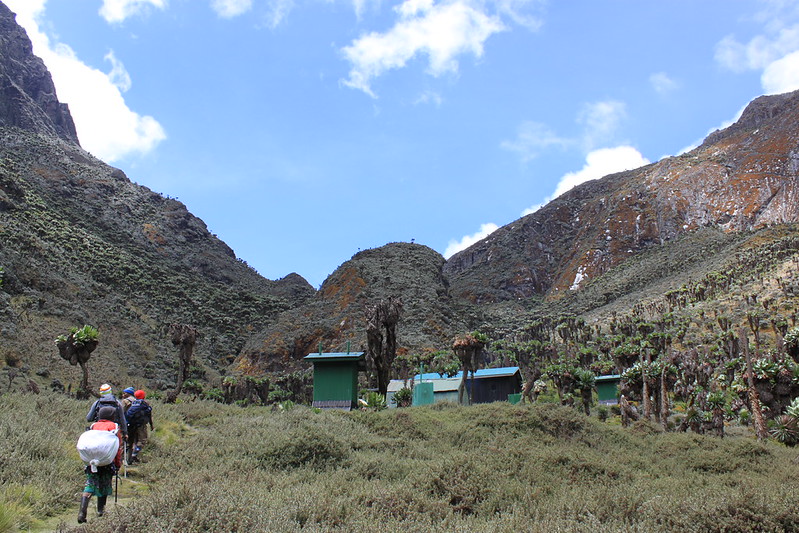
The approach to Elena Hut passes near the Scott Elliott Pass junction — the point on the Central Circuit where routes diverge toward Mount Baker and Mount Speke for longer multi-peak programmes. The terrain here is genuinely high alpine: rock, ice-polished surfaces, remnant moraines from the glaciers’ former extent, and the particular emptiness of a landscape above the biological zone where most life is possible. Giant Senecio plants — defying the conditions with their prehistoric composure — stand at intervals among the rock, their presence at this altitude a reminder of the Rwenzori’s peculiar biological rules.
The Elena Glacier becomes visible on the approach to the hut — a remnant of what was, a century ago, a continuous ice sheet covering much of the upper Stanley massif. Even in its reduced state it is an extraordinary thing to see at the equator: blue-white ice in a landscape that is technically at the same latitude as Kampala, existing because altitude has compressed climate into a zone where equatorial sun and alpine cold coexist in a daily negotiation that the glacier is slowly losing. Your guide explains the glacier’s retreat without turning it into a lecture — the facts are visible enough without amplification.
Elena Hut — The Summit Begins Here
Elena Hut sits at 4,541 metres above sea level — the highest sleeping position on the Central Circuit trail and the launch point for all summit attempts on Margherita Peak. The hut is functional and no more: metal bunks, sleeping mats, a cramped but serviceable cook space, and walls that do their best against the wind and the cold. At 4,541 meters, the cold is a different order of magnitude from anything at John Matte: temperatures regularly fall to -5°C or below overnight, and the wind at the hut’s exposed position adds a chill factor that makes down insulation non-optional. Every layer in the pack comes out at Elena Hut, and guests who underestimated how much warmth they would need at this altitude find the guide’s earlier gear advice acquiring a sharp retrospective logic.
The afternoon at Elena Hut is the summit excursion’s only unscheduled time — and it is not, in practice, particularly idle. Your guide conducts a final gear check: crampons fitted and tested, ice axe familiarization for those who have not used one in alpine terrain, harness sizing confirmed, the summit route explained in specific detail. The Elena Glacier crossing — which begins in darkness several hours after midnight — is walked through verbally, step by step. Questions are answered fully. The cook prepares the best dinner the hut’s altitude will permit. And then, as early as 8pm, the guide indicates that sleep is the most important preparation remaining for the summit push that begins before midnight.
Overnight: Elena Hut (4,541 m) — shared mountain hut accommodation with sleeping mats. Dinner and summit-day breakfast (served at midnight) included. Technical gear fitted and confirmed this afternoon.
Day 4 — The Summit: Margherita Peak (5,109 m) and Return
Midnight Departure — The Mountain at its Most Demanding
The alarm at midnight at 4,541 metres is a physical experience before it is an emotional one. The cold is immediate and absolute — the kind that finds every gap in layering before you are fully awake. The guide has breakfast ready: something hot, something caloric, consumed in the headtorch light of the Elena Hut’s cramped interior while crampons are clipped to boots and harnesses are buckled over down jackets. The summit party assembles outside the hut door in the pre-dawn dark, torches illuminating small cones of frozen ground, the stars overhead — at this altitude, above most of the moisture and dust of the lower atmosphere — extraordinary in their density and clarity.
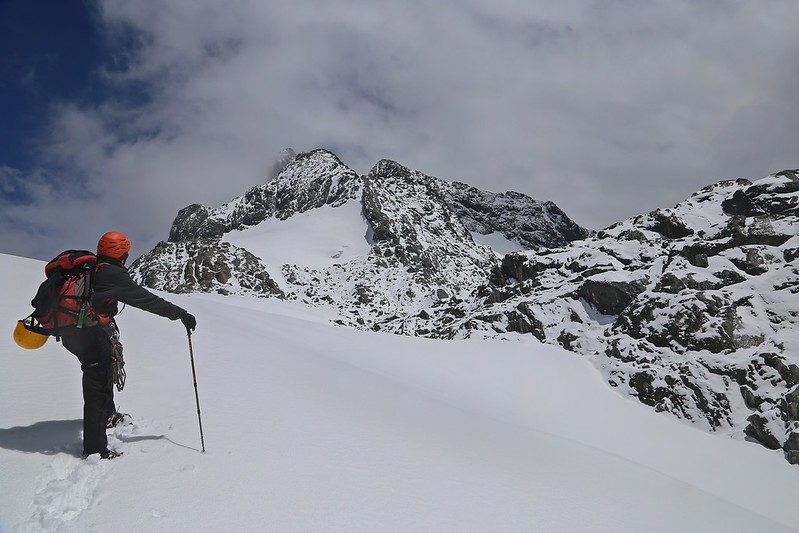
The first section of the summit route from Elena Hut climbs steep, rocky terrain toward the base of the Elena Glacier. At 4,600 metres in the dark, the route demands full attention — handholds on cold rock, careful crampon placement on ice-crusted surfaces, the guide’s headtorch ahead as the only reference point in a world reduced to the circle of your own light, the sounds of your own breathing, and the wind. No conversation. No photographs yet. Only the patient, deliberate business of moving upward on difficult terrain with the summit still above.
The Elena Glacier Crossing
The glacier crossing is where the 4-Day Margherita Peakcrosses its most significant technical threshold. The Elena Glacier — shrunk dramatically from its former extent, but still a proper glacier, still blue-white in the headtorch beam, still requiring respect and care — is traversed on fixed ropes that your guide attaches the group to before any glacier terrain is entered. Crampons bite into the ice. The ice axe is ready in the uphill hand. Movement is deliberate, sequential, guided by the rope and by the voice ahead. The glacier’s surface is not uniformly flat — there are crevasse zones to avoid, ice ridges to cross, sections where the angle steepens and the crampon work requires conscious attention rather than automatic movement.
In the pre-dawn darkness, with the glacier ice reflecting the headtorches in blue-white fragments, the experience is elemental in a way that no amount of preparation fully anticipates. The cold and the altitude and the dark and the technical demands combine to produce a state of focused presence that most climbers describe as the most completely engaged they have ever been — a state in which the ordinary concerns of the world below are not merely distant but genuinely unreal, replaced entirely by the immediate requirements of the next foothold, the next rope section, the next fifty metres toward the summit ridge.
Margherita Peak — Africa’s Third Highest Summit
The summit ridge of Mount Stanley appears in the pre-dawn grey — a narrow spine of rock and ice above the Elena Glacier, with Alexandra Peak to the left, Albert Peak to the right, and Margherita — the highest point — ahead. The final approach to the summit cairn crosses the ridge itself: exposed, cold, with the Congo Basin visible through gaps in the cloud on the western side and the Rwenzori’s full upper massif laid out to the south and east on the best mornings. Each step on the ridge is deliberate, guided by the rope, anchored in the full knowledge of what is below on either side.
And then the summit. The moment. At 5,109 metres above sea level — Africa’s third highest point, Uganda’s highest summit — the mathematics of the ascent become irrelevant and the experience becomes simply what it is: the top of the mountain, the achievement of something that required everything you had to give, and the view — in whatever visibility the Rwenzori chooses to offer that morning — across a landscape that has been covered in permanent ice for thousands of years and will not be covered in permanent ice for very much longer. Take the moment. Stay as long as the guide and the conditions permit. Look in every direction. This is the one.
The summit is typically reached in the pre-dawn hours — between 4am and 7am depending on conditions and group pace. On clear days, the sunrise from Margherita Peak — the equatorial sun rising over the East African Rift Valley with the Congo Basin still dark to the west — is one of the finest mountain views available anywhere in Africa, and your guide will time the ascent, where conditions allow, to be on the summit at or before first light.
The Descent — From 5,109 m to the Valley in a Single Day
The descent from Margherita Peak on Day 4 is, by any measure, an extraordinary physical undertaking. The full summit Rwenzori excursion returns from the Margherita Peak, across the Elena Glacier, down the rocky approach to Elena Hut, back through the afro-alpine and Erica zones to John Matte Camp for a rest stop and a hot meal, and then continues all the way down the valley through the Hagenia-Hypericum woodland, the bamboo zone, and the lower montane forest to Nyabitaba Camp and finally back to the Nyakalengija trailhead — a descent of over 3,000 metres across the full length of the Central Circuit in a single day.
The descent is long and it is hard. The knees carry the cumulative load of every vertical metre of the morning’s ascent, reversed over terrain that is wet, rooted, and technically demanding in its own right. Trekking poles are not optional at this point — they are structural. The guide maintains the group’s pace throughout, ensuring that the descent does not become a race to the trailhead. Rest stops are taken at John Matte and at Nyabitaba. And the final section — through the lower montane forest in the late afternoon light, the cicadas back at full volume, the air warming with every hundred metres of descent — has a quality of earned completion that no short walk can manufacture.
The Nyakalengija headquarters is reached in the early evening of Day 4. The park register is signed. Trekking certificates — issued by the Uganda Wildlife Authority to all guests completing a full Central Circuit summit Rwenzori trekking excursion— are presented. Your dedicated vehicle is waiting. And the evening in Kasese — hot shower, proper bed, a meal at a table that does not require crampons to reach — is the finest reward that the Mountain of the Moon can provide to the person who has just climbed to its top and walked all the way back down in a single day.
Day 4 includes: midnight summit departure from Elena Hut, Elena Glacier crossing with technical equipment, Margherita Peak (5,109 m), descent via John Matte Camp and Nyabitaba Camp to Nyakalengija trailhead. Full day: approximately 12–16 hours of active travel. Transfer to Kasese accommodation by Gorilla Safaris dedicated vehicle.
Technical Requirements and Physical Preparation
Experience and Fitness
The 4-Day Rwenzori trek to Margherita Peak Trek is classified as expert level. Applicants should have prior experience trekking or climbing above 4,000 meters — ideally with glacier or technical terrain experience — and should be in excellent cardiovascular condition at the time of the climb. The compressed acclimatization schedule (reaching 4,541 meters on Day 3 and 5,109 metres on Day 4) provides a narrower physiological window than longer Rwenzori trekking expeditions and places greater demands on the body’s altitude adaptation response. Guests who have prior Kilimanjaro, Mount Kenya, or alpine experience are best positioned for this 4 days Rwenzori trekking to Margherita peak. Those without prior high-altitude experience are strongly recommended to consider the 7-Day Central Circuit Margherita Programme which provides a more gradual acclimatization profile.
Technical Gear for the Summit Day
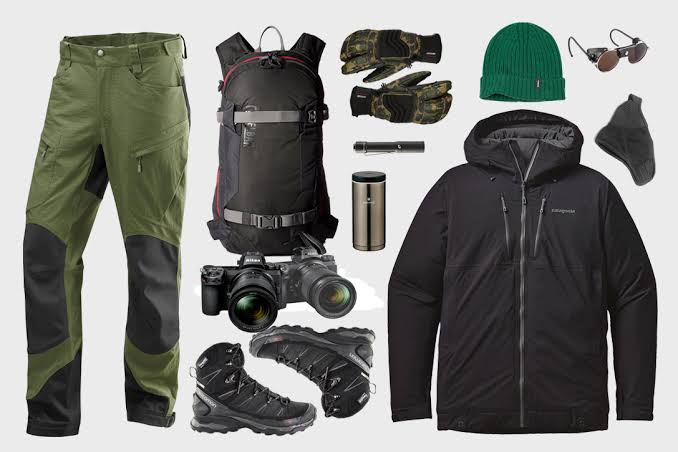
The summit push on Day 4 requires technical gear that provides as part of the guided 4 days Rwenzori trekking to Margherita Peak, eliminating the need for guests to transport specialist alpine equipment internationally. Provided items include: crampons (sized and fitted at Elena Hut), ice axe, climbing harness for fixed rope sections, helmet, and connection equipment. Guests must bring their own: heavyweight down jacket (rated to at least -15°C), waterproof hard-shell jacket and trousers, insulated gloves (two pairs), balaclava and warm hat, gaiters, and fully waterproof, well-broken-in mountaineering boots compatible with the crampons provided. A complete technical gear list is provided to all guests at the time of booking and must be confirmed before departure.
What to Pack for the 4-Day Margherita Peak Climb
Layering for a 3,500-Metre Altitude Range
The four-day Rwenzori trekking to Margherita Peak moves from the warm, humid lower forest at 1,646 metres to the Margherita summit at 5,109 metres — a temperature range of approximately 30°C across the altitude spectrum. The layering system must function across all of these conditions, and packing for comfort at the trailhead and safety at the summit simultaneously requires discipline. The essential layers are: a merino or synthetic moisture-wicking base layer, a mid-layer fleece, a heavyweight down jacket rated to at least -15°C (non-negotiable for Elena Hut and the summit), and a waterproof hard-shell jacket and trousers. Add insulated gloves, a balaclava, and a warm hat for the summit push. At the lower end of the altitude range, the down jacket is packed away and the shell layer is carried in the daypack — accessible but not worn.
Footwear
Footwear for the 4-Day Margherita programme requires mountaineering boots compatible with the crampons provided by Gorilla Safaris — specifically, boots with a stiff sole that accepts semi-rigid crampon binding. Standard hiking boots, even high-quality ones, are not suitable for glacier travel and will be incompatible with the crampon system. Your guide confirms boot compatibility at booking and, if necessary, advises on appropriate footwear sourcing before departure. Gaiters are essential above John Matte Camp and are provided by Gorilla Safaris if not brought from home.
Sleeping and Camp Essentials
The mountain hut accommodation across all four camps provides sleeping mats and blankets. Guests are strongly recommended to bring a personal sleeping bag rated to at least -10°C — particularly for the Elena Hut night at 4,541 metres, where the hut’s insulation is not sufficient to compensate for the external temperature without additional personal sleeping insulation. A sleeping bag liner adds meaningful warmth at minimal pack weight. A headtorch with multiple sets of spare batteries is essential — the summit departure is in complete darkness and the torch will be used continuously for four to six hours on Day 4. A trekking pole pair, 2–3 litre water capacity (Camelbak or bottles — bottles are preferred at summit temperatures where Camelbak tubes freeze), high-energy compact snacks for the summit day, personal medications and altitude treatment items, and a camera with cold-temperature battery spares complete the essential personal kit list. A full equipment checklist is provided at booking.
What’s Included in Your 4-Day Margherita Peak Trek
Your 4 days Rwenzori trekking to Margherita Peak expedition is arranged as a completely supported, privately guided summit programme. Every element — from the permits secured months in advance to the technical gear fitted at Elena Hut — is confirmed before your arrival in Uganda.
- All Uganda Wildlife Authority (UWA) park entry fees and Central Circuit trekking permits for all 4 days
- Professional, UWA-certified private mountain guide experienced on the Central Circuit and Margherita summit route
- Dedicated UWA armed ranger escort throughout all 4 days on the trail
- Technical summit equipment: crampons, ice axe, climbing harness, helmet, and fixed rope connection equipment for the Elena Glacier crossing
- Experienced porter team carrying all group camping equipment, food supplies, and shared loads for all 4 days
- All meals on the mountain: hot dinner and full breakfast at each camp (Nyabitaba, John Matte, Elena Hut) plus summit-day midnight breakfast at Elena Hut, packed trail lunch for descent from Elena Hut
- Drinking water and electrolyte supplements throughout all 4 days
- 3 nights mountain accommodation: Nyabitaba Camp (2,651 m), John Matte Camp (3,414 m), Elena Hut (4,541 m) — shared mountain huts with sleeping mats and blankets
- Altitude monitoring and basic alpine first-aid kit throughout; guide trained in altitude illness recognition and emergency descent protocols
- UWA Margherita Peak summit certificate issued on successful completion
- Private vehicle transfers between Kasese and Nyakalengija trailhead in both directions
- All government taxes and statutory levies
- Comprehensive pre-departure gear list, technical briefing document, and altitude preparation guidance
What’s Not Included
For complete planning transparency, the following are not covered within the expedition package.
- International flights to Uganda (Entebbe International Airport)
- Uganda tourist visa — apply via the official online e-visa portal before travel
- Comprehensive travel, medical, and evacuation insurance — mandatory and non-negotiable for all summit programme guests; policy must explicitly cover high-altitude mountaineering above 5,000 m
- Personal mountaineering footwear: stiff-soled boots compatible with semi-rigid crampons — specifications confirmed at booking; sourcing guidance provided if required
- Personal sleeping bag (rated to -10°C or below, strongly recommended for Elena Hut)
- Personal heavyweight down jacket (rated to -15°C), hard-shell jacket and trousers, insulated gloves, balaclava, warm hat
- Personal trekking poles — strongly recommended throughout all 4 days; available for hire through Gorilla Safaris
- Guide, porter, and cook gratuities — suggested amounts provided in pre-departure information
- Hotel accommodation in Kasese before and after the trek
- Medical evacuation costs beyond standard insurance coverage — guests must confirm that their travel insurance specifically covers helicopter evacuation from high altitude in Uganda
- Personal expenditure and souvenirs
Best Time to Attempt the 4-Day Margherita Peak Trek
December to February — The Premier Summit Window
The short dry season from December through February is widely regarded by experienced Rwenzori guides as the finest window for a Margherita summit attempt. Precipitation is at its annual lowest, the trail surfaces — including the Elena Glacier approach — are at their most stable, and the chance of clear summit conditions on Day 4 is significantly higher than in the wet season months. The overnight temperature at Elena Hut during this period is consistently cold (frequently -5°C to -10°C) but predictably so, without the additional challenge of wet gear and sodden camp kit that the rainy season adds to the summit night. For guests who can arrange their travel for this window, December to February represents the 4-Day Margherita Rwenzori trek at its most achievable and most visually rewarding.
June to August — The Long Dry Season
June through August — Uganda’s peak dry season and the most popular travel window for the country’s national parks — offers the second-best summit conditions on the Central Circuit. Compared to December–February, the June–August period tends to carry slightly more precipitation on the upper circuit (the Rwenzori’s weather systems are influenced by the Congo Basin’s own rainfall patterns, which peak in different months than Uganda’s standard seasons). Summit conditions are reliable but less consistently clear than in the short dry season, and the glacier approach on Day 4 may involve more variable snow conditions. Pre-departure permit booking for June–August is strongly recommended at least four to six months in advance.
March to May and September to November — Possible but Demanding
The Rwenzori’s two rainy seasons do not make the 4-Day Rwenzori Trekking Margherita Peak — but they make it significantly more demanding and significantly less likely to produce the clear summit conditions that justify the physical investment. Rain on the upper circuit adds technical difficulty to the glacier crossing, increases the risk of hypothermia at Elena Hut, and frequently obscures the summit views that make the achievement visually memorable. For guests who cannot travel in the dry season windows, the 7-Day Central Circuit Rwenzori Trek is a more resilient option in the wet season months — its longer acclimatisation profile and more flexible summit scheduling better accommodate the variable weather of the rainy periods.
A Note on Glacier Conditions
The Elena Glacier is retreating at a measurable rate and its character changes year by year. Summit conditions on Day 4 are therefore never precisely predictable from historical data, and your guide assesses the glacier route immediately before the summit departure. The fundamental safety principle that your guide operates by is non-negotiable: if glacier conditions on the day are unsafe for the group composition, the summit attempt will not proceed and descent will begin. No summit is worth a risk that a trained guide has determined to be unacceptable. Our guests’ safety, on every Rwenzori trekking expeditions and in every condition, takes absolute precedence over any itinerary commitment.
Related Rwenzori Summit and Trekking Programmes
The 5 days Rwenzori Trek To Margherita Peak Central Circuit is the fastest route to Uganda’s highest summit, but it is not the only route, and it is not the right route for every climber. Gorilla Safaris offers a full range of Central Circuit and Kilembe Trail programmes that approach Margherita Peak and the Rwenzori’s higher zones with different timelines and acclimatisation profiles.
The 5-Day Margherita Peak Trek adds a single acclimatisation day between John Matte and Elena Hut — an invaluable addition for climbers who want a higher chance of summit success and a more manageable altitude gain profile. The 7-Day Central Circuit to Margherita Peak is the classic programme: seven days on the full Central Circuit, passing through all 5 vegetation zones with proper acclimatisation stops at each camp, and reaching Margherita Peak with a physiological adaptation profile that maximises both summit success rate and the depth of the botanical and wildlife experience. It is the Rwenzori trekking expedition that experienced Rwenzori guides most consistently recommend to guests who have never been above 4,000 metres before. The 8-Day Rwenzori Trek to Margherita Peak Kilembe Trail Peak approaches the summit from the southern circuit via a different ecological character and a different set of camps. The 8-Day Three Peaks Trek — Stanley, Speke and Baker extends the summit ambition to include Mount Speke (4,890 m) and Mount Baker (4,843 m) alongside Margherita, for climbers who want the full upper-circuit experience. And for the truly committed, the 10-Day Four Peaks Rwenzori Expedition and the 12-Day Gorilla and Rwenzori Combined Safari represent the Rwenzori at its most complete.
Frequently Asked Questions — 4 Days Rwenzori Trek to Margherita Peak
What is Margherita Peak and why is it significant?
Margherita Peak is the highest summit of Mount Stanley in the Rwenzori Mountains of Uganda, standing at 5,109 metres above sea level — Africa’s third highest point after Kilimanjaro (5,895 m) and Mount Kenya (5,199 m). It is Uganda’s highest summit and one of the few glaciated peaks on the African continent. The peak was first climbed on June 18, 1906, by the Italian explorer the Duke of Abruzzi, whose expedition produced the first comprehensive documentation of the Rwenzori’s upper ecology and topography. The mountain sits on the Uganda-DRC border and its summit ridge carries three named peaks: Margherita (5,109 m), Alexandra (5,091 m), and Albert (5,087 m). The summit’s significance extends beyond its altitude: the Elena Glacier that must be crossed to reach Margherita is one of Africa’s last equatorial glaciers, projected to disappear before 2050 due to climate change, making a climb to Margherita Peak a witness to a geological phenomenon actively disappearing within our lifetimes.
How difficult is the 4-Day Margherita Peak Trek?
The 4-Day Rwenzori trekking to Margherita Peak Trek is classified as expert level and is the most demanding short-timeline programme available on the Rwenzori. The primary challenges are: the compressed acclimatisation schedule (Elena Hut at 4,541 m on Day 3, summit at 5,109 m on Day 4), the technical requirements of the Elena Glacier crossing (crampons, ice axe, fixed rope in pre-dawn darkness), the total elevation gain of over 3,400 metres, and the Day 4 full descent from summit to trailhead — a descent of over 3,000 metres in a single day. Guests should have prior high-altitude experience above 4,000 metres, excellent cardiovascular fitness, and ideally some glacier or technical terrain experience. Those without prior high-altitude experience are strongly advised to consider the 7-Day Rwenzori trekking Central Circuit programme for a safer and more comprehensive acclimatization profile.
What is the Elena Glacier and is it still crossable?
The Elena Glacier on the south face of Mount Stanley is the primary ice field that must be traversed on the summit approach to Margherita Peak from Elena Hut. It has retreated by more than 80% from its early twentieth-century extent and continues to shrink at an accelerating rate. Despite its significantly reduced size, it remains a technically serious obstacle requiring crampons, ice axe, harness, and fixed rope sections for safe passage. Summit conditions on the glacier — ice angle, snow coverage, crevasse position — vary by season and by year, and are assessed by the guide on the morning of the summit attempt. The glacier is currently still cross-able with appropriate technical support, but its ongoing retreat means that this assessment is updated regularly and that conditions may change year on year.
What technical equipment is needed for the summit day?
The summit day requires: crampons (compatible with the guest’s mountaineering boots), ice axe, climbing harness for fixed rope sections, helmet, and connection equipment for the fixed rope. Gorilla Safaris provides all of this as part of the guided programme — guests do not need to transport technical climbing equipment internationally. Guests must provide: stiff-soled mountaineering boots compatible with semi-rigid crampons (specifications confirmed at booking), heavyweight down jacket rated to -15°C, hard-shell jacket and trousers, insulated gloves (two pairs), balaclava, warm hat, gaiters, and a headtorch with multiple battery sets. A complete technical gear checklist is provided at the time of booking and must be confirmed complete before departure.
How many people successfully summit Margherita Peak?
The Rwenzori Mountains receive fewer than 1,000 trekkers annually, making Margherita Peak one of the least climbed major summits in Africa. Of those attempting the summit via any Rwenzori routes, success rates vary considerably by Rwenzori itinerary duration and individual fitness — the compressed acclimatization of the 4-day Rwenzori trekking Expedition to Margherita peak produces lower success rates than the 7-day Rwenzori Trek to Margheri via central circuit trail more gradual approach. Across all Rwenzori Trekking expeditions guided summit attempts, the principal reasons for turning back before the summit are: altitude sickness symptoms that the guide determines require immediate descent, adverse glacier conditions that make the crossing unsafe for the group’s composition, or individual fitness limitations that emerge during the ascent. Your guide’s summit decision is final and non-negotiable — and guests who understand this before the climb begins have a fundamentally different (and better) experience of the summit day than those who do not.
Is the 4-Day Rwenzori Margherita Trek suitable for complete beginners?
No. The 4-Day Rwenzori trekking Margherita Peak at 5109m is not suitable for beginners or for those without prior high-altitude experience. The compressed acclimatization schedule, the technical demands of the Elena Glacier crossing, and the physical requirements of the Day 4 summit-to-trailhead descent make this programme appropriate only for guests with previous experience above 4,000 meters and a demonstrable level of alpine fitness. Beginners and first-time high-altitude trekkers are warmly welcomed on the Rwenzori’s shorter programmes — the 2-Day Sine Camp Trek, the 3-Day Rwenzori Mahoma Loop Trail, and the 7-Day Rwenzori Central Circuit trail — which provide extraordinary mountain experiences with acclimatization profiles appropriate to a first-time high-altitude expedition.
What is the best time of year to attempt the 4-Day Margherita Trek?
The best windows for the 4-Day Rwenzori Trek to Margherita summit programme are December to February (the short dry season, offering the most consistently stable summit conditions and the lowest precipitation on the glacier approach) and June to August (the long dry season, Uganda’s peak travel period, with reliable but slightly more variable summit conditions). The March–May and September–November rainy seasons make the 4-day Rwenzori Trekking To Margherita Peak is significantly more demanding and less likely to produce clear summit conditions, though the Rwenzori trekking expeditions can be attempted year-round by properly prepared, experienced climbers. For those who cannot travel in a dry season window, the 7-day Rwenzori trekking to Margherita Peak via Central circuit is a more weather-resilient option due to its longer, more flexible summit scheduling.
How do I get to the Nyakalengija trailhead from Kampala?
Nyakalengija, the Central Circuit trailhead, is located approximately 5 kilometres from Kasese town in western Uganda — roughly 370 kilometres west of Kampala on the main western highway. The drive from Kampala or Entebbe takes five to six hours. Uganda Airlines domestic flights from Entebbe to Kasese Aerodrome reduce the transfer to under an hour in the air, with your dedicated Gorilla Safaris vehicle completing the short road transfer to the trailhead on arrival. Most guests overnight in Kasese the night before Day 1, arriving at the trailhead rested and ready for the 4-day Rwenzori Trekking to begin.
What happens if I get altitude sickness on the summit programme?
Altitude illness at any point on the 4-Day Rwenzori Trek to Margherita Peak is managed by your private guide, who is trained in altitude illness recognition, assessment, and emergency response. Mild symptoms — headache, nausea, reduced appetite — at Nyabitaba or John Matte are managed with hydration, rest, and paracetamol. Moderate or severe symptoms — ataxia, confusion, severe shortness of breath, or the onset of High Altitude Pulmonary or Cerebral Oedema — require immediate descent, which the guide initiates without delay and without consultation. The 4 days Rwenzori trek to Margherita Peak expedition has no provision for waiting and hoping that symptoms improve at altitude. Descent is the only effective treatment for serious altitude illness, and your guide’s authority to initiate descent is absolute. All guests are required to hold comprehensive travel insurance that covers helicopter evacuation from high altitude in Uganda.
Can families or couples attempt the 4-Day Margherita Peak Trek?
The 4-Day Rwenzori trek to Margherita Peak at 5109m is designed for experienced, physically prepared adults — couples who are serious mountaineers and in excellent fitness will find this 4 day Rwenzori trek to margherita peak one of the finest shared physical challenges available anywhere in the world. Small groups of friends with prior high-altitude experience regularly complete the programme successfully. Solo climbers are fully accommodated in the private guided format. The 4 days Rwenzori Trek Margherita Peak Trek is not suitable for children or teenagers due to the technical demands of the summit day and the altitude at Elena Hut. Families interested in the Rwenzori Mountains are warmly directed toward the 2-Day Sine Camp Trek or the 3-Day Mahoma Loop Trail Trek, both of which are extraordinary family mountain experiences at more accessible altitudes.
Can I combine the Margherita summit climb with gorilla trekking in Uganda?
Yes — this is one of the finest combination itineraries in East Africa. The most common structure pairs 2–3 days of gorilla trekking in Bwindi Impenetrable National Park with the 4-Day Margherita summit programme, often including a morning game drive in Queen Elizabeth National Park on the Bwindi-to-Kasese transfer day. The combined itinerary runs 7–9 days and covers the two most extraordinary wildlife and mountain experiences that Uganda offers. Gorilla Safaris coordinates all permits, transfers, accommodation, and logistics between the two experiences as a single seamlessly managed private itinerary. Our 12-Day Gorilla and Rwenzori Combined Safari extends the combination to include chimpanzee tracking in Kibale Forest National Park and a full Queen Elizabeth game drive safari.