2-Day Rwenzori Trek To Sine Camp Trek — Itinerary at a Glance
A brief overview of both days. The full immersive narrative follows below.
- Day 1 — Kilembe Trailhead to Sine Camp: Transfer from Kasese to Kilembe | Uganda Wildlife Authority briefing | Trek begins through evergreen forest | Enock’s Falls | Bamboo zone ascent | Overnight at Sine Camp (2,596 m)
- Day 2 — Sine Camp — Morning Walk and Return Descent: Guided morning walk in Erica forest above camp | Descent through bamboo and montane forest | Return to Kilembe trailhead | Onward transfer or overnight Kasese
Total Distance: Approximately 16–20 km over 2 days (route length varies slightly by conditions)
Highest Point: Sine Camp, 2,596 m above sea level
Difficulty: Moderate — suitable for fit adults and children aged 10+; no technical mountaineering required
Trek Style: Fully private, guide-led, porter-supported — your pace, your programme
Day 1 — The Forest Swallows You: Kilembe to Sine Camp
Morning: Arrival at the Kilembe Trailhead
The drive from Kasese to Kilembe takes roughly twenty-five minutes on a road that narrows progressively as the copper-belt foothills close in and the first ridgelines of the Rwenzori begin to assert themselves overhead. Kilembe itself — a former copper mining settlement whose infrastructure now supports trekking operations as part of the area’s economic rehabilitation — has the feel of a place in transition: quiet, purposeful, and aware that the forest beginning just above its rooftops is something extraordinary.
Your private guide meets the group at the Uganda Wildlife Authority Kilembe ranger station, where permits are checked, the ranger escort is assigned, and the trail briefing is delivered with the particular efficiency of someone who has been up this mountain many times and wants your first hour on it to be spent looking at the forest rather than filling out forms. Poles are checked, day pack weights confirmed, and the cool morning air — already noticeably different from the heat of Kasese town — provides the first confirmation that altitude is already doing its quiet work.
Late Morning: The Evergreen Forest
The trail enters the forest immediately. There is no transition zone, no gradual fade from the human world into the wild one. The canopy simply closes overhead like a door being shut gently behind you, and the forest begins. The first zone is evergreen montane forest — Uganda’s version of what people elsewhere call tropical rain forest, though here the altitude moderates the temperature and gives the whole environment a freshness that the equatorial lowlands never achieve. Massive trees rise overhead, their trunks colonised by ferns and orchids, their canopy busy with movement.
The cicadas make themselves known before anything else does — a high, sustained wall of sound that fills every acoustic space in the forest and takes most first-time visitors completely by surprise. It is not unpleasant. After twenty minutes it recedes into the background of consciousness and becomes simply part of what the Kilembe Trail sounds like.
Blue monkeys appear in the mid-canopy within the first thirty minutes — Cercopithecus mitis, the Rwenzori’s most reliably encountered primate on this trail, watching the group with the alert but unhurried attention of animals accustomed to occasional human passage and entirely unimpressed by it. Black-and-white Colobus monkeys — those spectacular acrobats of the African canopy, their white mantles swinging as they move — are less reliable but not uncommon this low on the trail. Your guide reads the forest overhead with the practised ease of someone for whom the canopy is a social map, pointing upward before most guests have registered that anything is moving.
The forest floor is extraordinary in its own right. Every fallen branch disappears under a thick archaeology of mosses, lichens, and fungi. Giant ferns unfurl from the damp soil of stream banks. Colonies of ants — sometimes in numbers that darken the trail surface for metres in every direction — move with the focused urgency of their kind.
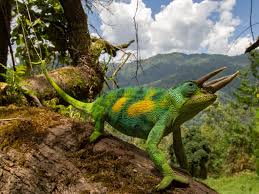 The Rwenzori Horned Chameleon — one of the mountain’s most celebrated reptile endemics, its multiple horns giving it an improbably prehistoric appearance — inhabits the undergrowth here, and your guide knows the branches and shrubs where they are most frequently found.
Midday: Enock’s Falls — The Trail’s First Masterpiece
The trail climbs steadily through the forest, crossing multiple small streams on log bridges and stepping stones before arriving, without particular announcement, at Enock’s Falls — a cascade of clear, cold mountain water dropping over dark rock into a pool fringed by bamboo, its sound audible for several minutes before it comes into view. The falls are named for one of the Rwenzori’s early local guides — a fitting memorial for a man whose knowledge of this landscape shaped the experience of countless trekkers who came before you.
This is where many groups stop for a proper rest and a trail lunch — your camp cook team will have prepared packed food for the day, and the pool below the falls provides the option of cold water for face and hands after two hours on the trail. The falls are the kind of place that makes grown adults reach instinctively for their cameras and find that no photograph does it justice. The light, the sound, the cold spray, and the bamboo framing — it is an experience that requires presence to fully receive.
Afternoon: The Bamboo Zone and the Final Ascent
Above Enock’s Falls, the character of the trail changes. The dense evergreen canopy gives way to bamboo — great stands of Arundinaria alpina that create a different kind of enclosed world: lighter, more geometric, the canes rattling in a rhythm that varies with the breeze. The bamboo zone is the Rwenzori’s transition zone — the botanical threshold between the lower montane forest and the upper heather landscape — and its atmosphere is unmistakable: a quality of light that filters through the stems in long shafts, a sound environment dominated by the hollow percussion of bamboo on bamboo, and occasional glimpses through gaps in the cane to the valley far below.
The ascent through the bamboo is the most physically demanding section of the day — sustained, with sections of rooted trail that require attention underfoot — and it is here that the wisdom of trekking poles becomes fully apparent. Your guide sets the pace, allowing for rest stops at the stream crossings where the water is cold enough to make the back of the neck gasp, and where the view back down the valley through breaks in the bamboo is the first hint of the mountain’s real scale.
The bamboo thins and the first Erica trees appear — early sentinels of the upper forest, their trunks already clothed in the extraordinary club mosses and beard lichens that become the defining visual character of the camp zone. The trail levels briefly. A clearing opens. And Sine Camp is there.
Late Afternoon and Evening at Sine Camp
Sine Camp at 2,596 metres sits in one of the Kilembe Trail’s most beautiful positions: a clearing in the lower Erica forest with views down the forested valley toward Kilembe Trail and, on clear afternoons, the hazy plains of western Uganda stretching away toward the DRC border. The camp’s huts are simple and functional — twin-share sleeping with mats and blankets provided — but the setting transforms simplicity into something approaching luxury: the kind of luxury that can only be provided by remoteness, altitude, and the complete absence of anything that doesn’t matter.
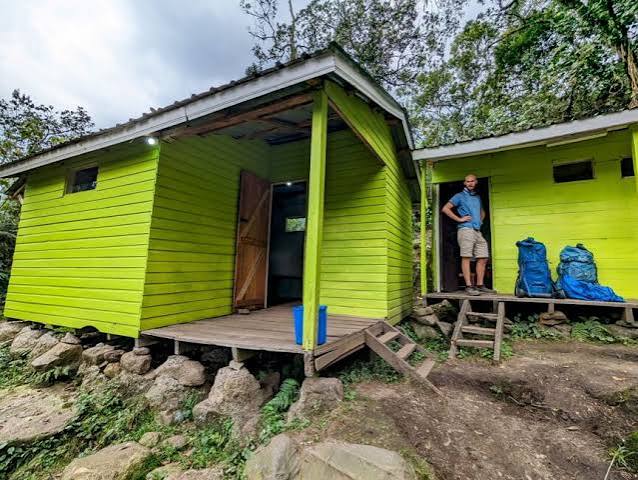
The evening hours at Sine Camp are among the most serene in the Rwenzori experience. As the light fades, the forest sounds change register — daytime birds give way to night jars, the temperature drops sharply, and the sky, on clear evenings, offers the particular density of stars that only genuine distance from any city can provide. A hot meal is ready when you want it: substantial, warm, prepared with the care that a cook team takes when they understand that a properly fed trekker is a happy trekker. Your guide, typically the most undemanding of company at the end of a long day, is available for conversation or content with silence, whichever the evening calls for.
Overnight: Sine Camp (2,596 m) — twin-share mountain huts with sleeping mats and blankets provided. All meals and drinking water prepared by your dedicated cook and porter team.
Day 2 — Above the Clouds: Morning in the Erica Forest and the Long Walk Home
Dawn at 2,596 Metres
Sine Camp mornings arrive cold and quiet. The temperature before sunrise at 2,596 metres is a physical object rather than a number on a weather app — something you put on layers to meet rather than read about. Tea is ready before full light, and the first cup drunk in the doorway of the hut, watching the forest emerge from darkness, is one of those small, complete pleasures that the mountains manufacture more efficiently than anywhere else on earth.
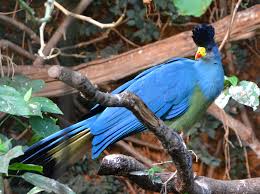
The forest above camp in the early morning is remarkably active. The Rwenzori Turaco — that bird of impossible colours, scarlet and green and iridescent blue, its call a deep, resonant croaking that carries far through the Erica trees — is typically encountered within fifty metres of the camp in the first hour of light. The Rwenzori Double-collared Sunbird, the Cinnamon-chested Bee-eater, and multiple species of warbler and robin-chat move through the camp clearing and the adjacent heather scrub with a focus and energy that rewards patience and binoculars equally. For guests with serious birding interests, your guide can arrange an extended early morning observation session before breakfast.
The Morning Walk: Higher into the Erica
The programme for Day 2’s morning — before the descent begins — includes a guided walk above Sine Camp into the lower Erica heath. This is where the Rwenzori’s botanical strangeness becomes fully legible: Erica arborea and Erica johnstonii growing to heights of eight and ten metres, their trunks twisted into shapes that seem deliberate, their branches draped so thickly with old man’s beard lichen and club mosses that the wood beneath is invisible. The ground is cushioned with sphagnum moss so deep and springy that each step produces a slight sink-and-spring, as if the earth itself is elastic. Giant Senecio plants — the so-called groundsel trees of the high Rwenzori — begin appearing at the edge of this zone, their strange, prehistoric silhouettes visible against the sky on the upper ridge above camp.
This morning walk above Sine Camp is genuinely one of the Kilembe Trail’s signature experiences — a glimpse into the Rwenzori’s higher botanical zones without the full elevation commitment of the longer treks. Guests who complete the two-day version of this trek almost universally report that the morning above Sine Camp is the moment the mountain reveals its most extraordinary face, and that the desire to go higher — to spend more days in these zones — arrives fully formed on the walk back down to breakfast.
Midday: The Descent
The descent from Sine Camp reverses the ascent route, but the experience is different in every meaningful way. Moving downhill through the bamboo zone, the views open differently — the valley below visible in long sections where the ascent focused attention on the trail immediately ahead. The morning light in the bamboo canes produces a quality of illumination that the afternoon climb misses entirely. The same streams, the same log bridges, the same rooted trail — but read in the opposite direction, at a different pace, with the particular ease of legs that have rested overnight at altitude and are moving confidently on familiar ground.
Enock’s Falls, revisited on the descent, looks completely different: approached from above rather than below, the full drop visible, the bamboo framing the cascade from a new angle. If the morning has been kind to the weather, this is typically where the final long rest of the trek occurs — boots off, feet in the cold water, the waterfall making its unceasing argument for the superiority of wild places over any other kind.
Return to Kilembe and Onward
The trail re-enters the lower evergreen forest in the early afternoon, the cicadas resuming their wall of sound as the canopy closes overhead. The Kilembe ranger station appears at the end of a final section of trail that emerges from the trees into the quiet of the trailhead clearing — the car waiting, the cold box open, clean clothes and a long drink and the particular satisfaction of someone who has just spent two days genuinely inside the Mountains of the Moon.
The remainder of the day belongs entirely to your wider itinerary. Some guests return to Kasese for an overnight and fly home or connect onward the following morning. Others drive east toward Queen Elizabeth National Park for a game drive, or north toward Murchison Falls. For guests whose Rwenzori trek follows their Bwindi gorilla trekking, the Sine Camp descent typically completes a five-to-six-day Uganda itinerary that ranks, without question, among the finest adventure circuits that East Africa offers. Your dedicated vehicle is waiting, the transfer is seamlessly managed, and the only thing left to decide is what you want to eat for dinner.
What Awaits You on the Kilembe Trail to Sine Camp
Enock’s Falls — The Rwenzori’s Most Beautiful Cascade
Enock’s Falls is the showpiece of the Kilembe Trail’s lower section — a multi-tiered cascade of clear, cold mountain water dropping through a bamboo-framed gorge that photographers attempt to do justice to and almost always fail. Named for an early local guide who helped establish the Kilembe Trail, the falls sit at approximately 2,100 metres and mark the natural lunch stop and midpoint of the Day 1 ascent. The pool below the main drop is cold and clear, the sound immense in proportion to the falls’ size, and the surrounding bamboo creates an enclosure that gives the place a cathedral quality. Many trekkers describe Enock’s Falls as the single most beautiful natural feature on any of the Rwenzori’s short treks.
The Rwenzori’s Evergreen Forest — Africa’s Most Complex Botanical World
The lower Kilembe Trail passes through some of the Rwenzori’s richest and most intact evergreen montane forest — a biological environment of extraordinary complexity that supports more than 70 endemic mammal and bird species found nowhere else on earth. The forest is botanically layered in a way that most African forests are not: a high closed canopy of Podocarpus and Symphonia, a mid-storey of Macaranga and tree ferns, an understorey of wild ginger and Mimulopsis, and a forest floor that is more wildlife habitat per square metre than almost anything else on the continent. Walking through it in the company of a trained naturalist guide transforms what might otherwise be a pleasant forest walk into a graduate seminar in Albertine Rift ecology.
Sine Camp’s Erica Forest — The Rwenzori at Its Most Surreal
The Erica forest around Sine Camp is the Rwenzori doing what it does better than any other mountain on earth: producing vegetation that seems to exist outside of normal botanical time. Erica trees at this altitude grow to dimensions that are possible nowhere else — eight, ten, even twelve metres of twisted, lichen-encrusted wood, their forms more sculptural than biological, their moss-cushioned roots producing a ground cover so thick and soft that the forest floor itself seems to breathe. This is the zone that invariably stops trekkers in their tracks, that produces the silence of genuinely encountering something that exceeds expectation, and that — more than any other section of the trek — produces the desire to spend more time on this mountain.
Endemic Birdlife of the Kilembe Trail
The Rwenzori Mountains hold more than 217 recorded bird species, of which over 70 are Albertine Rift endemics found nowhere else on earth. The Kilembe Trail to Sine Camp is among the finest birding transects in the park — passing through three distinct vegetation zones, each with its own endemic assemblage. Key species on the Sine Camp route include the Rwenzori Turaco (the mountain’s signature bird, with its vivid crimson wing panel), the Rwenzori Double-collared Sunbird, the Archer’s Robin-Chat, the Cinnamon-chested Bee-eater, the Handsome Francolin, and the Rwenzori Nightjar whose churring call defines the Sine Camp evenings. Your private guide doubles as a trained naturalist and can tailor the pace and route to maximise birding time on request.
Related Rwenzori Trekking Itineraries
The 2-Day Sine Camp trek is the perfect opening chapter of a longer relationship with the Rwenzori. For guests who find, at the end of two days, that the mountain has not finished with them — and it rarely has — Gorilla Safaris offers a full range of extensions and alternative Kilembe Trail expeditions.
The 2-Day Lake Mahoma Trek via the Central Circuit offers an alternative two-day experience on the mountain’s northern trail system, reaching the sacred crater lake at 2,988 metres via the Nyakalengija entrance — a different ecological character and a different kind of destination. The 3-Day Mahoma Loop Trail extends the Central Circuit experience by adding the Nyabitaba Camp overnight and completing the full loop, providing the most comprehensive short-trek experience available in the park.
For guests ready to go significantly higher, the 7-Day Rwenzori Central Circuit Trek reaches the permanent snowfields below Margherita Peak and traverses all five vegetation zones in a full mountain traverse. And for those who want the complete Uganda experience, our 12-Day Gorilla and Rwenzori Combined Safari pairs gorilla trekking in Bwindi impenetrable National Park and chimpanzee tracking in Kibale with a Rwenzori mountain expedition — the ultimate Uganda itinerary.
What to Wear and Carry on the Rwenzori Sine Camp Trek
Waterproof Boots — Non-Negotiable
The Kilembe Trail is wet in all seasons. The evergreen forest holds moisture even on dry days, stream crossings are frequent, and the bamboo zone’s soil is rarely fully firm underfoot. Waterproof, ankle-supporting hiking boots that have been broken in before departure are the single most important item on the Sine Camp packing list. Lightweight trail runners provide insufficient ankle support for the rooted, uneven trail surface, and fashion boots or urban footwear are entirely unsuitable. Gaiters — which keep mud and debris from entering boot tops — are strongly recommended and available for hire through Gorilla Safaris if you do not own a pair.
Waterproof Layers
A waterproof shell jacket with a sealed hood is essential from Day 1. The Rwenzori’s weather changes without notice, and the bamboo and Erica zones above 2,000 metres can produce significant rainfall at any time of year. Waterproof trousers are worth the pack weight for the upper trail sections. All base and mid-layers should be wool or synthetic — never cotton, which loses all insulating value when wet and becomes dangerously cold at altitude. For the Sine Camp evenings, temperatures drop to between 10°C and 15°C: a fleece or lightweight down jacket is essential, and many guests find a warm hat and gloves welcome at dawn.
Trekking Poles
Trekking poles are strongly recommended for both days. On Day 1, they provide stability on the steep sections through the bamboo. On Day 2, they protect the knees on the long descent through the same terrain. Poles are available for hire through Gorilla Safaris — please notify the team at booking so they are ready at the trailhead.
Daypack Essentials
Each trekker carries their own day-pack; the group’s shared loads and camping equipment are carried by your dedicated porter team. The daypack should contain: 2–3 litres of water (refillable from treated mountain sources), high-energy trail snacks, high-SPF sunscreen (UV intensifies significantly above 2,000 m), insect repellent, personal medications, a camera with spare batteries or charging pack (no mains electricity at Sine Camp), a headtorch with spare batteries, and a lightweight rain cover for the daypack. A comprehensive gear list is provided to all guests at the time of booking.
What’s Included in Your 2-Day Sine Camp Trek
Your Sine Camp Trek with Gorilla Safaris is arranged as a complete, supported private expedition. Every logistical element is confirmed before you leave Kampala, so the mountain receives your full attention from the first step.
- All Uganda Wildlife Authority (UWA) park entry fees and Kilembe Trail trekking permits
- Professional, UWA-certified private mountain guide for all 2 days
- Dedicated UWA armed ranger escort throughout the full trek
- Experienced porter team for group equipment, camping gear, and shared loads
- All meals on the mountain: packed trail lunch Day 1, hot dinner Day 1, full breakfast Day 2, packed trail lunch for the descent
- Drinking water and electrolyte supplements throughout
- 1 night mountain accommodation at Sine Camp (2,596 m) — twin-share mountain huts with sleeping mats and blankets
- Basic first-aid kit and emergency protocol on all days
- UWA trekking certificate on completion
- Private vehicle transfers between Kasese and the Kilembe trailhead
- All government taxes and levies
- Detailed pre-departure gear list and trek briefing
What’s Not Included
For complete planning transparency, the following are not covered within the trek package.
- International flights to Uganda (Entebbe International Airport)
- Uganda tourist visa — apply via the official online e-visa portal before travel
- Comprehensive travel and emergency medical insurance including evacuation — mandatory for all trekking guests
- Personal trekking gear: waterproof boots, gaiters, trekking poles, waterproof jacket and trousers, warm layers (detailed list provided at booking; select items available for hire)
- Guide and porter gratuities — suggested amounts provided in pre-departure information
- Beverages beyond included drinking water
- Hotel accommodation in Kasese before or after the trek
- Any activities not described in this itinerary
- Personal expenditure and souvenirs
Best Time to Trek the Rwenzori Mountains to Sine Camp
June to August — Peak Trekking Season
The long dry season of June through August produces the Kilembe Trail‘s most reliable conditions. The forest canopy dries between rain events, stream crossings are at their most manageable, and the chance of a clear afternoon view from the ridge above Sine Camp — across the valley toward the western Rwenzori peaks — is at its annual highest. This is Uganda’s peak travel season and aligns with the northern hemisphere summer; advance booking of permits and porter teams is strongly recommended for June–August departures, ideally several months ahead.
December to February — The Short Dry Season
December through February mirrors the conditions of the peak season with considerably fewer fellow trekkers. This is the preferred window for guests who value a quieter, more intimate mountain experience, and the Christmas and New Year period in western Uganda carries a particular atmosphere that regular visitors return for specifically. Gorilla trekking permits for Bwindi are also in high demand at this time — our team coordinates both experiences as part of a single seamlessly arranged itinerary.
March to May — Lush, Dramatic, and Rewarding for the Well-Equipped
The long rains of March to May transform the Kilembe Trail into a different kind of experience: the forest at its most vivid, Enock’s Falls at full volume, the moss and lichen on the Erica trees at their most saturated and extraordinary. Trails are muddier and stream crossings require more care, but for trekkers with proper waterproofing and a willingness to embrace the Rwenzori in its natural state — wet, atmospheric, and spectacularly alive — the long rains season is genuinely the most beautiful version of this trek. Birdwatching peaks in this period, with migrants joining the resident endemics in a species count that serious ornithologists specifically target.
September and October — The Sweet Spot for Families
The short rains of October are lighter and less persistent than the March–May system, and September represents the mountain at its most agreeable: the vegetation freshly green from the short rains, trail surfaces firming from the dry season, and temperatures throughout the trek comfortable for guests of all ages. For families with school-age children whose October half-term provides a window for an East African adventure, the September–October period on the Kilembe Trail is an ideal match. Gorilla trekking permits for Bwindi Impenetrable National Park in this period are also more readily available than in the peak months, making a combined Bwindi–Rwenzori itinerary both logistically and experientially compelling.
Frequently Asked Questions — 2 Days Rwenzori Trek to Sine Camp
What is Sine Camp on the Rwenzori Kilembe Trail?
Sine Camp is a mountain overnight camp located at 2,596 metres above sea level on the Kilembe Trail in Rwenzori Mountains National Park, Uganda. It sits within a grove of ancient Erica trees — giant heather that grows to heights of up to ten metres in the Rwenzori’s middle-altitude zones — and serves as the destination for the 2-day Sine Camp trek and the starting point for longer Kilembe Trail expeditions toward Mutinda Camp and the higher mountain circuit. The camp provides basic twin-share mountain huts with sleeping mats and blankets, a simple cook hut for meal preparation, and some of the finest evening and dawn environments of any camp on the Rwenzori’s short trekking routes.
How difficult is the 2-Day Rwenzori Trek to Sine Camp?
The Sine Camp trek is graded moderate. Day 1 involves an ascent of approximately 950 metres over 8–10 kilometres through three vegetation zones, typically taking 5–7 hours of hiking time with rest stops. Day 2’s morning walk above camp and subsequent descent take 4–5 hours. No technical mountaineering skills or specialist equipment beyond standard hiking gear are required. The trail is well-maintained for a mountain environment, though it includes rooted sections in the forest and muddy passages through the bamboo zone that require sure footing. Trekking poles are strongly recommended. Children aged 10 and above with reasonable fitness complete this trek regularly.
What is the Kilembe Trail and how does it differ from the Central Circuit?
The Kilembe Trail is the southern trekking system of Rwenzori Mountains National Park, entering the park from the former copper mining town of Kilembe approximately 10 kilometres south of Kasese. It differs from the Central Circuit — the park’s primary trekking route entering at Nyakalengija — in several important ways: it is less frequently visited, producing a more solitary and intimate trekking experience; its trail character is steeper and more dramatic in its lower sections, with more pronounced waterfalls including the celebrated Enock’s Falls; and it reaches different mountain hut camps that serve as bases for the Kilembe Trail’s higher routes toward Mutinda and beyond. The two trail systems share the park’s core ecological character but offer meaningfully different experiences.
What is Enock’s Falls and where does it sit on the trail?
Enock’s Falls is a multi-tiered waterfall on the Kilembe Trail, located at approximately 2,100 metres above sea level on the Day 1 ascent to Sine Camp. It is named for an early local guide who contributed to the establishment of the Kilembe trekking route. The falls consist of several drops of clear, cold mountain water over dark rock, framed by bamboo canes at the entrance to the bamboo zone. They are widely considered the most photographed and most memorable natural feature on the Sine Camp route, and they serve as the natural lunch stop for most groups on the ascent. On the descent return of Day 2, the falls look different again — approached from above, with the full drop visible — making it a genuinely two-way experience.
What wildlife can I expect to see on the Kilembe Trail to Sine Camp?
The Kilembe Trail to Sine Camp passes through three distinct wildlife habitats, each with its own characteristic species. In the lower evergreen forest, blue monkeys and black-and-white Colobus monkeys are regularly encountered in the canopy, while the undergrowth harbours the Rwenzori Horned Chameleon and a remarkable diversity of frogs, lizards, and small mammals. The bamboo zone supports Colobus monkeys and various endemic forest birds. The Erica forest around Sine Camp is prime territory for the Rwenzori Turaco, Rwenzori Double-collared Sunbird, Archer’s Robin-Chat, and Rwenzori Nightjar. Giant forest hog signs are commonly found on the camp’s perimeter. Occasional leopard signs — tracks and scat — are recorded on the Kilembe Trail, though sightings of the animal itself are extremely rare. The park records 217 bird species in total.
Do I need a permit to trek the Kilembe Trail to Sine Camp?
Yes. All trekking in Rwenzori Mountains National Park requires a Uganda Wildlife Authority (UWA) entry permit and a registered, certified park guide and ranger escort. These are mandatory and non-negotiable for all trekkers. When you book the Sine Camp trek through Gorilla Safaris, all permits, park fees, guide certification, and ranger arrangements are confirmed and paid for by our team in advance of your arrival. You arrive at the Kilembe ranger station with everything in order and proceed directly to the trail.
What altitude does Sine Camp sit at and should I worry about altitude sickness?
Sine Camp sits at 2,596 metres above sea level — well below the altitude at which serious altitude-related illness typically occurs. For the majority of healthy adults, this elevation presents no significant risk beyond mild symptoms such as slight headache or reduced appetite on the first evening at camp. The gradual ascent profile of the Kilembe Trail — gaining altitude progressively over a full day rather than abruptly — minimises even these minor effects. Anyone with pre-existing cardiovascular or respiratory conditions should consult a physician before booking. Your private guide carries a basic first-aid kit including altitude medications and monitors all guests throughout both days.
Can families with children do the 2-Day Sine Camp Trek?
Yes, and many do. The Sine Camp trek is well-suited to families with children aged 10 and above who are physically active and comfortable with sustained walking days of five to seven hours. Younger children are generally not recommended for this route due to the length and gradient of the Day 1 ascent. The private guiding format is particularly beneficial for families: your guide sets the pace entirely around the group’s needs, rest stops are taken wherever and whenever needed, and younger or less experienced trekkers are never rushed by the schedule of other parties. Many family guests rate the Sine Camp trek as the most memorable shared physical experience of their East Africa trip.
How do I get to Kilembe from Kampala or Entebbe?
Kilembe village is located approximately 380 kilometres west of Kampala — a drive of five to six hours on the Kampala–Mbarara–Kasese highway, with Kilembe a further 10 kilometres south of Kasese town. Domestic flights from Entebbe to Kasese Aerodrome reduce the journey to under an hour in the air, with your dedicated Gorilla Safaris vehicle completing the short transfer to the trailhead on arrival. For guests combining the Sine Camp trek with gorilla trekking in Bwindi, the Bwindi–Kasese drive is approximately three hours through the Queen Elizabeth National Park corridor.
What is the best time of year to do the 2-Day Sine Camp Trek?
The June to August long dry season and December to February short dry season offer the most reliable trail conditions and the best chances of clear views at Sine Camp. The March to May long rains produce the most dramatically beautiful version of the Kilembe Trail — Enock’s Falls at full volume, the forest at its most vivid, birdlife at its most diverse — but require proper waterproof gear and a tolerance for mud. September and October represent a pleasant middle ground with freshly green vegetation, manageable trails, and comfortable temperatures, making this the recommended window for families with school-age children.
Is the Sine Camp Trek suitable to combine with gorilla trekking in Uganda?
Absolutely — it is one of our most popular combinations. A typical combined itinerary spends 2–3 days trekking for mountain gorillas in Bwindi Impenetrable National Park, transfers west to Kasese for a comfortable overnight, and begins the Sine Camp trek the following morning. This creates a five-to-six-day Uganda mountain itinerary that pairs the continent’s most celebrated primate encounter with its most extraordinary highland trekking environment. Gorilla Safaris coordinates all permits, transfers, and accommodation between the two experiences as part of a single seamlessly managed private itinerary. Many guests also add a game drive in Queen Elizabeth National Park on the transfer day between Bwindi and the Rwenzori.