The 5 Days Rwenzori trek to Margherita Peak takes you to Margherita Peak(5,109m) in 5 days from via the Central Circuit with Bujuku acclimatization.
Five Days. One Summit. The Right Way Up.
The difference between the 4-Days Rwenzori Trek to Margherita Peak and this five-day Rwenzori trek to Margherita Peak at 5,109m is a single day—and that single day changes everything. On the four-day Rwenzori trek to Margherita Peak, the itinerary drives the body up the Central Circuit trail faster than altitude physiology prefers, and the summit push from Elena Hut begins before the body has had adequate time to register, accept, and adapt to the demands of 4,541 metres. The 5 days Rwenzori trek to Margherita peak expedition works with experienced, fit climbers summit successfully—but it is the most compressed timeline available for Margherita Peak and its margin for altitude-related difficulty is narrow.
The 5 Days Rwenzori trek to Margherita Peak inserts a day, One additional camp. One additional night at altitude. And that insertion happens at Bujuku Camp at 3,977 metres — a position in the upper Bujuku Valley, beneath the permanent ice of Mount Stanley and within sight of the glaciated flanks of Mount Speke, that no lower camp can replicate. The extra day at Bujuku gives the body 24-hours to process what 3,977 metres requires of it: time for red blood cell production to respond, time for breathing patterns to adjust, time for the physiological stress of altitude to convert from something the body is fighting into something it is accepting. The result is a summit attempt on Day 4 that begins from a better-prepared body, a clearer head, and a significantly higher statistical likelihood of actually reaching Africa’s third highest summit at 5,109 metres.
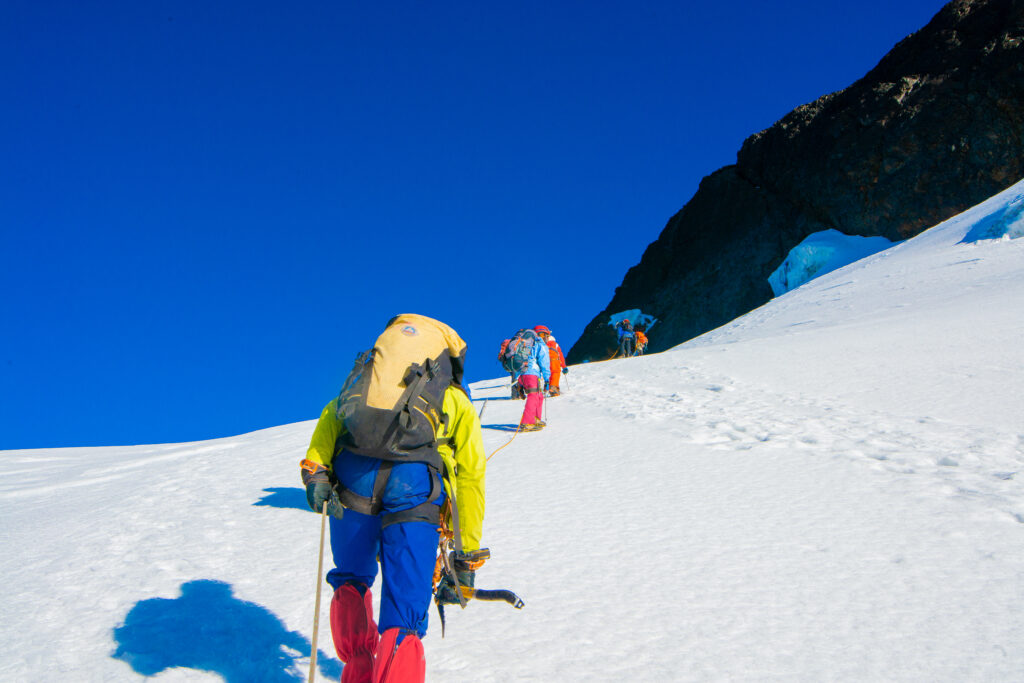
The 5-Day Rwenzori Trek to Margherita Peak via the Central Circuit is the Rwenzori’s finest balance between summit ambition and physiological wisdom. It is designed for the experienced mountaineer who wants to climb Margherita Peak and wants to reach it with the maximum reasonable chance of success. It is a technically demanding trekking expedition—the summit push on Day 4 involves glacier travel with crampons, ice axe, and fixed rope on the Elena Glacier—but it is not the reckless compression of the shortest possible timeline into the highest possible altitude. It is five days on one of the most extraordinary mountains in Africa, guided privately by people who know the Central Circuit trail as intimately as any mountain professionals anywhere in the world.
Many guests combine this program with gorilla trekking in Bwindi Impenetrable National Park as a preceding or following chapter—Uganda’s most celebrated wildlife encounter paired with its most demanding and most visually extraordinary mountain expedition. At Gorilla Safaris, both experiences are arranged and managed as a single, seamlessly coordinated private itinerary.
Important: This 5 day Rwenzori trekking to Margherita Peak requires prior high-altitude trekking experience (above 4,000 m), excellent cardiovascular fitness, and the technical requirements of glacier travel on the summit day (crampons, ice axe, harness, and fixed rope). It is not suitable for beginners, those without prior high-altitude experience, or guests with cardiac or respiratory conditions. Medical clearance is required for all summitting guests. Please confirm your experience level and fitness at the time of booking.
The Bujuku Acclimatisation Advantage
The Central Circuit’s acclimatization profile is the most important variable in any Margherita summit program—more important than fitness, more important than equipment, more important than weather. The body’s adaptation to altitude is a physiological process with a timeline that willpower cannot compress: red blood cells require time to increase, breathing patterns require time to adjust, and the risk of High Altitude Pulmonary Oedema (HAPE) and High Altitude Cerebral Oedema (HACE)—the two potentially life-threatening altitude illnesses—is directly related to how rapidly altitude is gained.
The five-day Rwenzori trek to Margherita’s key difference from the four-day rwenzori trek to Margherita’s version is the night at Bujuku Camp at 3,977 metres, positioned between the John Matte and Elena Hut camps of the standard four-day trekking expedition. This camp sits in the upper Bujuku Valley directly beneath the glaciated faces of Mount Stanley and Mount Speke — a position of extraordinary visual drama and, more practically, a position at which the body begins to encounter the thin-air demands of the summit zone before the summit day itself. Guests who sleep at Bujuku before attempting Elena Hut and the Margherita summit arrive at the glacier crossing with a measurably better acclimatization profile than those who move from John Matte to Elena in a single day. The summit success rate for 5 days Rwenzori trek to Margherita Peak consistently exceeds that of four-day programme as a result.
Bujuku Camp — The Circuit’s Most Remote Overnight
Beyond its acclimatization function, Bujuku Camp, at 3,977 meters, is the Central Circuit’s most dramatically positioned overnight point. The camp sits in the upper Bujuku Valley—the mountain corridor that leads directly toward the glaciated summits of the Rwenzori’s highest massifs — in a landscape that has more in common with the high Himalayas than with anything visible from the Rwenzori’s lower slopes. Giant Lobelia plants rise from the valley floor in their prehistoric architectural forms. The permanent ice of Mount Stanley’s south face is visible above the camp in the hour before the daily cloud cycle builds. Mount Speke’s Vittorio Emanuele Peak frames the eastern valley wall. The Bujuku Lake lies in the valley floor to the south — a high-altitude tarn fed by glacial meltwater that reflects the peaks on the clearest mornings in a composition that no camera has ever done full justice to. Spending a night here—absorbing the scale of what surrounds the camp, understanding viscerally the elevation at which you are sleeping, and waking before dawn to stars that appear at this altitude with a clarity that lower camps cannot offer—is an experience that the 4-day Rwenzori trek to Margherita peak, in its necessary compression, cannot include.
The Six Rwenzori Massifs — Seen in Full from the Upper Circuit
The five-day Rwenzori trek to Margherita Peak upper circuit section—from John Matte through Bujuku to Elena Hut—provides the finest sequential views of the Rwenzori’s six major massifs available on any trekking or summit program. Mount Stanley (5,109 m), carrying the Margherita, Alexandra, and Albert peaks above the Elena and Coronation glaciers, dominates the view from Bujuku and fills the summit corridor approached on Day 4. Mount Speke (4,890 m) with Vittorio Emanuele Peak is a constant presence on the valley’s eastern side from John Matte through Bujuku. Mount Baker (4,843 m) with Edward Peak and the Freshfield Pass corridor, Mount Emin (4,798 m), Mount Gessi (4,715 m), and Mount Luigi di Savoia (4,627 m) complete the range’s panoramic presence from the upper circuit. Standing at Bujuku Camp in the pre-dawn dark and watching these massifs emerge from the night—the glacier faces catching the first equatorial light in fragments of blue-white against the fading stars—is one of the Rwenzori’s most defining moments, and it belongs exclusively to those who have climbed high enough to be among them.
Getting to Nyakalengija — The Central Circuit Gateway
From Kampala or Entebbe
The Nyakalengija trailhead sits approximately 5 kilometers from Kasese town in western Uganda, roughly 370 kilometers west of Kampala on the main western highway. The drive from Kampala or Entebbe takes five to six hours through the highlands of southwestern Uganda and the rift valley escarpment above Kasese. Your dedicated Gorilla Safaris vehicle handles the full transfer in comfort. Most summit programme guests overnight in Kasese the night before Day 1, arriving at the Nyakalengija trailhead rested and ready for the five days ahead rather than road-worn.
By Domestic Flight to Kasese
Uganda Airlines operates domestic flights from Entebbe International Airport to Kasese Aerodrome, reducing the transfer to under an hour in the air. For guests whose East Africa itinerary includes a Rwanda gorilla trekking safari before the Rwenzori summit climb, the domestic flight from Entebbe to Kasese removes a full day of road travel from the expedition timeline—a meaningful advantage for a programme already precisely planned around acclimatisation days
5-Day Margherita Peak Trek — Itinerary at a Glance
Five days. All five vegetation zones. Africa’s third highest summit. The full narrative follows.
- Day 1 — Nyakalengija to Nyabitaba Camp: Transfer from Kasese to Nyakalengija UWA headquarters | Permits and summit programme briefing | Montane forest and bamboo ascent | Blue monkeys and Rwenzori Turaco | Overnight at Nyabitaba Camp (2,651 m)
- Day 2 — Nyabitaba to John Matte Camp: Kurt Schafer Bridge crossing | Hagenia-Hypericum woodland | Bigo Bog margins and giant Senecio | First summit views | Overnight at John Matte Camp (3,414 m)
- Day 3 — John Matte to Bujuku Camp — The Acclimatisation Day: Upper Bujuku Valley | Giant Lobelia field | Bujuku Lake | Mount Stanley and Speke in full view | Overnight at Bujuku Camp (3,977 m) | Altitude assessment
- Day 4 — Bujuku to Elena Hut — Summit Night: Scott Elliott Pass approach | Elena Hut (4,541 m) | Technical gear fitting | Pre-midnight departure | Elena Glacier crossing with crampons and ice axe | Margherita Peak summit (5,109 m) | Descent to Nyabitaba Camp
- Day 5 — Nyabitaba to Nyakalengija — Full Descent: Morning forest descent | Mubuku River corridor | Return through bamboo and lower montane forest | Nyakalengija trailhead | Summit certificate | Transfer to Kasese
Total Elevation Gain: Approximately 3,463 m from Nyakalengija (1,646 m) to Margherita Peak (5,109 m)
Total Distance: Approximately 65–70 km across all 5 days including summit and full descent
Highest Point: Margherita Peak, 5,109 m — Africa’s third highest summit, Uganda’s highest point
Difficulty: Expert — prior high-altitude experience above 4,000 m required; glacier travel with technical equipment on summit day
Key Advantage Over 4-Day Programme: Bujuku Camp night at 3,977 m provides superior acclimatisation profile and higher summit success rate
Day 1 — The Forest Begins: Nyakalengija to Nyabitaba Camp (2,651 m)
Arrival at the Trailhead
The drive from Kasese to Nyakalengija follows a valley road that narrows consistently as the Mubuku Valley closes, the Rwenzori’s ridgelines growing more insistent overhead with each kilometer. The Uganda Wildlife Authority headquarters at Nyakalengija is where the summit programme formally begins: permits are checked, the ranger escort for all five days is introduced, and your private guide — a certified, experienced Central Circuit mountaineer who has stood on Margherita more times than is easily countable — delivers the full programme briefing. Five days. Five vegetation zones. A glacier crossing before midnight on Day 4. The mountain begins when the log book is signed and the Mubuku River bridge is crossed.
The Montane Forest
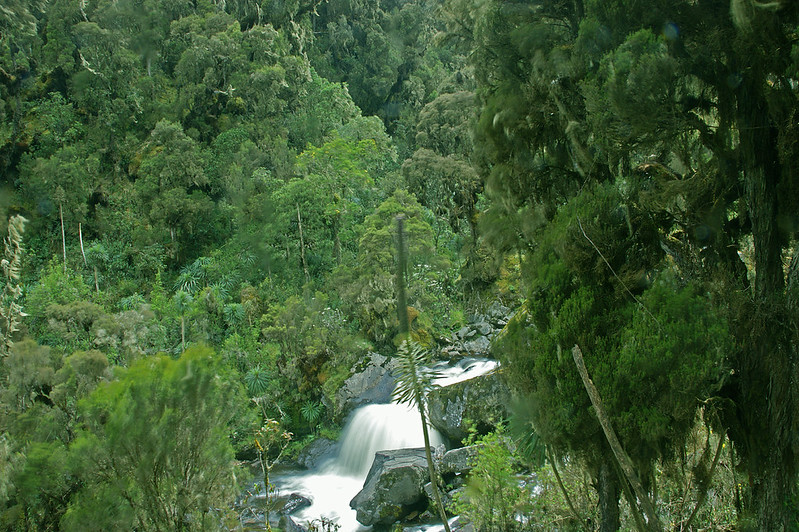
The Central Circuit’s lower montane forest opens immediately after the bridge crossing — the canopy closing overhead with the completeness that the Rwenzori’s forest produces at a boundary rather than a gradient. Giant Podocarpus and Symphonia trees, orchid-colonised trunks, the understorey of wild ginger and Mimulopsis, the dense and layered biological architecture of an Afro-montane forest that has been building complexity for millions of years. Blue monkeys in the canopy with their customary unhurried composure. Black-and-white Colobus monkeys in the upper branches. The Rwenzori Turaco heard before it is seen, its deep croaking resonance arriving through the forest well ahead of the bird itself and the crimson wing-flash that confirms its presence when it finally crosses a gap in the canopy.
The Day 1 pace is disciplined. Your guide knows five days is a narrow window for the summit programme and that Nyabitaba must be reached with energy rather than exhaustion. The trail covers approximately 9 kilometres and gains 1,005 metres through the lower forest and bamboo zone. By mid-afternoon, the bamboo thins and the Nyabitaba ridge appears: the camp’s huts visible through the last of the cane, the Mubuku and Bujuku valleys meeting in the gorge below, the upper mountain still entirely hidden in cloud above.
Overnight: Nyabitaba Camp (2,651 m) — twin-share mountain huts with sleeping mats and blankets. Hot dinner and full breakfast. Summit programme briefing continued over dinner.
Day 2 — The Botanical Ascent: Nyabitaba to John Matte Camp (3,414 m)
The Kurt Schafer Bridge and the Upper Circuit
Day 2 begins with a descent from Nyabitaba to the Kurt Schafer Bridge in the valley below — the suspension crossing named for a Swiss mountaineer whose contribution to the Central Circuit’s development is commemorated here, and the symbolic threshold between the lower forest and the upper circuit. The confluence of the Mubuku and Bujuku rivers roars beneath the bridge’s span. On the far side: the upper circuit, the Hagenia forest, the giant plants, and the beginning of the botanical transformation that defines the Central Circuit’s most extraordinary characteristic.
The Hagenia-Hypericum World
The ascent from the bridge climbs through the Hagenia-Hypericum woodland — one of the Rwenzori’s most botanically distinctive and most visually compelling zones. Hagenia trees grow in forms of extraordinary variety, their massive, gnarled trunks draped from base to crown in old man’s beard lichen, their horizontal branches creating complex canopy structures that the diffuse cloud light illuminates in ways that make photography feel simultaneously irresistible and inadequate. Hypericum trees add their yellow flowers wherever the canopy opens. The cloud moisture saturates every surface continuously, giving the whole zone a quality of permanent, gentle rain that never quite becomes rain.
Bigo Bog and the Giant Plants
The Bigo Bog — the upper Bujuku Valley’s most celebrated and most physically distinctive feature — is crossed on the wooden boardwalks that traverse its most waterlogged sections. Giant Senecio plants stand at the bog’s margins in their prehistoric architectural forms: rosettes of large succulent leaves spiralling from thick central stems, dead lower leaves forming insulating skirts, individual plants hundreds of years old and growing at altitudes that should, by ordinary botanical logic, preclude their existence. The giant Lobelia accompanies them in the wettest sections, closing its leaves each night against the frost and reopening them at dawn in a movement that the patient early-morning observer can witness in real time.
John Matte Camp appears at the far end of the bog crossing and the final climb of the day: 3,414 metres, named for one of the Rwenzori’s greatest Bakonzo guides, positioned with the first unobstructed views up the Bujuku Valley toward the Stanley and Speke massifs. The guide’s post-dinner acclimatisation assessment — a quiet, thorough check of each group member’s altitude response — is as important a part of the evening as the meal itself. Tomorrow’s ascent to Bujuku Camp at 3,977 metres will be the first genuine test of how the body is managing the altitude progression.
Overnight: John Matte Camp (3,414 m) — mountain huts with sleeping mats and blankets. Hot dinner and full breakfast. Guide’s altitude assessment conducted throughout the evening.
Day 3 — The Acclimatisation Day: John Matte to Bujuku Camp (3,977 m)
The Upper Bujuku Valley — The Circuit’s Most Remote Section
Day 3 is the five-day program’s defining advantage over its four-day counterpart, and the day that most guests describe, in retrospect, as the one that made the difference. The trail from John Matte to Bujuku Camp ascends through the upper Bujuku Valley — the terrain between the last of the Hagenia forest and the permanent glaciers of the Stanley massif above — through a landscape that has no equivalent in Africa and very few anywhere on earth.
The giant Lobelia field above John Matte is where the program’s botanical journey reaches its most dramatic expression: dozens of Lobelia wollastonii plants in the valley floor and bog margins, their spike-leaved architecture rising three to four metres from the sphagnum cushions in configurations that produce in first-time observers the same arrested attention that the Rwenzori’s botanical world reliably generates — a sense that the landscape has been designed by something operating outside normal aesthetic constraints, and that it is more real and more extraordinary than any image of it suggested. The giant Senecio accompanies the Lobelia in the drier sections, and the two species together create a plant community that Ptolemy might have imagined when he called this range the Mountains of the Moon: alien, precise, and entirely, magnificently alive.
Bujuku Lake — A Mirror for Mountains
The trail passes Bujuku Lake—a high-altitude tarn at approximately 3,962 metres in the valley floor, fed by glacial meltwater from the Stanley and Speke massifs above, its surface on the clearest mornings reflecting the permanent ice of both ranges in a composition that the Duke of Abruzzi’s 1906 expedition photographs captured imperfectly and that contemporary cameras do no better. The lake is cold, clear, and surrounded by the bog vegetation of the upper valley in a setting of profound and specific beauty. Many groups rest here for longer than the program strictly requires.
Bujuku Camp — Beneath the Ice
Bujuku Camp at 3,977 metres occupies the most dramatically positioned overnight site on the Central Circuit. The camp sits directly beneath the glaciated south face of Mount Stanley—the Margherita summit and its Elena and Coronation glaciers visible above the camp on clear evenings in a display that makes the following day’s objective feel simultaneously more real and more audacious than it seemed from lower altitude. Mount Speke frames the valley’s eastern wall. The Bujuku Lake reflects the peaks to the south. And in every direction, the scale of the upper Rwenzori is visible in a way that only reaching 3,977 meters allows.
The guide’s acclimatization assessment at Bujuku Camp is the summit program’s most critical diagnostic moment. At 3,977 meters, mild symptoms—headache, reduced appetite, and disturbed sleep—are common and expected and manageable. More concerning symptoms require immediate response. The guide assesses each group member individually and, in consultation with the group, makes the final decision on whether the summit attempt proceeds the following day. This assessment is not a formality. It is the most important professional judgment the guide makes on the entire programme, and the decision is absolute.
Dinner at Bujuku Camp is the program’s most purposeful meal: substantial, high-calorie, and consumed with the knowledge that tomorrow begins before midnight. The guide goes over the summit day in specific, practical detail—departure time, glacier crossing procedure, crampon technique, ice axe self-arrest, rope attachment, the ridge section between Alexandra and Margherita peaks, and the descent route. Questions are answered fully. Equipment is checked for the final time. And sleep, which the altitude makes more difficult than usual, is pursued as early as the guide’s briefing permits.
Overnight: Bujuku Camp (3,977 m) — twin-share mountain huts with sleeping mats and blankets. Hot dinner and midnight summit-day breakfast. Critical altitude assessment by guide throughout the evening.
Day 4 — The Summit: Margherita Peak (5,109 m) and Descent to Nyabitaba
Midnight Departure from Bujuku Camp
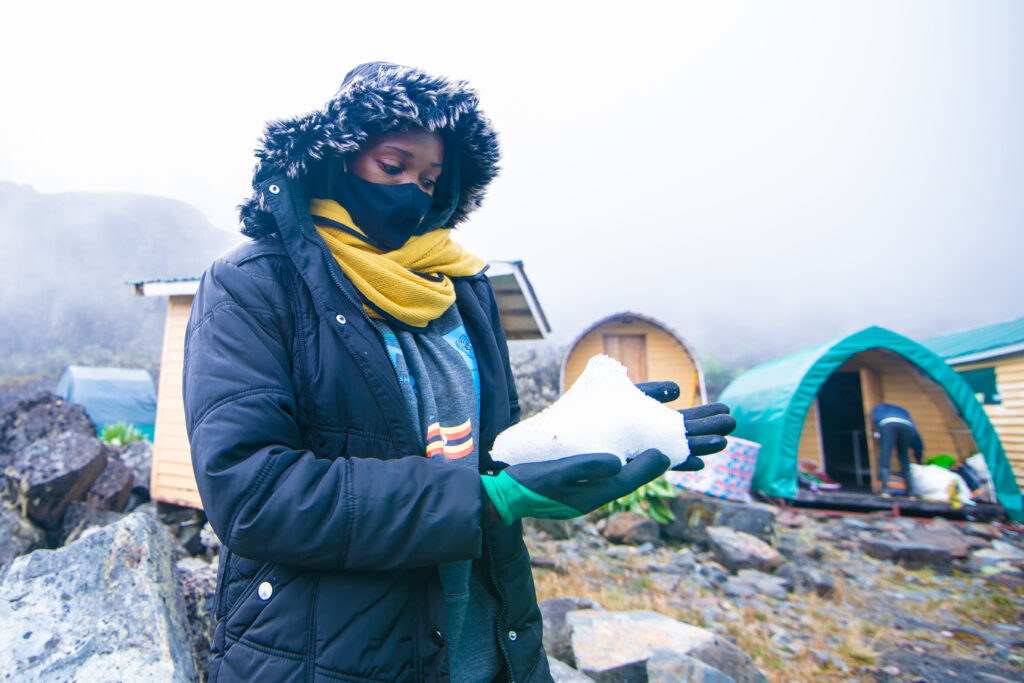
The alarm at midnight at 3,977 meters is a physical event. The cold at Bujuku Camp before dawn is a different order of magnitude from anything at John Matte—temperatures of -5°C or below and the wind that channels through the upper valley arriving at the camp from multiple directions without warning. The summit party assembles outside the huts in the headtorch dark: crampons fitted, ice axe in hand, harness buckled, every layer wearing. The guide checks each group member’s equipment with the thorough efficiency of someone who has done this many times and understands that nothing about the Elena Glacier crossing is casual.
The Approach to Elena Hut
The trail from Bujuku Camp climbs steeply toward Elena Hut at 4,541 metres — passing through the afro-alpine zone in pre-dawn darkness, the headtorches illuminating small cones of frozen ground and moss-covered rock, the guide’s lamp ahead the only navigation reference in a world reduced to the circle of your own light. At Elena Hut, the group pauses for a brief rest and hot drink prepared by the cook team who have climbed ahead. The hut at 4,541 metres in the dark and the cold is a stark, purposeful place: no unnecessary comfort, no surplus of anything. Just the altitude, the cold, and the glacier immediately above.
The Elena Glacier Crossing
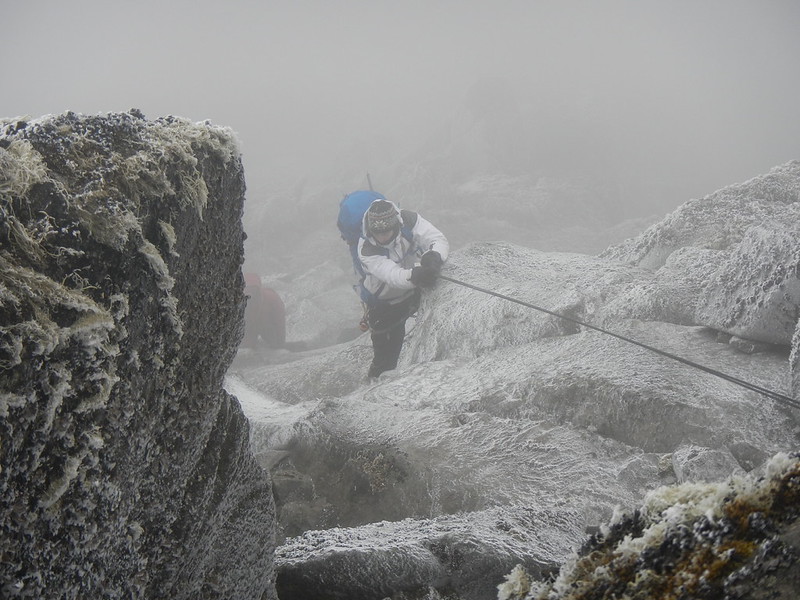
The Elena Glacier approach begins in the hour before dawn. The glacier — blue-white in the headtorch beam, its surface varying between firm neve, ice ridges, and crevasse zones that the guide navigates with the absolute authority of long familiarity — is traversed on fixed ropes attached by the guide before any glacier terrain is entered. Crampons bite into the ice with the particular sound of metal on frozen water that carries through the pre-dawn silence. The ice axe is in the uphill hand, its pick toward the slope, ready for the arrest technique that is never expected to be needed and always prepared for. Movement is sequential, deliberate, guided by the rope.
In the darkness above 4,500 metres, with the glacier below and the summit ridge above and the entire world reduced to the next foothold and the next rope section, the experience arrives at a quality of focused presence that most climbers describe as unlike any other state of consciousness they have encountered. The ordinary concerns of ordinary life are not merely distant. They are genuinely, completely absent. What remains is the ice, the altitude, the guide’s voice, and the summit.
Margherita Peak — 5,109 Metres
The summit ridge of Mount Stanley appears in the pre-dawn grey — a narrow spine of rock and ice with Alexandra Peak to the left, Albert Peak to the right, and Margherita Peak — the highest point — ahead. The final approach crosses the ridge itself: exposed, cold, with the Congo Basin visible through gaps in the cloud on the western side and the Rwenzori’s full upper massif laid out to the east and south on clear mornings. Each step on the ridge is deliberate, anchored, guided by the rope and by the full knowledge of what is on either side.
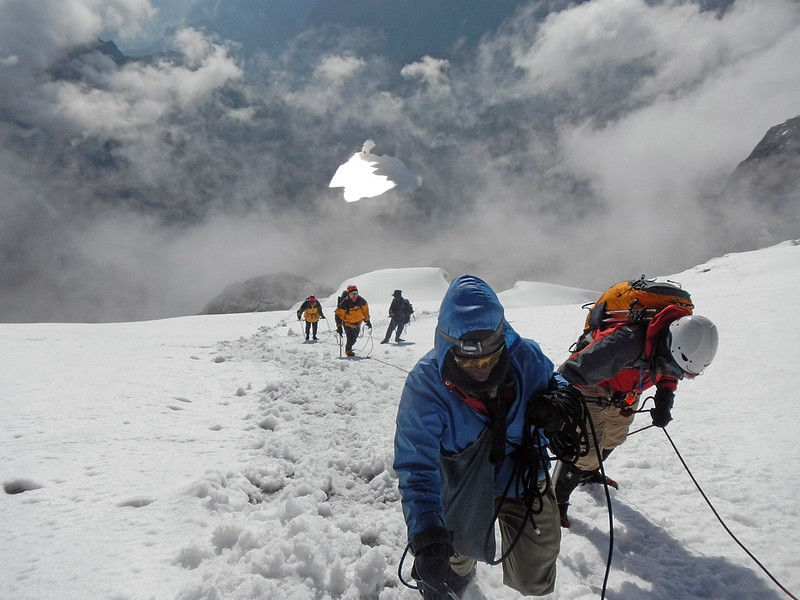
The summit cairn at 5,109 metres. Africa’s third highest point. Uganda’s highest. The Rwenzori’s ultimate reward for everyone who has climbed through its five botanical worlds and crossed its glacier in the dark. The view — in whatever visibility the mountain chooses to offer — is the view from the highest point that most of the world never reaches on this continent. The Congo Basin to the west. The East African Rift Valley to the east. The Rwenzori’s own glaciated massifs below and around. And the glaciers themselves — what remains of them, still blue and cold and extraordinary, still reflecting the equatorial dawn in fragments of colour that no camera setting fully captures.
Stay for as long as the guide and the conditions permit. Look in every direction. The mountain has given you everything it has, and this is the moment to receive it.
The Descent — From 5,109 m to Nyabitaba in a Single Day
The Day 4 descent is the summit programme’s most physically demanding sustained section: from Margherita Peak back across the Elena Glacier, down to Elena Hut, through the afro-alpine and Erica zones to Bujuku Camp for a rest stop, continuing to John Matte Camp for a hot lunch, and then the full descent through the Hagenia woodland, bamboo zone, and lower montane forest to Nyabitaba Camp for the night. The total descent covers more than 3,300 metres across all five botanical zones in a single sustained day of 12 to 16 hours of active movement.
The descent is long, and it is hard. The knees carry the accumulated load of every meter of descent reversed. Trekking poles are essential throughout. The guide maintains pace with the consistent attention of someone who understands that a safe, steady descent to Nyabitaba is the priority and that the achievement of the summit does not reduce the demands of the mountain below it. Rest stops are taken at Bujuku, at John Matte, and at intervals through the lower forest sections. The final approach to Nyabitaba in the late afternoon carries the particular quality of earned arrival: the day behind, the summit behind, the world below reachable again.
Overnight: Nyabitaba Camp (2,651 m) — twin-share mountain huts. Hot dinner and full breakfast. The summit is behind you.
Day 5 — The Forest Returns You: Nyabitaba to Nyakalengija
The Final Morning
The fifth morning at Nyabitaba Camp is the programme’s quietest and most restorative. The summit is four days of ascent and one complete descent behind the group. The body, at 2,651 metres after a day that included 5,109 metres, is processing the achievement and the effort simultaneously. Tea. Breakfast. The blue monkeys in the canopy above the camp’s clearing. The sound of the rivers in the valley below. Your guide, who has been to the summit many times and brought many guests back from it, moves through the morning with the practiced calm of someone who understands that the last day of a summit programme deserves to be easy.
The Descent Through the Lower Forest
The trail from Nyabitaba to Nyakalengija reverses the Day 1 ascent through the bamboo zone and the lower montane forest—the same canopy, the same streams, the same blue monkeys in the same sections of trail that the ascent passed four days ago. The cicadas are at their sustained wall of sound. Enock’s Falls—or the lower forest’s unnamed cascades — cold and clear and indifferent to whether you have just stood on Margherita Peak. The forest does not celebrate. It simply receives you back.
The Nyakalengija headquarters appears in the mid-morning. The park register is signed for the final time. The Uganda Wildlife Authority Margherita Peak summit certificate — issued to all guests who successfully reach the summit — is presented by your guide with the understated ceremony appropriate to an achievement that fewer than 1,000 people per year manage. Your dedicated vehicle is there. The road to Kasese is clear. And the particular, unshakeable satisfaction of someone who has just climbed Africa’s third highest mountain and walked all the way back down through five botanical worlds settles, quietly and lastingly, across everything that follows.
The remainder of the day and the onward itinerary belong entirely to your program. Kasese overnight. Queen Elizabeth National Park game drive. Onward flights from Entebbe or—for guests whose five days on the Central Circuit followed their Bwindi gorilla trekking safari — the particular completeness of a Uganda expedition that has included both the mountain gorillas of Bwindi and the summit of the Mountains of the Moon in a single extraordinary journey. Your Gorilla Safaris team manages every transition.
Technical Requirements and Physical Preparation
Experience and Fitness
The 5-day Margherita Peak Rwenzori trekking expedition is classified as expert level. Trekkers must have prior trekking or climbing experience above 4,000 meters—ideally Kilimanjaro, Mount Kenya, or alpine terrain. Cardiovascular fitness should be excellent: the summit day from Bujuku Camp covers over 1,100 meters of ascent and over 3,300 metres of descent across 12 to 16 hours of active travel. The five-day program’s improved acclimatization profile—via the Bujuku Camp overnight at 3,977 meters—significantly increases summit success rates compared to the four-day version but does not eliminate the physiological demands of glacier travel above 5,000 metres. Anyone with pre-existing cardiac or respiratory conditions must obtain medical clearance before booking and must inform Gorilla Safaris of their condition at enquiry stage.
Technical Gear for the Summit Day
Gorilla Safaris provides as part of the guided program: crampons (fitted at Bujuku Camp and confirmed at Elena Hut), ice axe, climbing harness for fixed rope sections, helmet, and connection equipment for the glacier rope. Guests must bring their own mountaineering boots compatible with semi-rigid crampons (boot compatibility confirmed at booking—this is non-negotiable), heavyweight down jacket rated to -15°C, waterproof hard-shell jacket and trousers, insulated gloves in two pairs, balaclava and warm hat, and gaiters. A complete technical gear list is provided at booking confirmation.
What to Pack for the 5-Day Margherita Trek
Layering for a 3,463-Metre Altitude Range
The 5 day trek to Margherita peak’s full altitude range—from Nyakalengija at 1,646 meters to Margherita Peak at 5,109 meters—requires a layering system that functions across an effective temperature range of approximately 35°C. Essential layers: merino or synthetic moisture-wicking base layer, mid-layer fleece, heavyweight down jacket rated to at least -15°C (non-negotiable for Bujuku and Elena nights and the summit approach), waterproof hard-shell jacket and trousers, insulated gloves in two pairs (one liner, one outer), balaclava and warm hat. At the programme’s lower altitudes, the down jacket stays packed. Above Bujuku, every layer is on.
Sleeping Equipment
Mountain hut accommodation at all camps provides sleeping mats and blankets. A personal sleeping bag rated to at least -10°C is strongly recommended for the Bujuku Camp night at 3,977 metres and the Elena Hut rest stop on the summit day — the hut’s blankets are insufficient at these temperatures without personal sleeping insulation. A sleeping bag liner adds meaningful warmth at minimal weight. Trekking poles — strongly recommended throughout all five days, essential on the Day 4 descent from 5,109 metres. Headtorch with multiple spare battery sets—the summit departure is in complete darkness; a torch failure above the glacier is a serious safety event. Camera with cold-temperature spare batteries—lithium cells preferred above 4,000 metres.
What’s Included in Your 5-Day Margherita Peak Trek
Your Gorilla Safaris Margherita Peak expedition is arranged as a completely private, fully supported summit programme. Every element is confirmed before your arrival in Uganda.
- All Uganda Wildlife Authority (UWA) park entry fees and Central Circuit permits for all 5 days
- Professional, UWA-certified private mountain guide experienced on the Central Circuit and Margherita summit route
- Dedicated UWA armed ranger escort throughout all 5 days
- Technical summit equipment: crampons, ice axe, climbing harness, helmet, and fixed rope connection equipment for the Elena Glacier
- Experienced porter team for all group camping equipment, food, and shared loads across all 5 days
- All meals: hot dinner and full breakfast at Nyabitaba (Nights 1 and 4), John Matte (Night 2), and Bujuku (Night 3), plus Elena Hut midnight breakfast, packed lunch for summit descent and Day 5 descent
- Drinking water and electrolyte supplements throughout
- 4 nights mountain accommodation: Nyabitaba (Nights 1 and 4), John Matte (Night 2), Bujuku (Night 3) — twin-share mountain huts with sleeping mats and blankets
- Altitude monitoring and alpine first-aid kit; guide trained in HAPE/HACE recognition and emergency descent protocol
- UWA Margherita Peak summit certificate on successful completion
- Private vehicle transfers to and from Nyakalengija trailhead
- All government taxes and statutory levies
- Comprehensive pre-departure gear list, technical briefing, and altitude preparation guidance
What’s Not Included
For complete transparency, the following are not covered within the expedition package.
- International flights to Uganda (Entebbe International Airport)
- Uganda tourist visa — apply via the official e-visa portal before travel
- Comprehensive travel, medical, and evacuation insurance — mandatory; policy must explicitly cover high-altitude mountaineering above 5,000 m in Uganda
- Personal mountaineering footwear: stiff-soled boots compatible with semi-rigid crampons (specifications confirmed at booking)
- Personal sleeping bag rated to -10°C or below — strongly recommended
- Personal heavyweight down jacket rated to -15°C, hard-shell jacket and trousers, insulated gloves, balaclava
- Trekking poles (available for hire through Gorilla Safaris)
- Guide, porter, and cook gratuities—suggested amounts in pre-departure information
- Hotel accommodation in Kasese before and after the trek
- Medical evacuation costs: guests must confirm that travel insurance covers helicopter evacuation from altitude in Uganda
- Personal expenditure and souvenirs
Best Time for the 5-Day Margherita Peak Climb
December to February — The Premier Summit Window
The short dry season from December through February is widely regarded by the Rwenzori’s most experienced guides as the optimal window for Margherita summit programs. Precipitation on the upper circuit is at its annual minimum, the Elena Glacier approach is at its most stable, and the pre-dawn conditions on the summit day are cold but predictable—without the additional challenge of wet gear and saturated camp kit that the rainy season adds to the midnight departure. The Bujuku Camp night at 3,977 metres in December or January is the coldest of the year (regularly -8°C to -12°C) but also the clearest, with summit morning visibility at its annual best. For guests who can arrange the December–February window, this is the programme at its most achievable.
June to August — The Long Dry Season
The long dry season from June through August offers the second most reliable summit conditions on the Central Circuit — slightly more precipitation than December–February but still substantially drier than the rainy season months. The glacier approach on the summit day may involve more variable snow conditions than in the short dry season. For guests who cannot travel in December–February, June–August is the natural alternative. Permit booking four to six months in advance is strongly recommended for peak season departures.
March to May and September to November — Possible but Demanding
The Rwenzori’s two rainy seasons do not make the 5-Day Margherita Rwenzori expedition impossible, but they make the glacier crossing more technically variable and the summit conditions less predictably clear. The 5 Day Rwenzori Trek to margherita Peak’s superior acclimatization profile—versus the 4 day Rwenzori trek to Margherita Peak version—partially offsets the additional physiological demands of wet, cold summit conditions in the rainy months. For guests who cannot travel in either dry season window, the five-day program is a more resilient choice than the four-day alternative precisely because of the Bujuku acclimatization day. However, the seven-day Central Circuit program is the most weather-resilient Margherita route available and is recommended for rainy season summit attempts.
The Glacier Condition Note
The Elena Glacier has retreated by more than 80% from its early twentieth-century extent and is projected to disappear entirely before 2050. Glacier conditions on the summit approach vary year by year as the retreat continues, and the guide assesses the route on the morning of the summit attempt based on current conditions. The guide’s authority to call a summit attempt off is absolute — if conditions are unsafe for the group’s composition on that day, descent begins. No summit certificate is worth the risk that a trained guide determines to be unacceptable.
Related Rwenzori Summit Programmes
The 5-Day Margherita Peak Trek sits at the optimal midpoint of the Rwenzori’s summit program spectrum—better acclimatized than the four-day version, more accessible in timeline than the seven-day classic circuit. Understanding its neighbors helps guests identify the right program for their experience level and available time.
The 4-Day Margherita Peak Trek is the fastest legitimate route to the summit, omitting the Bujuku acclimatization night for guests with very limited time and prior high-altitude experience. The 7-Day Central Circuit to Margherita Peak is the classic full program, traversing all five vegetation zones with the most comprehensive acclimatization profile available and the highest summit success rates of any Margherita program—recommended for guests without prior Rwenzori experience or those attempting the summit for the first time. The 8-Day Kilembe Trail to Margherita Peak approaches the summit from the southern circuit via a different set of camps and a different ecological character. For guests whose ambitions extend beyond Margherita, the 8-Day Rwenzori Trek to Three Peaks Trek adds Mount Speke (4,890 m) and Mount Baker (4,843 m) to the summit programme. The 12-Day Gorilla and Rwenzori Combined Safari incorporates the full 5-day Margherita programme within a comprehensive Uganda expedition.
Frequently Asked Questions — 5-Day Rwenzori Trek to Margherita Peak
What is the difference between the 4-Day and 5-Day Margherita Peak Trek?
The 5-Day Margherita Peak Rwenzori Trek inserts one additional acclimatization night at Bujuku Camp (3,977 m) between the John Matte and Elena Hut camps of the 4-day Rwenzori trek to margherita Peak. This extra night gives the body 24 additional hours to adapt to the altitude demands of the upper circuit before the glacier crossing and summit push begin. The practical result is a measurably better physiological starting position for the summit day, a higher statistical summit success rate, and the additional experience of spending a night at one of the Central Circuit’s most dramatically positioned and most remote camps, directly beneath the glaciated face of Mount Stanley. Guests with limited time and strong prior high-altitude experience may opt for the 4-day Rwenzori Trek, but for most climbers, the 5-day programme’s additional day represents the most important single improvement available within the summit programme spectrum.
How difficult is the 5-Day Rwenzori Trek to Margherita Peak?
The 5-Day Rwenzori Trek to Margherita Peak is classified as expert level. It requires prior trekking or climbing experience above 4,000 metres, excellent cardiovascular fitness, and comfort with the technical requirements of glacier travel on the summit day, including crampons, ice axe, harness, and fixed rope. The summit day from Bujuku Camp is the most demanding: it begins before midnight, involves 1,100-plus metres of ascent including the Elena Glacier crossing, and is followed by a full descent of more than 3,300 metres back to Nyabitaba Camp in a single continuous day of 12 to 16 hours. The expedition is not suitable for beginners, guests without prior high-altitude experience, or those with cardiac or respiratory conditions. Medical clearance is required for all summit program guests.
What is Bujuku Camp and why is it the key to the 5-Day Rwenzori trek to Margherita Peak Programme?
Bujuku Camp sits at 3,977 metres above sea level in the upper Bujuku Valley on the Rwenzori Central Circuit, directly beneath the glaciated face of Mount Stanley and within sight of Mount Speke’s Vittorio Emanuele Peak. It is the Central Circuit’s most dramatically positioned overnight camp and the highest sleeping point on the 5-day program before the summit day. Its significance to the programme is primarily physiological: spending a night at 3,977 metres before attempting Elena Hut (4,541 m) and Margherita Peak (5,109 m) gives the body substantially more time to adapt to altitude than the 4-day programme’s direct John Matte to Elena Hut ascent provides. The Bujuku Camp night is also the programme’s most visually extraordinary overnight experience, with Mount Stanley’s permanent ice visible above the camp on clear evenings.
What technical equipment is needed for the summit day?
The summit push on Day 4 requires crampons, ice axe, climbing harness for fixed rope sections, and a helmet. Gorilla Safaris provides all of this as part of the guided programme. Guests must provide: stiff-soled mountaineering boots compatible with semi-rigid crampons (specifications confirmed at booking), heavyweight down jacket rated to at least -15 degrees Celsius, waterproof hard-shell jacket and trousers, insulated gloves in two pairs, balaclava, warm hat, gaiters, and a headtorch with multiple spare battery sets for the pre-midnight departure in complete darkness. A complete technical gear checklist is provided at booking confirmation.
What is the summit success rate for the 5-Day Margherita Peak Rwenzori Trek?
Summit success rates on the Rwenzori’s Margherita Peak expeditions vary by season, individual fitness, and acclimatisation response. The 5-Day Rwenzori trek to Margherita peak’s Bujuku acclimatisation night consistently produces higher success rates than the 4-Day Rwenzori trekking expedition to Margherita Peak across all seasons, because guests arrive at the Elena Glacier crossing in a better physiological condition. The principal reasons for turning back before the summit on any Margherita program are altitude sickness symptoms that the guide determines require immediate descent, adverse glacier conditions that make the crossing unsafe for the group’s composition, and individual fitness limitations that emerge during the ascent. The guide’s summit decision is final. Guests who understand these factors before the climb have a fundamentally different and better summit day than those who do not.
How does the 5-Day programme compare to the 7-Day Central Circuit Trek?
The 7-Day Rwenzori trek to Margherita Peak via central circuit is the classic Margherita summit Rwenzori expedition with the most comprehensive acclimatization profile available on the Central Circuit trail. It adds two additional days to the 5-day Rwenzori trek to Margherita Peak, spending more time at intermediate camps and providing the most gradual altitude gain profile of any Margherita route. The 7-day Rwenzori trek to Margherita Peak via central circuit has the highest summit success rate of any Central Circuit Margherita trekking expedition and is recommended for guests attempting the Rwenzori summit for the first time or those without prior experience above 4,500 meters. The 5-Day Rwenzori Margherita Peak trek is appropriate for experienced high-altitude trekkers who have been above 4,000 meters before and who want to summit Margherita in the most time-efficient format that includes a proper acclimatization day. The 4-Day Rwenzori Trek is for experienced climbers with very limited time.
What is the Elena Glacier and is it safe to cross?
The Elena Glacier on the south face of Mount Stanley is the ice field that must be traversed to reach the Margherita summit from Elena Hut. It has retreated by more than 80 percent from its early twentieth-century extent and continues to shrink. Despite its reduced size, it remains a technically serious obstacle requiring crampons, ice axe, harness, and fixed rope for safe passage. Summit conditions on the glacier vary by season and year, and are assessed by the guide on the morning of the summit attempt. If conditions are determined to be unsafe for the group’s composition on that specific day, the summit attempt does not proceed. The glacier is currently still crossable with proper technical support, but its continued retreat means conditions change year on year, and the guide’s assessment on the day is the definitive authority.
What is the best time of year for the 5-Day Margherita Peak Rwenzori Trek?
December to February is the premier window for the 5-Day Margherita program, offering the lowest precipitation on the upper circuit, the most stable glacier approach, and the best statistical chance of clear summit conditions. June to August is the second-best window, with reliable but slightly more variable conditions. The March-to-May and September-to-November rainy seasons make the program more demanding and summit visibility less predictable but do not make it impossible. The 5-day Rwenzori trek to Margherita Peak expedition’s Bujuku acclimatization night provides a partial buffer against the additional physiological demands of rainy season climbing compared to the 4-day Rwenzori trekking.
Can I combine the 5-Day Margherita Trek with gorilla trekking in Uganda?
Yes—this is one of Gorilla Safaris‘ most requested expedition combinations. The most common structure spends 2 to 3 days gorilla trekking in Bwindi Impenetrable National Park before transferring west to Kasese via Queen Elizabeth National Park for the 5-Day Margherita climb. The combined itinerary runs 8 to 10 days and pairs the continent’s most celebrated primate encounter with its most demanding non-technical alpine summit. Our 12-Day Gorilla and Rwenzori Combined Safari incorporates the full 5-day Rwenzori Trek to Margherita Peak expedition within a comprehensive Uganda expedition.
How do I get to Nyakalengija from Kampala or Entebbe?
Nyakalengija is approximately 5 kilometers from Kasese town in western Uganda, roughly 370 kilometers west of Kampala on the main western highway. The drive from Kampala or Entebbe takes five to six hours, or under an hour by Uganda Airlines domestic flight from Entebbe to Kasese Aerodrome, with a short road transfer to the trailhead upon arrival. Most summit program guests overnight in Kasese the night before Day 1. Your dedicated Gorilla Safaris vehicle handles all transfers to and from the Nyakalengija trailhead.
What happens if I develop altitude sickness on the 5-Day programme?
Altitude sickness management on the 5-Day Margherita Rwenzori trek is a continuous responsibility of your private guide, who is trained in altitude illness recognition, the clinical distinction between mild, moderate, and severe symptoms, and the emergency response protocol for HAPE and HACE. Mild symptoms at John Matte and Bujuku camps are managed with hydration, rest, and analgesics. The guide’s decision to initiate descent for more serious symptoms is immediate and non-negotiable. The 5-day Rwenzori trek to margherita Peak’s Bujuku acclimatization night provides additional time for the guide to assess each group member’s altitude response before the summit day begins, making the go or no-go summit decision better-informed than on the 4-day Rwenzori trek to Margherita Peak. All guests must carry comprehensive travel insurance that covers helicopter evacuation from high altitude in Uganda.