A Complete Travel Guide — Islands, Activities, Lodges & Curated Itineraries
| Location | Elevation | Islands |
| SW Uganda, Kabale–Kisoro | 1,962 m (6,437 ft) | 29 islands |
| Length × Width | Max Depth (est.) | Bird Species |
| 25 km × 7 km | ~44 m (crocodile-free) | 200+ recorded |
Before the Water Catches the Light
There is a particular kind of silence that belongs only to high-altitude lakes in equatorial Africa — a silence that is not empty but full, layered with birdsong and the soft percussion of a dugout canoe moving through still water. Lake Bunyonyi arrives before you can quite prepare for it. The road from Kabale climbs through terraced hillsides crowded with banana groves and sweet potato fields, the highland air cooling noticeably as you rise, and then the road crests a ridge and the lake is simply there: vast, impossibly blue, scattered with twenty-nine green islands like an archipelago that belongs to a sea, and framed on every side by hills that fall so steeply to the water’s edge that they appear to be kneeling.
Bunyonyi means, in the language of the Bakiga people who have lived here for generations, the place of many little birds. The name is accurate in the way that the best names always are — not a description so much as an invitation. More than 200 bird species have been recorded here. In the morning mist they move through the papyrus reeds and hagenia trees with a freedom and variety that makes the lake feel alive from its first light, long before any visitor stirs.
At 1,962 metres above sea level in Uganda‘s southwestern highlands, Lake Bunyonyi sits in a deep valley that was formed roughly ten thousand years ago when lava flows dammed a river and the water slowly claimed the landscape. What the water claimed, it transformed. The submerged ridges became islands. The valleys became arms of the lake that extend between hills in long, silver channels. The result is a body of water of extraordinary intricacy and beauty — one that rewards the canoe far more than the motor boat, the early riser far more than the late sleeper, and the curious traveler far more than the passive passenger.
Lake Bunyonyi is, for the vast majority of travelers who discover it, not the destination they came to Uganda for. They came for gorilla trekking in Bwindi Impenetrable Forest, or for the chimpanzees of Kibale National Park, or for the game drives of Queen Elizabeth National Park. And then they spend a night at the lake on the way through, and something shifts. The lake does this with quiet consistency: it stops people. It makes plans feel negotiable. It turns one planned night into two, and two into three. At Gorilla Safaris, we include Lake Bunyonyi into almost every Uganda itinerary we design — not as an afterthought, but as the unhurried breath that every great safari deserves.
Lake Bunyonyi does not shout for your attention. It simply waits, blue and still, and when you finally sit beside it, you understand immediately why people come here to think, to rest, and to return.
The Lake and Its Landscape
Lake Bunyonyi stretches approximately 25 kilometres in length and 7 Km at its widest point, covering a surface area of around 61 square kilometers. The depth is estimated at roughly 44 meters at its deepest point, though the lake continues to deepen as its river inflow — which has been flooding the valley for millennia — still slowly raises the water level. Former mountain peaks, now cut off from the mainland by centuries of rising water, emerge as islands of various sizes, each with its own ecology, history, and character.
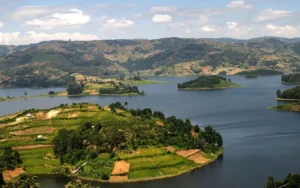
The lake sits at the intersection of two districts — Kabale to the east and Kisoro to the west — in the Kigezi region, a part of Uganda so green and so dramatically terraced that it is sometimes called the Switzerland of Africa. The comparison is imperfect, as all such comparisons are, but it gestures at something true: the scale of the hills, their organist by human hands into productive agricultural terraces, and the cool, clear quality of the highland air all conspire to produce a landscape that feels improbably tidy and deeply beautiful at the same time.
One of the lake’s most celebrated and practical characteristics is what it does not contain. Lake Bunyonyi is entirely free of hippopotamus and Nile crocodile, making it one of the very few large bodies of water in East Africa that is genuinely safe to swim in. The water is also free of bilharzia — the parasitic infection that makes swimming inadvisable in many African lakes — though it is worth entering gradually on hot days, as the water temperature, while reaching 25°C at the surface in warm conditions, can be bracing at depth.
How to Get to Lake Bunyonyi
By Road from Entebbe or Kampala
The overland journey from Entebbe International Airport to Lake Bunyonyi covers approximately 420 kilometres and takes between six and seven hours by private vehicle on Uganda’s improved southwestern highway. The route passes through Kampala, then southwest through Masaka and Mbarara, climbing steadily into the Kigezi highlands before descending to Kabale town and the final 9-kilometre drive to the lake shore. Gorilla Safaris provides private, air-conditioned safari vehicles for this transfer — driven by professional, English-speaking driver-guides who transform the journey into an orientation to western Uganda, pointing out the changing landscape, the agricultural communities, and the highland atmosphere that distinguishes this part of the country.
For travelers combining Lake Bunyonyi with Bwindi Impenetrable Forest, the lake sits approximately 25 kilometres — roughly 40 minutes by road — from Bwindi Impenetrable National Park‘s southern trekking sectors at Rushaga and Nkuringo. This proximity makes Lake Bunyonyi the natural bookend to a gorilla trekking itinerary: the final night on the water, the morning kayak that processes everything the forest gave you.
By Light Aircraft
For travelers on tighter schedules or those who prefer to arrive with unhurried elegance, light aircraft connections are available from Entebbe to Kisoro airstrip, approximately 30 minutes from Lake Bunyonyi, or to Kabale airstrip with a short road transfer. Charter flights can also be arranged from other airstrips within Uganda — from Kihihi near Bwindi’s northern sectors, or from the airstrip near Queen Elizabeth National Park. Gorilla Safaris coordinates all charter flight arrangements as part of the itinerary, ensuring that every connection is seamless and every transfer is met.
From Rwanda: The Cyanika–Kisoro Border Crossing
For travellers combining Lake Bunyonyi with gorilla trekking in Rwanda’s Volcanoes National Park, the lake is easily accessible via the Cyanika-Kisoro border crossing — a smooth and well-managed entry point that connects the Rwandan highlands with Uganda’s Kisoro district. From the border, the lake is approximately one and a half hours by road. This cross-border routing is a staple of Gorilla Safaris’ dual-country itineraries, and our team manages the logistics of the border crossing entirely, with Uganda driver-guides meeting Rwanda clients at the crossing and continuing the journey without interruption.
| Route | Approx. Journey Time |
| Entebbe/Kampala → Lake Bunyonyi (road) | 6–7 hours by private vehicle |
| Entebbe → Kisoro airstrip (charter) | ~1 hour flying + 30 min transfer |
| Bwindi (Rushaga) → Lake Bunyonyi | 40–60 minutes by road |
| Kigali, Rwanda → Lake Bunyonyi (via Cyanika) | ~3–3.5 hours by road |
| Queen Elizabeth NP → Lake Bunyonyi | ~3 hours by road |
Best Time to Visit Lake Bunyonyi
Lake Bunyonyi can be visited at any time of year, and its highland location insulates it from the temperature extremes that make lowland Uganda uncomfortable in peak dry season. The lake is, in truth, pleasant in every month — but the seasons shape the experience in ways worth understanding before you choose.
June to September — The Long Dry Season
Uganda’s long dry season, running from June through September, offers the most consistently clear weather for Lake Bunyonyi. The hills are golden-green, the morning mists burn off quickly to reveal blue skies that reflect in the water with photographic perfection, and the hiking trails on the steeper ridges are firm and manageable. This is also peak gorilla trekking season, and Lake Bunyonyi is at its busiest — lodges fill early and the lake has more visitors than at any other time of year. Booking at least four to six months ahead is essential for the finest properties during this window.
December to February — The Short Dry Season
The shorter dry season, from December through February, is increasingly popular with travelers who prefer slightly quieter parks and slightly more negotiable lodge rates. The weather is excellent, the lake is calm, and the surrounding hills are at a transitional beauty — the long rains have recently ended, the vegetation is lush, and the highland light has a particular quality of clarity in these months. January is one of the finest individual months to be on the lake: cool, clear, uncrowded, and ideal for both photography and the kind of unhurried rest that Lake Bunyonyi does so well.
March to May and October to November — The Rain Seasons
The long rains of March through May and the short rains of October and November bring afternoon showers that are rarely all-day events. Mornings at the lake during the rainy seasons are frequently stunning — the mist on the water is at its most atmospheric, the hills are the deepest imaginable green, and the birds are at their most active. Activities like canoeing and nature walks are still entirely possible and often more rewarding in reduced-visitor conditions. Lodge rates are generally more attractive, and the lake retains its essential character regardless of what the sky does in the afternoon.
The 29 Islands: What to See on the Lake
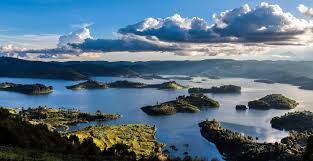
The islands of Lake Bunyonyi are not uniform. Each has its own ecology, its own human history, its own reason to visit. A boat journey across the lake is, in the most accurate sense, a journey through time as well as water — past communities, past legends, past the physical evidence of conservation and cultural survival. These are the islands that carry the most meaning.
Akampene — Punishment Island
Of all the islands scattered across the lake’s surface, none carries heavier historical weight than Akampene — Punishment Island. It is a small, low-lying patch of land, barely large enough to constitute a destination, and yet it draws visitors with the gravity of a place where real human suffering occurred within living memory. According to the oral history of the Bakiga people, young women who became pregnant outside of marriage were brought to this island and abandoned without food or shelter — a punishment designed to enforce the community’s strict moral code and protect family honor. Men who could not afford the bride price demanded by a woman’s family would sometimes paddle to the island at night to rescue the women stranded there, taking them as wives outside the formal system.
The practice ended with the arrival of missionaries in the early twentieth century, but the island remains a place of contemplation — a reminder that beauty and cruelty have always shared landscapes, and that the cultures of the lake’s shores have their own complex histories that no brief visit can fully encompass.
Bushara Island — A Conservation Community
Bushara Island is one of the lake’s most rewarding destinations for the engaged traveler. Home to the Bushara Island Camp, one of the lake’s most established and community-connected lodges, the island is a working example of conservation-linked tourism — a model in which visitor revenue flows directly into the maintenance of the lake’s ecosystem and the livelihoods of the surrounding community. The island’s trails wind through forest that is being actively restored, and guided nature walks here produce some of the finest birding on the lake.
Kyahugye Island — The Closest Landfall
Kyahugye Island is the largest island and the closest to the mainland shore, covering approximately 74 acres of mixed vegetation — papyrus reed beds giving way to eucalyptus and pine on higher ground, with the flat summit developed to accommodate visitors for birding walks and guided exploration. The island is easily accessed from the main shore by canoe or motorboat and offers a pleasant half-day excursion for those based at lakeside lodges.
Bwama and Njuyeera Islands — Sharp’s Islands
These two connected islands, historically known as Sharp’s Islands after the Scottish missionary Dr. Leonard Sharp who established a leprosy treatment centre here in 1921, carry a powerful legacy of medical and humanitarian work. The leprosy hospital that Sharp built on Bwama operated for decades and served thousands of patients from across the region, transforming what was then a feared and stigmatized disease into a treatable condition. The remains of the original structures are still visible, and visiting the islands carries the particular emotional resonance of places where enormous human kindness was practiced quietly and over many years.
Bucuranuka — The Upside-Down Island
The smallest and most whimsically named of the lake’s notable islands, Bucuranuka — the Upside-Down Island — takes its name from a legend in which an entire village was flipped by a divine act into the lake after its inhabitants refused to share food with a hungry stranger. The island’s conical shape, rising sharply from the water like an inverted hill, gives the legend its physical plausibility and makes Bucuranuka one of the most visually distinctive landmarks on the lake.
Activities at Lake Bunyonyi
Canoeing and Kayaking
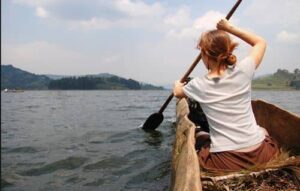 The definitive Lake Bunyonyi experience is the one that the lake was, in a sense, designed for: a dugout canoe on still water in the early morning, the papyrus reeds parting ahead of you, a heron lifting from the shallows with deliberate, slow wingbeats, the terraced hills reflected so perfectly in the lake’s surface that you move through a doubled world. Dugout canoes — locally called ‘bwato’ — have been the primary vessel on this lake for centuries, and paddling one requires a specific technique that most visitors acquire within the first twenty minutes and then spend the next two hours perfecting.
Guided canoe excursions to the main islands are available from most lakeside lodges, ranging from two-hour introductory paddles to full-day island-hopping journeys. Kayaks are available at several properties for those who prefer a more athletic option. Evening canoe trips — paddling out as the sun drops behind the western hills, the water turning copper and then silver, the first frogs and crickets beginning their chorus from the reeds — are among the most quietly extraordinary experiences the lake offers.
Bird Watching
With more than 200 bird species recorded in and around the lake, Bunyonyi is a rewarding destination for both dedicated birders and casual wildlife watchers who simply enjoy the variety of life that moves through a healthy wetland ecosystem. The papyrus-fringed shores are home to the African jacana, the malachite kingfisher, the grey-crowned crane, and the papyrus yellow warbler, among dozens of other species. The Nyombi swamp on the lake’s eastern shore is a particularly productive birding site, best accessed by canoe.
Early morning birding walks along the lake shore, or guided canoe excursions into the reed beds, are available through most lodges and are typically arranged by your Gorilla Safaris guide as part of the stay. Birding at Lake Bunyonyi pairs naturally with a broader Uganda birding itinerary — Uganda is consistently ranked among the world’s top five birding destinations, with over 1,000 recorded species.
Swimming
Lake Bunyonyi is one of the very few lakes in East Africa in which swimming is genuinely safe — free of crocodiles, hippopotamus, and bilharzia. The lake’s water is clean and clear at the shore, and the temperature at the surface can be pleasantly warm on sunny afternoons. Several lodges have dedicated swimming areas or jetties from which guests can enter the water. Night swimming under clear highland skies, with the lake’s phosphorescence occasionally visible in the water, is a particular luxury that some of the more private properties offer exclusively to their guests.
Nature Walks and Hiking
The hills surrounding Lake Bunyonyi are threaded with walking trails that reward those willing to climb. A ridge walk from the lake shore to a hilltop viewpoint reveals the lake in its full breadth — the islands scattered below, the channels between them catching the light, the distant hills of Rwanda just visible on a clear day. Guided nature walks through the surrounding farmland and community forest introduce the visitor to the agricultural systems of the Bakiga people, the medicinal plants of the highlands, and the birdlife of the transition zone between cultivated land and native vegetation.
More demanding multi-day treks are also possible — the Three Upland Lakes Trek, which connects Lake Bunyonyi with Lake Mutanda and the Virunga volcanoes beyond, is one of East Africa’s most rewarding and least-known long-distance walking experiences, covering some of the most dramatic highland scenery on the continent.
Cultural Encounters: The Bakiga and Batwa Communities
The shores and islands of Lake Bunyonyi are home to two communities whose histories are intertwined with the lake itself. The Bakiga are the highland farmers whose terraced cultivation of the surrounding hills has shaped the landscape over centuries — the terraces that make the hillsides so visually dramatic are the product of generations of agricultural ingenuity. A guided visit to a Bakiga village, arranged through a responsible community tourism program, offers an authentic and deeply human encounter with a way of life that is both ancient and actively evolving.
The Batwa — the original forest-dwelling pygmy people of the Kigezi region — were displaced from their ancestral forests when Bwindi Impenetrable Forest and Mgahinga Gorilla National Park were gazetted as national parks in the early 1990s. Many Batwa communities now live in the hills around Lake Bunyonyi, where cultural programs allow visitors to engage with traditional Batwa music, storytelling, and forest knowledge in a context that supports community income. The Batwa cultural experience at Lake Bunyonyi is one of the most moving and thought-provoking encounters available to any traveler in Uganda, and it contextualizes the conservation story of the gorillas in ways that a forest trek alone cannot.
Mountain Biking
The highland roads and tracks surrounding Lake Bunyonyi are well-suited to mountain biking — undulating terrain, limited vehicle traffic, and the consistent visual reward of lake views appearing through forest and farmland as the track turns. Several lodges maintain a small fleet of mountain bikes for guest use, and guided cycling excursions to nearby villages or viewpoints can be arranged through your Gorilla Safaris guide. The riding is not technical, but it is hilly, and the altitude of nearly 2,000 metres means that even fit cyclists may find the climbs more demanding than expected.
Zip-lining
For those seeking an adrenaline register that the lake’s characteristic tranquillity does not provide, a zip-line facility on the lake’s western shore offers a canopy run above the water with views across the surface and islands that are, from this elevation and velocity, genuinely spectacular. It is a brief but genuinely exhilarating experience, and it has the practical virtue of being the one Lake Bunyonyi activity that no amount of previous Africa travel prepares you for.
Where to Stay: Lake Bunyonyi Accommodation
Lake Bunyonyi’s accommodation ranges from extraordinary to simply excellent, across three distinct tiers. Every property is positioned on or beside the water, and the experience of waking to a lake view in the highland morning is a constant regardless of which tier you choose.
Luxury Accommodation
Arcadia Cottages
Arcadia Cottages occupies one of the most coveted positions on the lake shore — a cluster of well-appointed stone cottages set into the hillside above the water, each with a private terrace that frames the lake and its islands without interruption. The property offers exceptional food, a swimming area, canoes for guest use, and the kind of attentive, unhurried service that characterises the finest small properties in Uganda. It is consistently the first choice of Gorilla Safaris for clients seeking a premium Lake Bunyonyi experience.
Bird Nest at Bunyonyi
Perched dramatically on a ridge above the lake with 360-degree views of the water and hills, Bird Nest at Bunyonyi is one of the most visually striking properties in southwest Uganda. The accommodation is in elevated cottages constructed largely from natural materials, the restaurant serves locally sourced food with genuine care, and the sense of being above the lake — in the trees, almost — gives the property a treehouse quality that appeals strongly to couples and to travelers seeking a more immersive connection with the landscape.
Birdnest Resort
Not to be confused with the property above, Birdnest Resort is a lake-level property with direct access to the water and a well-maintained fleet of canoes and kayaks. The rooms are spacious and well-finished, the gardens slope to the water’s edge, and the evening sundowner from the lakeside bar — a gin and tonic in hand as the last light leaves the western hills — is a ritual that guests return to every evening of their stay.
Mid-Range Accommodation
Bushara Island Camp
Accessible only by canoe from the mainland shore, Bushara Island Camp offers a lake experience that is genuinely different from any mainland lodge. The camp sits on its own island, surrounded by water on all sides, with the lake accessible from every point of the shoreline. Accommodation is in simple but comfortable bandas and cottages, the camp’s community focus means that the staff are all local, and the guided activities — canoe trips, island walks, cultural visits — are managed by people who know the lake intimately. Reaching the camp by canoe at dusk is, for many guests, the moment they decide they wish they had booked more nights.
Lake Bunyonyi Rock Resort
A well-established and popular mid-range property on the lake’s western shore, Lake Bunyonyi Rock Resort occupies a dramatic position at the base of a forested hillside with direct lake frontage. The rooms are comfortable and well-maintained, the restaurant is among the best on the lake for consistent quality, and the property’s range of activities — including mountain biking, cultural visits, and canoe excursions — makes it a practical base for a full programme of lake activities.
Byoona Amagara
Byoona Amagara, meaning ‘our whole being’ in Rukiga, is a community-operated eco-lodge on the lake’s Itambira Island, run by a cooperative of local families. The accommodation ranges from simple tree houses and caves to island bandas, and the philosophy of the property — environmental sustainability, community benefit, cultural authenticity — is evident in every aspect of the guest experience. It is the lodge for travellers who want their stay to mean something beyond their own comfort.
Budget Accommodation
Crater Bay Cottages
Crater Bay Cottages offers clean, comfortable, and well-positioned accommodation at a price point that makes Lake Bunyonyi accessible to budget-conscious travelers without any compromise to the essential experience. The cottages are simply furnished but adequately equipped, the staff are warm and genuinely helpful, and the lake view from the terrace is identical to that enjoyed by guests paying three times the price at a neighboring property.
Kisoro Tourist Hotel
Located in Kisoro town, approximately 30 minutes from the lake, the Kisoro Tourist Hotel serves as a practical and affordable base for travellers combining Lake Bunyonyi with Mgahinga Gorilla National Park. The hotel is clean, reliably staffed, and well-connected to the town’s transport options, making it the most practical budget choice for travellers arriving late or departing early.
| Tier | Property | Key Feature |
| Luxury | Arcadia Cottages | Stone cottages, superb food, lake frontage |
| Luxury | Bird Nest at Bunyonyi | Ridge-top position, 360° views |
| Luxury | Birdnest Resort | Direct water access, kayaks included |
| Mid-Range | Bushara Island Camp | Island access by canoe, community-run |
| Mid-Range | Lake Bunyonyi Rock Resort | Western shore, full activities programme |
| Mid-Range | Byoona Amagara | Eco-lodge on Itambira Island |
| Budget | Crater Bay Cottages | Excellent value, genuine lake views |
| Budget | Kisoro Tourist Hotel | Kisoro town, close to Mgahinga NP |
What to Wear and Pack for Lake Bunyonyi
Lake Bunyonyi’s highland elevation keeps temperatures pleasantly cool by East African standards, but the combination of equatorial sun and physical activity on the water means that packing thoughtfully genuinely improves the experience. These are the essentials our guides recommend.
Clothing
Lightweight, breathable clothing in neutral colours is the practical choice for daytime activities — a combination of short and long-sleeved options allows you to layer as the temperature shifts through the day. The mornings and evenings at nearly 2,000 metres can be surprisingly cool, and a light fleece or warm layer is genuinely necessary. For the lake’s cultural visits, modest clothing that covers the shoulders and knees is respectful and appropriate. Swimwear for those planning to swim, and quick-drying fabrics for anything that might get wet on the canoe.
Footwear
Comfortable walking shoes or trail shoes are sufficient for the lake’s flat shoreline paths and easier ridge walks. For longer or steeper hikes, ankle-support hiking boots are recommended. Water sandals or reef shoes are practical for boat boarding and swimming access. If combining Lake Bunyonyi with gorilla trekking in Bwindi, your trekking boots serve double duty.
Equipment and Essentials
Binoculars are the single most rewarding piece of optional equipment you can bring to Lake Bunyonyi — the birding alone justifies a quality pair. A wide-brimmed sun hat, high-factor waterproof sunscreen, and insect repellent are practical necessities. A lightweight waterproof jacket or poncho covers the possibility of afternoon showers. A dry bag or waterproof pouch protects cameras, phones, and passports on canoe excursions. A personal water bottle — refillable from lodge supplies — is both practical and environmentally responsible.
Frequently Asked Questions About Lake Bunyonyi
Is Lake Bunyonyi safe to swim in?
Yes — Lake Bunyonyi is one of the very few large lakes in East Africa that is genuinely safe for swimming. The lake contains no hippopotamus, no Nile crocodile, and is free of bilharzia. The water is clean and, at the surface, can be pleasantly warm on sunny afternoons. It is recommended to enter gradually on hot days as the deeper water is considerably cooler.
How deep is Lake Bunyonyi?
The maximum depth of Lake Bunyonyi is estimated at approximately 44 metres, though the ongoing inflow from the river that originally formed the lake means the depth has likely increased over the decades since this measurement was made. Early claims of Lake Bunyonyi being the second deepest lake in Africa are generally considered inaccurate and cannot be traced to a reliable scientific source.
How many islands does Lake Bunyonyi have?
Lake Bunyonyi has 29 islands of varying sizes. These islands were formed when lava flows dammed a river approximately 10,000 years ago and the rising water surrounded and isolated the former mountain ridges and hilltops. The most well-known islands are Akampene (Punishment Island), Bushara Island, Kyahugye Island, Bwama and Njuyeera (Sharp’s Islands), and Bucuranuka (the Upside-Down Island).
How do you get to Lake Bunyonyi from Entebbe?
The drive from Entebbe International Airport to Lake Bunyonyi takes approximately six to seven hours by private vehicle. The route follows Uganda’s main southwestern highway through Masaka and Mbarara before climbing into the Kigezi highlands and descending to Kabale town and the lake. Light aircraft connections are available from Entebbe to Kisoro airstrip, approximately 30 minutes from the lake, for travellers preferring a shorter journey. Gorilla Safaris arranges all transfers privately with dedicated driver-guides.
How far is Lake Bunyonyi from Bwindi Impenetrable Forest?
 Lake Bunyonyi is approximately 25 kilometres from Bwindi’s southern trekking sectors at Rushaga and Nkuringo — a drive of 40 to 60 minutes depending on road conditions. This proximity makes the lake the natural and almost inevitable conclusion to any Bwindi gorilla trekking itinerary, offering a perfect day or two of rest and reflection after the intensity of the forest.
What are the best activities at Lake Bunyonyi?
The most popular and rewarding activities at Lake Bunyonyi are canoeing and kayaking among the islands, guided bird watching (with over 200 species recorded), swimming in the crocodile-free water, cultural visits to Bakiga and Batwa communities, guided nature walks and ridge hikes, and sunset boat excursions. For the more adventurous, mountain biking on highland trails and zip-lining above the lake are also available.
What is the best time to visit Lake Bunyonyi?
Lake Bunyonyi is enjoyable year-round, but the dry seasons — June to September and December to February — offer the most reliable weather and the clearest conditions for photography and outdoor activities. The rainy seasons (March to May, October to November) bring atmospheric mist and reduced visitor numbers, and are recommended for travellers who prefer a quieter, more immersive experience at better lodge rates.
Can I visit Lake Bunyonyi as a day trip from Kabale?
Yes — Lake Bunyonyi is approximately nine kilometers from Kabale town and easily accessible as a day trip. However, the lake’s greatest qualities — the early morning mist, the sunset canoe, the silence of the water after dark — are only available to those who stay overnight. Gorilla Safaris strongly recommends at least two nights at the lake for guests who want to experience its full character.
Are there luxury lodges at Lake Bunyonyi?
Yes. Arcadia Cottages, Bird Nest at Bunyonyi, and Birdnest Resort represent the lake’s luxury tier, offering well-appointed accommodation with private terraces, excellent food, and attentive service. Mid-range options include Bushara Island Camp, Lake Bunyonyi Rock Resort, and Byoona Amagara. Budget-conscious travelers are well served by Crater Bay Cottages, which offers lake views and basic comfort at a very accessible price.
Is Lake Bunyonyi worth visiting without doing gorilla trekking?
Absolutely. While Lake Bunyonyi is most commonly visited as part of a broader Uganda safari itinerary that includes gorilla trekking in Bwindi, the lake is a rewarding destination in its own right. Its extraordinary scenery, rich birdlife, cultural depth, and variety of activities make it a standalone destination that would satisfy any traveler interested in the natural and human heritage of East Africa’s highlands. That said, its proximity to Bwindi Impenetrable National Park and Mgahinga Gorilla National Park makes combining both almost irresistible for anyone visiting southwestern Uganda.
Gorilla Safaris provides every client with a detailed pre-departure packing list specific to their itinerary, including Lake Bunyonyi-specific advice. Your dedicated guide will also conduct a practical check before any activity that requires specific preparation.