The 3-Day Mahoma Loop Trail Trek is an extraordinary, immersive wilderness Rwenzori trekking expedition in Rwenzori Mountains National Park, taking . This 3 days Rwenzori Mahoma loop Trail Hike, takes a circular route which measures approximately 18.5 to 28 km, ascends from the Mihunga Gate (1,615m) to Lake Mahoma (3,000m – 3,515m), passing through unspoiled rainforests, towering bamboo, and Afro-alpine heather zones, without necessitating glacier-climbing expertise.
The 3-day Mahoma Loop trail route delves into ecosystems at lower elevations, including tropical rainforests, bamboo zones, and the mountainous heather flora around Lake Mahoma (2,990 meters).
Understanding the Rwenzori: Africa’s Most Extraordinary Mountain Range
The Rwenzori range extends for approximately 120 kilometres along the Uganda-DRC border, rising from the western arm of the East African Rift Valley to a maximum elevation of 5,109 metres at Margherita Peak — the highest point in Uganda and the third highest on the African continent, after Kilimanjaro and Mount Kenya. Unlike those two volcanic peaks, the Rwenzori Mountains is a block mountain — a vast crystalline massif pushed upward by tectonic forces over hundreds of millions of years — and its character is entirely different from anything else in Africa.
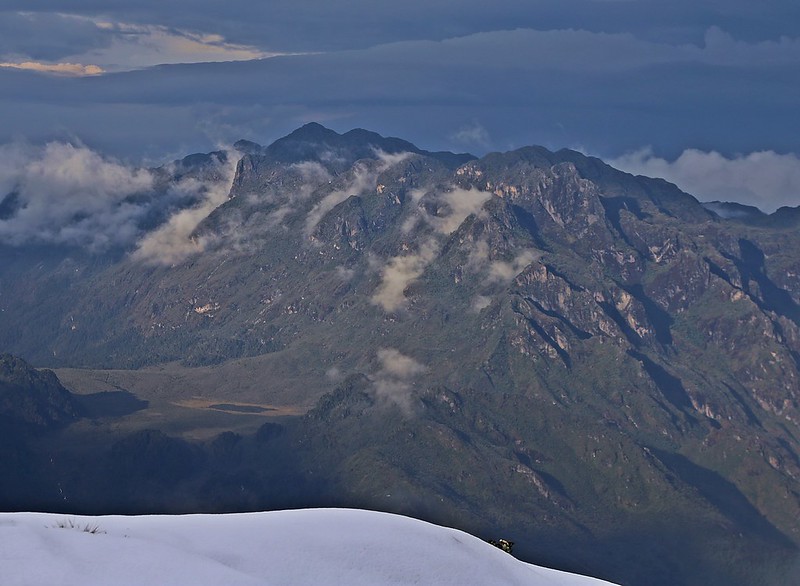 The range carries six principal massifs: Mount Stanley (5,109 m), Mount Speke (4,890 m), Mount Baker (4,843 m), Mount Emin (4,798 m), Mount Gessi (4,715 m), and Mount Luigi di Savoia (4,627 m). Each carries multiple named summits. The Margherita Peak on Mount Stanley is the range’s highest point and the objective of the classic 7-day Central Circuit trek. The Mahoma Loop Trail visits the lower ecological zones of the Central Circuit Trail — the montane forest, the bamboo belt, the Hagenia-Hypericum woodland, and the lower Erica heath — without venturing above 3,000 metres, making it accessible to any fit, well-prepared trekker.
The Rwenzori Mountains receives rainfall throughout the year — its moisture arrives from the Congo Basin to the west and is trapped and amplified by the mountain’s own topography. This perpetual cloud and rain is what creates the extraordinary botanical richness for which the range is celebrated: five distinct vegetation zones stacked one above the other, each with its own architecture of plants, its own atmospheric quality, and its own palette of colour. The Mahoma Loop passes through four of these five zones across three days, offering a vertical botanical journey that no other short trek in East Africa can match.
What You Need About Rwenzori Mountains National Park?
The Rwenzori Mountains of western Uganda are that range. Africa’s third highest massif. A UNESCO World Heritage Site. The most biodiverse mountain environment on the continent. A place where giant lobelia plants grow taller than a man, where the forest floor is upholstered in luminescent moss, where a crater lake sits so perfectly round at nearly 3,000 metres that it looks like the mountain has been punched through to the sky on the other side. And where, on three extraordinary days, the Mahoma Loop Trail takes you deeper into this world than most travelers ever venture — without requiring technical mountaineering experience, without demanding weeks of preparation, and without ever asking you to compromise on the quality and care with which the journey is handled.
The 3-Day Mahoma Loop Trail Hike is the Rwenzori’s finest short expedition: long enough to move through multiple ecological zones, sleep in the forest, wake beside a sacred crater lake, and return by a different trail through landscapes you could not have anticipated. It is suited to active families with children aged 10 and above, to couples seeking a genuinely shared physical challenge, to solo travelers who want to move through wild country with an expert beside them, and to groups of friends who understand that the right kind of difficulty, shared, is the foundation of the best kind of memory.
At Gorilla Safaris, this trek is arranged privately — your own guide, your own porter team, your own schedule. Many guests pair it with a gorilla trekking safari in Uganda, typically trekking the gorillas in Bwindi Impenetrable National Park before moving west to the Rwenzori Mountains— a combination that produces, without question, one of the most extraordinary weeks that East Africa can offer any traveler.
- Day 1 — Transfer to Rwenzori & Trek Begins: Arrival in Kasese or transfer from Bwindi / Kampala | Park briefing at Nyakalengija | Forest ascent through montane zone | Overnight at Nyabitaba Camp (2,651 m)
- Day 2 — The Great Climb to Lake Mahoma: Early morning departure from Nyabitaba | Ascent through bamboo and Hagenia forest | Crossing the Mahoma River | Arrival at Lake Mahoma crater (2,988 m) | Afternoon birdwatching | Overnight at Lake Mahoma Camp
- Day 3 — The Loop Descent & Return to the Valley: Dawn at Lake Mahoma | Return via alternate Mahoma Loop trail through Erica heath and montane forest | Park exit at Nyakalengija | Onward transfer or overnight Kasese
Total Distance: Approximately 28–30 km over 3 days
Highest Point: Lake Mahoma, 2,988 m above sea level
Difficulty: Moderate (suitable for fit adults and children aged 10+, no technical mountaineering required)
Trek Style: Private, fully guided, porter-supported — entirely your own pace
A Detailed 3 Days Rwenzori Mahoma Loop Trail Hike/Trail
Day 1 — The Forest Receives You: Nyakalengija to Nyabitaba Camp
The Drive In and the Briefing
The approach to Nyakalengija — Rwenzori’s central circuit trailhead — is its own kind of prelude. The road from Kasese narrows steadily as the valley closes, the mountains ahead lost in their customary veil of cloud, the air cooling and sweetening through the open windows of your dedicated vehicle. Banana plantations give way to the homesteads of the Bakonzo people, Uganda’s mountain people, who have farmed these foothills and guided trekkers into the high country for generations. The final kilometres are red earth, hemmed on both sides by vegetation that leans inward with a quiet persistence.
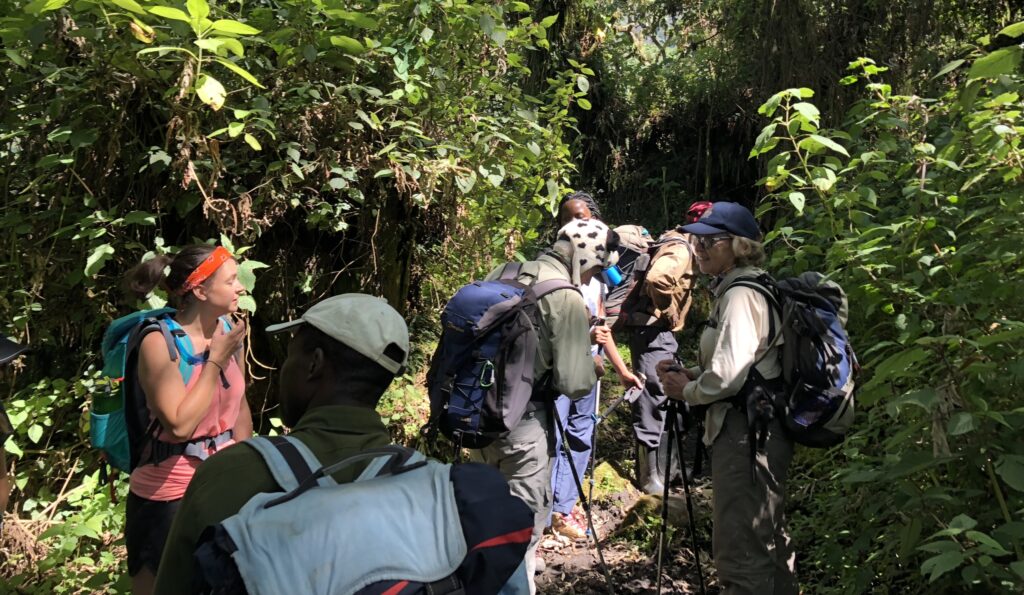
At the Uganda Wildlife Authority headquarters, your private guide leads the registration and park briefing — brisk, informative, and personal. Permits and park fees are already arranged. The UWA ranger who joins your group for the full duration of the trek is introduced. Maps are shared. The character of the next three days is sketched in, and then — with the administrative formalities behind you — the mountain begins.
Into the Montane Forest
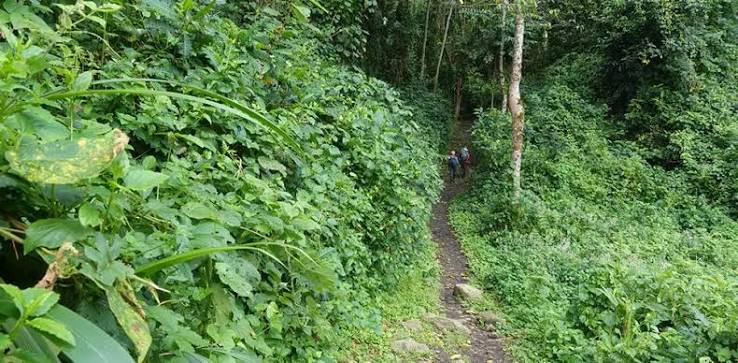
The trail crosses the Mubuku River on a wooden bridge within the first quarter-hour, and the transition is immediate. One moment you are in the warm, open air of the valley. The next, the forest canopy closes overhead and you are somewhere entirely different — cooler, darker, dense with sound and smell. The Rwenzori’s lower montane forest is not the dark, oppressive jungle of imagination. It is a layered, complex, extraordinarily alive environment where every surface carries something: ferns on tree trunks, orchids in the canopy, mosses on every stone.
The trail climbs through stands of giant Podocarpus and Symphonia trees — the Afro-montane zone in its purest expression. The understorey is tangled with wild ginger, Mimulopsis, and tree ferns whose fronds catch the light in arcs of pale green. The forest floor is soft underfoot, a deep litter of fallen leaves and rotting wood that muffles your footfall and gives the whole environment a quality of stillness that feels almost deliberate, as if the mountain is listening.
Your guide reads the forest as naturally as a native language, pausing at intervals to name what others would simply walk past. The first sighting of a Rwenzori Turaco — that flash of crimson in the green, vivid as a wound — typically provokes genuine shock. The bird is real. Its colours are not exaggerated. The Rwenzori has a habit of exceeding expectations in precisely this way.
The Approach to Nyabitaba
The ascent of approximately 760 metres over 7–8 kilometres is sustained but never severe. The trail crosses several small streams — clear, cold water rushing off higher ground — and passes through a section of bamboo that marks the transition from the lower to middle montane zone. By mid-afternoon, the vegetation opens slightly and Nyabitaba Camp appears on a ridge at 2,651 metres, its cluster of wooden huts commanding a view down the valley that makes the effort of the day suddenly, completely worthwhile.
The camp sits where the Mubuku and Bujuku rivers meet in the valley below — a confluence visible on clear afternoons from the ridge where you stand. The Rwenzori’s perpetual cloud builds and shifts around the summits above, briefly revealing glimpses of higher ridgelines before closing again. Your guide and cook team — already at camp ahead of the trekking group — have a hot meal waiting. The evening at Nyabitaba is one of those curated simplicities that stays with people long after grander experiences have faded: the lamp light, the sound of the river below, the cold air pressing against the hut walls, and the quiet awareness that you are genuinely, deeply inside the Mountains of the Moon.
Overnight: Nyabitaba Camp (2,651 m) — twin-share mountain huts with sleeping mats and blankets provided. Simple cook hut. All meals prepared by your dedicated camp cook.
Day 2 — The Ascent to Lake Mahoma: Forest, Bamboo, and the Sacred Crater
Morning Departure and the Middle Zones
Day 2 of the 3 days Mahoma Loop Trail Trek/Hike begins before full light. Tea is ready when you wake. The forest is already alive — the bird chorus at Nyabitaba before dawn is the most concentrated sound of wildness that most trekkers have ever heard, a layered, relentless, joyful noise that makes it impossible to lie still for long. Breakfast is taken as the first grey light filters through the canopy, and the day’s ascent begins on full stomachs and rested legs.
The trail from Nyabitaba climbs steadily through the bamboo zone — stands of Arundinaria alpine whose canes rattle in the upslope breeze and whose hollow stems produce a percussion unlike anything in the lower forest. Bamboo zones in the Rwenzori are brief but distinctive: enclosed, rhythmic, lit by filtered greenish light that gives the impression of moving through water. Colobus monkeys inhabit the bamboo’s upper canopy, and your guide frequently halts here to locate the source of the crashing sounds overhead — a family group moving fast through the stems, their black and white forms briefly visible before the grove swallows them again.
The Hagenia-Hypericum Forest
Above the bamboo, the landscape shifts again — this time into the Hagenia-Hypericum forest, one of the Rwenzori’s most distinctive and beautiful zones. Hagenia trees grow in twisted, gnarled forms, their trunks thick with old man’s beard lichen and their branches reaching horizontally into the mist. Hypericum — the African St John’s Wort, growing here to tree proportions — adds its small yellow flowers at intervals. The whole zone feels ancient, unhurried, and enormously, quietly alive.
This is prime territory for the Rwenzori’s endemic birdlife. Your guide carries a well-worn field guide and an intimate familiarity with the calls of over a hundred species in this range. The African Green Broadbill — one of the most sought-after birds on the entire continent — inhabits these middle altitudes. The Archer’s Robin-Chat, the Rwenzori Batis, the Strange Weaver — these are birds that serious birders travel specifically to Uganda to find, and the Mahoma Loop trail passes through the heart of their territory.
The Mahoma River and the Final Push
The trail crosses the Mahoma River at a series of stepping stones — the water deep, fast, and icy with snowmelt from higher ground. This crossing, for younger trekkers, invariably produces a moment of genuine drama: the current pulls at boots, the stones are slick with algae, and the noise of the river drowns everything else. Your guide assists each member of the group across with practiced efficiency, and the crossing becomes one of those minor shared trials that bonds a traveling group more effectively than any organized activity could.
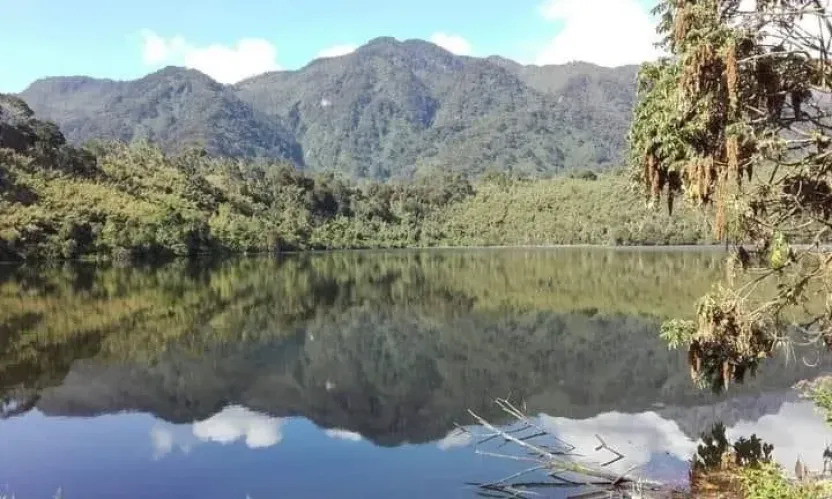
The final approach to the lake climbs through an increasingly open landscape as the forest thins and the lower Erica heath begins — twisted Erica trees draped in club mosses, the ground carpeted in sphagnum and sedge. The air is noticeably cooler. The sky appears more frequently between the branches. And then, with the particular drama that only truly unexpected beauty can produce, the trees open and Lake Mahoma is simply there — a perfect crater lake at 2,988 metres, its surface the colour of pewter in overcast light and the deepest blue imaginable when the afternoon allows a break in cloud.
Afternoon at Lake Mahoma
The Bakonzo consider Lake Mahoma sacred — a conviction that is easy to understand and impossible to dismiss once you are standing at its edge. The lake is circular, utterly still on calm afternoons, fringed by heather and Erica scrub, and surrounded by a silence that has a quality and weight entirely its own. Otters have been recorded in its waters. Giant forest hog tracks are common in the soft mud of the northern shore. The Rwenzori red duiker occasionally picks its way through the heather above the waterline at dusk.
The afternoon, from arrival at the lake until dinner, belongs entirely to the moment. Your guide leads a slow circuit of the shoreline, identifying birds and plants, pointing out the geological formations that explain the lake’s unusual shape. Guests who want to simply sit and absorb the scale of what they have achieved — two solid days of ascent, a wilderness camp, and now this — are given exactly that space. A curated camp dinner follows as the light dies and the temperature drops sharply.
Overnight: Lake Mahoma Camp (2,988 m) — mountain huts or tents depending on conditions, with sleeping mats and blankets. The camp’s position on the north shore of the lake offers the finest views of the crater from any point on the Mahoma Loop.
Day 3 — The Loop Closes: Dawn on the Lake and the Trail Home
First Light at 2,988 Metres
There are mornings in the field that reset the calibration for everything that follows. A dawn at Lake Mahoma is one of them. The crater holds cold air with unusual efficiency, and the temperature before sunrise at 2,988 metres is a physical presence rather than a meteorological measurement. Thermal layers, a hot mug, and the absence of any sound beyond water on the lake shore and birdsong in the heather — this is the morning, and it asks nothing more of you than presence.
Your guide is typically awake well before the rest of the group, watching the light change on the lake with the familiarity of someone who has seen it many times and never once tired of it. The bird activity at the lake in the first hour of light is genuinely exceptional — dozens of species moving through the heather and the lakeside sedge in the kind of concentrated activity that only the early morning produces. Guests with binoculars and serious photographic ambitions tend to sacrifice breakfast timing without hesitation.
The Mahoma Loop Trail: A Different Path Down
The genius of the Mahoma Loop design is that Day 3 never simply reverses the ascent. The return route follows the opposite arc of the loop — descending through the southern and western slopes of the lake basin, through forest sections that were not visited on the way up, with views oriented down into the valley rather than upward toward the cloud. The mood is genuinely different: the urgency of ascent replaced by the meditative quality of a return that is, in its own way, as rich as what came before.
The trail passes through sections of Erica woodland that were bypassed by the ascent route — older, denser stands where the trees have grown thick enough to form a genuine canopy, their roots wrapped in cushions of sphagnum moss that spring underfoot. Below the Erica line, the trail re-enters the Hagenia-Hypericum zone and then, over the course of a long, gradual descent, moves back through the bamboo and into the lower montane forest.
The Forest Below and the Bakonzo Foothills
The lower section of the descent passes through the cultivated buffer zone at the mountain’s base — terraced fields of sorghum, sweet potato, and cassava worked by Bakonzo farming families whose relationship with these slopes is generational and intimate. Your guide makes introductions where welcomed. Brief exchanges — a demonstration of a traditional farming technique, a shared laugh at the mutual bafflement of language — are the kind of unscripted human moments that no itinerary can plan for, and that no guest ever forgets.
The Nyakalengija headquarters reappears in the late morning. The park register is signed. Trekking certificates — issued by the Uganda Wildlife Authority to all guests who complete the Mahoma Loop — are presented by your guide with the quiet ceremony they deserve. And then your dedicated vehicle and driver are exactly where they were promised to be, three days and a mountain ago: a cold drink from the cooler, clean clothes from the day bag, and the particular, unshakeable satisfaction of someone who just walked the full Mahoma Loop Trail in the Rwenzori Mountains of Uganda.
Onward Transfer
The remainder of Day 3 is entirely shaped around your wider itinerary. Guests frequently return to Kasese for a well-earned night at Hotel Margherita or Sandton Hotel before onward travel. Others drive north toward Murchison Falls National Park, or east toward Fort Portal and the chimpanzee forests of Kibale. For guests who began their Uganda journey with gorilla trekking in Bwindi, the Rwenzori trek serves as a perfect final chapter — the great apes and the Mountains of the Moon, the two most extraordinary wilderness encounters in East Africa, held in the same week.
What You Will Encounter: Key Attractions of the Mahoma Loop Trail
Lake Mahoma — The Sacred Crater
At 2,988 metres, Lake Mahoma is the centrepiece and the destination of the 3-day Rwenzori Mahoma loop. This ancient crater lake — roughly 300 metres in diameter, its origin debated between volcanic collapse and glacial karst — is one of the few true crater lakes in East Africa that sits within a montane forest environment at this altitude. Its water is deep, cold, and extraordinarily clear. The Bakonzo consider it sacred, and the Uganda Wildlife Authority manages the lake shore as a strictly low-impact zone. Sitting at its edge at dawn or dusk, with the cloud reflected on the water’s surface and the heather silence pressing in from every direction, is an experience that resists the easy vocabulary of travel writing.
Endemic Birdlife — One of Africa’s Greatest Birding Destinations
Rwenzori Mountains National Park is classified as an Important Bird Area and holds more than 217 recorded bird species, of which more than 70 are Albertine Rift endemics — found nowhere else on earth. The Mahoma Loop trail passes through all the critical habitat zones for the park’s most sought-after species. Key targets include the Rwenzori Turaco (the most vivid bird in Africa’s highland forests), the African Green Broadbill, Archer’s Robin-Chat, the Rwenzori Nightjar, the Strange Weaver, Handsome Francolin, and multiple species of sunbird and weaver found only in this range. Your private guide doubles as a trained naturalist, and birdwatching rest stops are built into the daily programme at your request.
Botanical Zones — Five Worlds in Three Days
The Rwenzori Mahoma Loop Trail Trek passes through four of the Rwenzori’s five distinct Rwenzoris vegetation zones: the lower montane forest (1,800–2,500 m), dominated by Podocarpus and Symphonia; the bamboo zone (2,500–3,000 m); the Hagenia-Hypericum woodland (2,500–3,500 m); and the lower margins of the Erica heath (3,000–4,000 m). Each zone has its own botanical character, its own light quality, and its own atmospheric mood. The progressive movement upward through these zones over Days 1 and 2, and back down through them on Day 3, gives the trek a natural narrative arc that most short hikes lack.
Mammals and Larger Wildlife
The Rwenzori supports more than 70 mammal species, a number that understates the park’s wildlife significance because many are endemic to the Albertine Rift. On the Mahoma Loop, guests regularly encounter black-and-white Colobus monkeys and blue monkeys in the montane forest, giant forest hog tracks and signs throughout the middle altitudes, and occasional Rwenzori red duiker in the Erica heath. The Rwenzori Otter inhabits the park’s mountain streams, though sightings require patience and a degree of luck. African elephants and chimpanzees inhabit the park’s lower buffer zones, with the latter most frequently encountered near the Nyakalengija entrance.
Related Rwenzori Mountain Itineraries
The 3-Day Rwenzori Mahoma Loop Trek is the perfect starting point for understanding what the Rwenzori offers — but it is only the beginning. For guests who want to go higher, stay longer, or combine the mountains with Uganda’s wider wildlife and primate experiences, Gorilla Safaris curates a full range of Rwenzori-anchored expeditions.
Our 2-Day Lake Mahoma Trek compresses the lake experience into a single overnight for guests with limited time — a genuine introduction to the Rwenzori’s character without the full three-day commitment. For those ready to go deeper, the full 7-Day Rwenzori Trekking Central Circuit Trek traverses all five ecological zones and reaches the permanent snowfields near Margherita Peak, spending nights in the high-altitude huts of the John Matte and Bujuku camps. The 12-Day Gorilla and Rwenzori Combined Expedition is our most requested combination, pairing gorilla trekking in Bwindi with the full Central Circuit trail in a single seamlessly arranged Uganda Safari.
For guests approaching from Rwanda, our 10-Day Rwanda and Uganda Safari combines Volcanoes National Park gorilla trekking with a westward journey through Uganda’s national parks to the Rwenzori — one of the most logistically elegant and experientially rich itineraries in East Africa.
Getting to Rwenzori Mountains National Park
From Entebbe or Kampala
Rwenzori Mountains National Park’s Central Circuit entrance is located at Nyakalengija, approximately 5 kilometres from Kasese town in western Uganda. Kasese lies roughly 370 kilometres west of Kampala — a drive of five to six hours on the Kampala–Mbarara–Kasese highway, passing through Queen Elizabeth National Park’s northern corridor and the ancient volcanic landscape of western Uganda’s rift shoulder. Your dedicated Gorilla Safaris vehicle and driver handle this transfer in comfort, with a scenic stop at the equator crossing and at Katunguru Bridge over the Kazinga Channel if time and light permit.
By Domestic Flight
For guests who prefer to minimise road time, Uganda Airlines operates domestic flights between Entebbe International Airport and Kasese Aerodrome, reducing the journey to under one hour. Your dedicated vehicle meets the flight on arrival. This option works particularly well for guests arriving from a Rwanda gorilla trekking safari who wish to cross into Uganda and reach the Rwenzori without losing a full day to the road.
Combined with Bwindi and Queen Elizabeth
The most popular itinerary pairing for the Mahoma Loop trek combines 2–3 days of gorilla trekking in Bwindi with a drive north through the scenic Queen Elizabeth National Park corridor to Kasese — a journey of approximately three hours through one of Uganda’s most beautiful highland landscapes. The transfer is handled seamlessly by your assigned driver, with a packed lunch and drinks provided for the road. For guests building a longer expedition, our team also incorporates game drives in Queen Elizabeth National Park into the route between Bwindi Impenetrable National Park and the Rwenzori Mountains National Park.
What You Will Encounter: Key Attractions of the Mahoma Loop Trail
Lake Mahoma — The Sacred Crater
At 2,988 metres, Lake Mahoma is the centrepiece and the destination of the 3-day loop. This ancient crater lake — roughly 300 metres in diameter, its origin debated between volcanic collapse and glacial karst — is one of the few true crater lakes in East Africa that sits within a montane forest environment at this altitude. Its water is deep, cold, and extraordinarily clear. The Bakonzo consider it sacred, and the Uganda Wildlife Authority manages the lake shore as a strictly low-impact zone. Sitting at its edge at dawn or dusk, with the cloud reflected on the water’s surface and the heather silence pressing in from every direction, is an experience that resists the easy vocabulary of travel writing.
Endemic Birdlife — One of Africa’s Greatest Birding Destinations
Rwenzori Mountains National Park is classified as an Important Bird Area and holds more than 217 recorded bird species, of which more than 70 are Albertine Rift endemics — found nowhere else on earth. The Mahoma Loop trail passes through all the critical habitat zones for the park’s most sought-after species. Key targets include the Rwenzori Turaco (the most vivid bird in Africa’s highland forests), the African Green Broadbill, Archer’s Robin-Chat, the Rwenzori Nightjar, the Strange Weaver, Handsome Francolin, and multiple species of sunbird and weaver found only in this range. Your private guide doubles as a trained naturalist, and bird watching rest stops are built into the daily programme at your request.
Botanical Zones — Five Worlds in Three Days
The Mahoma Loop passes through four of the Rwenzori’s five distinct vegetation zones: the lower montane forest (1,800–2,500 m), dominated by Podocarpus and Symphonia; the bamboo zone (2,500–3,000 m); the Hagenia-Hypericum woodland (2,500–3,500 m); and the lower margins of the Erica heath (3,000–4,000 m). Each zone has its own botanical character, its own light quality, and its own atmospheric mood. The progressive movement upward through these zones over Days 1 and 2, and back down through them on Day 3, gives the trek a natural narrative arc that most short hikes lack.
Mammals and Larger Wildlife
The Rwenzori supports more than 70 mammal species, a number that understates the park’s wildlife significance because many are endemic to the Albertine Rift. On the Mahoma Loop, guests regularly encounter black-and-white Colobus monkeys and blue monkeys in the montane forest, giant forest hog tracks and signs throughout the middle altitudes, and occasional Rwenzori red duiker in the Erica heath. The Rwenzori Otter inhabits the park’s mountain streams, though sightings require patience and a degree of luck. African elephants and chimpanzees inhabit the park’s lower buffer zones, with the latter most frequently encountered near the Nyakalengija entrance.
Related Rwenzori Mountain Itineraries
The 3-Day Rwenzori Mahoma Loop Trail Trek/Hike is the perfect starting point for understanding what the Rwenzori offers — but it is only the beginning. For guests who want to go higher, stay longer, or combine the mountains with Uganda’s wider wildlife and primate experiences, Gorilla Safaris curates a full range of Rwenzori-anchored expeditions.
Our 2-Day Lake Mahoma Trek compresses the lake experience into a single overnight for guests with limited time — a genuine introduction to the Rwenzori’s character without the full three-day commitment. For those ready to go deeper, the full 7-Days Rwenzori Trekking Central Circuit Trek traverses all five ecological zones and reaches the permanent snowfields near Margherita Peak, spending nights in the high-altitude huts of the John Matte and Bujuku camps. The 12-Day Gorilla and Rwenzori Combined Expedition is our most requested combination, pairing gorilla trekking in Bwindi with the full Central Circuit trail in a single seamlessly arranged Uganda Safaris.
For guests approaching from Rwanda, our 10-Day Rwanda and Uganda Safari combines Volcanoes National Park gorilla trekking with a westward journey through Uganda’s national parks to the Rwenzori — one of the most logistically elegant and experientially rich itineraries in East Africa.
What to Carry and Wear on the Rwenzori Mahoma Loop Trek
Footwear — The Single Most Important Decision
The Rwenzori’s trails are wet, rooted, and muddy in all seasons — the mountain’s legendary rainfall saturates the soil, and even in the dry months, the lower forest holds moisture like a sponge. Waterproof, ankle-supporting hiking boots that have been properly broken in before arrival are non-negotiable. New boots on a 3-day Rwenzori trekking will produce blisters that define the experience in entirely the wrong way. Lightweight trail runners are insufficient — the terrain demands the stability of a full hiking boot, and the ankle support is essential on the steep, rooted descents of Day 3. Gaiters are strongly recommended and available for hire if you do not own a pair.
Waterproofing — Layers That Work
A waterproof jacket with a sealed hood is essential on every day of the trek — the mountain’s weather changes faster than any forecast can track, and being caught in a Rwenzori downpour without a proper shell layer is an experience nobody needs. Waterproof trousers are equally important for the middle and upper sections. Your base and mid-layers should be wool or synthetic — cotton holds moisture and becomes dangerously cold when wet at altitude. A fleece or lightweight down jacket for the evenings at Nyabitaba and Lake Mahoma camps, where temperatures drop to between 8°C and 14°C, is essential.
Trekking Poles
Trekking poles are strongly recommended for all guests and particularly for Day 3’s descent, where the trail can be slippery and the knees carry significant load over the long downhill sections. Poles are available for hire through Gorilla Safaris if you are not traveling with your own. Inform our team at booking and they will be ready at the trailhead.
Daypack Essentials
Your porter team carries the group’s shared loads and camping equipment. Each trekker carries their own daypack, which should contain: 2–3 litres of water (refillable from treated mountain sources), high-energy trail snacks, sun protection (high-SPF sunscreen and a hat — UV radiation intensifies significantly above 2,000 m), insect repellent, personal medications including any prescription items, a camera with extra batteries or a charging pack (no mains electricity in the mountain camps), a headtorch with spare batteries, and a light rain cover for the daypack itself. A full gear list is provided at booking.
What’s Included in Your 3-Day Mahoma Loop Trek
Every element of the 3-Day Rwenzori Mahoma Loop Trail Trek is arranged in advance by the Gorilla Safaris team, so that your attention from the first step on the trail to the last remains entirely on the experience. Nothing is left to improvisation or chance.
- All Uganda Wildlife Authority (UWA) park entry fees and trail permits for Rwenzori Mountains National Park
- Professional, UWA-certified private mountain guide for all 3 days
- Dedicated UWA armed ranger escort throughout the full trek
- Experienced porter team to carry group camping equipment, food supplies, and shared loads
- All meals on the mountain — dinner Day 1, breakfast and packed trail lunch Day 2, dinner Day 2, breakfast and packed lunch Day 3
- Drinking water, trail snacks, and electrolyte supplements throughout
- 2 nights mountain accommodation — Nyabitaba Camp (Day 1) and Lake Mahoma Camp (Day 2) — twin-share mountain huts or tents with sleeping mats and blankets
- Basic first-aid kit and emergency evacuation protocol on all days
- UWA trekking certificate on completion
- Private vehicle transfers to and from Nyakalengija trailhead as part of your wider Gorilla Safaris itinerary
- All government taxes and levies
- Pre-departure detailed gear list and trek briefing
What’s Not Included
For complete transparency, the following fall outside the trek package and should be accounted for in your personal planning.
- International flights to Uganda (Entebbe International Airport)
- Uganda tourist visa — apply online via the official e-visa portal prior to travel
- Comprehensive travel and emergency medical insurance, including evacuation coverage — mandatory for all trekking guests
- Personal trekking gear: waterproof boots, gaiters, trekking poles, waterproof jacket and trousers, warm layers (full gear list provided at booking; selected items available for hire)
- Guide and porter gratuities — suggested amounts provided in your pre-departure information
- Personal beverages beyond drinking water (beer, soft drinks, specialty coffee)
- Hotel accommodation in Kasese before or after the trek
- Any activities not mentioned in the itinerary above
- Personal expenditure and souvenirs
Best Time to Trek the Rwenzori Mahoma Loop Trail
June to August — The Peak Season
The long dry season from June through August offers the Rwenzori’s most reliable trekking conditions. Cloud cover is lower and more frequently breaks during the midday hours, allowing views toward the higher peaks from the Nyabitaba ridge and from the Lake Mahoma shore. Trail surfaces are firmer, stream crossings easier, and the general character of the days more predictable. This window coincides with the northern hemisphere summer, making it the park’s busiest period — though ‘busy’ in Rwenzori terms remains a fraction of what any alpine destination in Europe experiences on a quiet Tuesday. Advance booking of permits and porter teams is strongly recommended from April onward for a June–August departure.
December to February — The Short Dry Season
December through February replicates the trekking conditions of the peak season with significantly less company. Permits are more readily available, the porter teams less stretched, and the trail atmosphere more intimate. For guests combining the Rwenzori with gorilla trekking in Bwindi or Rwanda, the December–January window is particularly compelling: the dry conditions suit both experiences equally, and the Christmas–New Year period in Uganda’s mountain parks carries a special quality that regular visitors return for deliberately.
March to May — The Long Rains: A Different Kind of Rewarding
The Rwenzori’s long rainy season produces the mountain’s most vivid and dramatically atmospheric expression. The waterfalls along the Mubuku Valley run at full volume. The mosses and ferns glow with an intensity that dry-season visits simply cannot match. Birdlife peaks during the rains, with migrants joining the resident endemics in a species count that serious ornithologists schedule their entire trips around. The trade-off is genuine: trails are muddier, crossings higher, and waterproofs earn their place more completely. For well-equipped, experienced trekkers who understand what they are choosing, the March–May Rwenzori is arguably the most beautiful version of the mountain. Not the easiest. The most beautiful.
September and October — The Sweet Spot
The short rains of October are lighter and less persistent than the March–May period, and September represents the transition from the dry season into the first of the shorter rainfall events. Both months offer a pleasant combination of green, lush conditions, manageable trail surfaces, and relatively good visibility at the lake. For families with school-age children, the October half-term window aligns well with the mountain’s conditions, and school holiday itineraries in this window book quickly — early planning is advised.
Frequently Asked Questions — 3-Day Mahoma Loop Trail, Rwenzori Mountains
What is the Mahoma Loop Trail in Rwenzori Mountains National Park?
The Mahoma Loop Trail is a circular trekking route within Rwenzori Mountains National Park in western Uganda, forming part of the Central Circuit — the park’s primary trekking system. The loop begins and ends at the Nyakalengija Park Headquarters near Kasese town and passes through four distinct vegetation zones: the lower montane forest, the bamboo belt, the Hagenia-Hypericum woodland, and the lower Erica heath, before reaching its highest point at Lake Mahoma crater at 2,988 metres. The 3-day version includes an overnight at Nyabitaba Camp on Day 1 and at Lake Mahoma Camp on Day 2, with a return descent on Day 3 via the opposite arc of the loop. The total distance is approximately 28–30 kilometres across three days, making it the most complete short trekking experience available in the Rwenzori.
How difficult is the 3-Day Mahoma Loop Trail?
The 3-Day Rwenzori Mahoma Loop Trail/Trek is graded moderate. It requires a reasonable level of cardiovascular fitness — the ascent on Day 1 gains approximately 760 metres, and Day 2 a further 350 metres — but no technical mountaineering skills, specialist equipment, or altitude acclimatization beyond what the gradual ascent profile naturally provides. Most active adults who walk regularly complete the trek comfortably. Children aged 10 and above with reasonable fitness regularly participate. The most physically demanding section is the sustained ascent on Day 2 and the long descent on Day 3, which places significant load on the knees — trekking poles are strongly recommended.
What altitude does the Mahoma Loop Trail reach?
The trail reaches its highest point at Lake Mahoma, which sits at 2,988 metres above sea level. Nyabitaba Camp, where guests overnight on Day 1, sits at 2,651 metres. The Nyakalengija trailhead, where the trek begins and ends, is at approximately 1,646 metres. The total elevation gain from trailhead to lake is approximately 1,342 metres, achieved gradually over two days of ascent. Altitude sickness is uncommon at these elevations for healthy adults, though some guests experience mild symptoms on the first evening at the lake. Your guide monitors all guests and carries appropriate emergency medications.
Is the 3-Day Mahoma Loop suitable for families?
Yes, with appropriate preparation. The trek is well-suited to families with children aged 10 and above who are reasonably active and comfortable with full hiking days. Younger children are generally not recommended for the Lake Mahoma ascent due to the sustained nature of the Day 2 climb. The private guiding format — where your group sets its own pace, takes rest stops at will, and is never rushed by the needs of other trekkers — is particularly beneficial for families. Many of our family guests describe the Mahoma Loop as the most memorable shared physical experience of their time together.
Do I need a permit to trek in Rwenzori Mountains National Park?
Yes. All trekkers in Rwenzori Mountains National Park require a Uganda Wildlife Authority (UWA) entry permit, a registered and certified private guide, and a UWA ranger escort. These are mandatory for all trekking activities within park boundaries and cannot be circumvented. When you book through Gorilla Safaris, all permits, park fees, guide certification, and ranger arrangements are handled by our team before your arrival in Uganda. You will never arrive at the trailhead and find that something is missing.
What is Lake Mahoma and why is it significant?
Lake Mahoma is a high-altitude crater lake in Rwenzori Mountains National Park, situated at 2,988 metres above sea level on the lower Central Circuit trail. It is one of the most beautiful and ecologically significant freshwater bodies in Uganda’s mountain parks — home to the Rwenzori Otter, various endemic water birds, and surrounded by heather and Erica woodland that supports an extraordinary density of Albertine Rift endemic species. The lake is considered sacred by the Bakonzo people, who have inhabited the Rwenzori foothills for centuries, and is managed by the UWA as a strictly low-impact conservation area. Swimming in the lake is discouraged for ecological reasons.
What wildlife might I see on the Mahoma Loop Trek?
The Mahoma Loop Trail passes through some of the most biodiverse mountain forest in Africa. Birding highlights include the Rwenzori Turaco, African Green Broadbill, Archer’s Robin-Chat, Strange Weaver, Rwenzori Batis, Handsome Francolin, and multiple endemic sunbirds — the park records 217 species total, with 70 Albertine Rift endemics. Mammal sightings commonly include black-and-white Colobus and blue monkeys, giant forest hog signs, Rwenzori red duiker, and various endemic small mammals. The Rwenzori Otter inhabits the mountain streams, and elephant signs are occasionally found near the lower forest. Your private guide doubles as a trained naturalist throughout.
How do I get to Rwenzori Mountains National Park from Kampala or Entebbe?
The Nyakalengija trailhead is approximately 380 kilometres west of Kampala — a drive of five to six hours on the Kampala–Mbarara–Kasese highway. Kasese is also served by Uganda Airlines domestic flights from Entebbe, reducing travel time to under an hour. Your Gorilla Safaris dedicated vehicle and driver handle all transfers, including the 45-minute road from Kasese town to the park headquarters at Nyakalengija. For guests combining the Rwenzori with Bwindi Impenetrable National Park, the drive from Bwindi’s Buhoma or Rushaga sector to Kasese takes approximately three hours.
What should I pack for the 3-Day Mahoma Loop Trek?
The essential items are: waterproof hiking boots (well broken in), waterproof jacket and trousers, warm mid-layer (fleece or lightweight down for camp evenings), merino wool base layers, trekking poles, daypack (20–30 litres), 2–3 litres of water capacity, high-energy trail snacks, high-SPF sunscreen and lip balm, insect repellent, headtorch with spare batteries, personal medications, a camera with extra power, and a light rain cover for your daypack. All sleeping equipment, camp meals, and group gear are provided by Gorilla Safaris. A complete detailed gear list is provided to all guests at the time of booking.
Can I do the Mahoma Loop Trek as part of a longer Uganda safari?
Absolutely — and most of our guests do exactly this. The most popular combination pairs the 3-Day Rwenzori Mahoma Loop with 2–3 days of gorilla trekking in Bwindi Impenetrable National Park, creating a five to six day mountain and primates itinerary that covers the two most extraordinary wildlife encounters in East Africa. Other popular combinations include adding game drives in Queen Elizabeth National Park (approximately 90 minutes from Kasese), chimpanzee trekking in Kibale Forest, or extending into Rwanda for Volcanoes National Park gorilla trekking. Gorilla Safaris designs all combinations as seamlessly integrated private itineraries.
Is the Rwenzori trek available year-round?
Yes. The Mahoma Loop Trail is open to trekkers throughout the year. The peak dry seasons of June–August and December–February offer the firmest trail conditions and best chances of clear views at the lake. The March–May and October–November rainy seasons produce muddier trails and higher stream crossings, but also the most vivid forest conditions, the highest waterfall volumes, and the best bird watching of the year. With appropriate waterproof gear — which Gorilla Safaris ensures all guests have before departure — the trail is manageable and deeply rewarding in all seasons.
What is the difference between the 2-Day and 3-Day Mahoma Loop?
The 2-Day version of the Mahoma Loop compresses the route to reach Lake Mahoma in a single long day of ascent and returns directly the following day. It is suitable for guests with limited time who still want the lake experience. The 3-Day Mahoma Loop Trail serves two important purposes: it allows the ascent to be split into two manageable days (significantly reducing fatigue on the Lake Mahoma climb), and it adds a full evening and morning in the lower montane forest — the Rwenzori’s richest zone for wildlife and botanical observation. For guests with the time to choose, the 3-Day version is consistently the more rewarding and complete experience.