The 3-Day Rwenzori Trek to Sine Camp (2,596 m) & Enock’s Falls along the Kilembe Trail is a remarkable, short – trekking experience. It guides you through verdant Afro-montane rainforests and Enock Falls without necessitating high-altitude, specialist mountaineering gear.
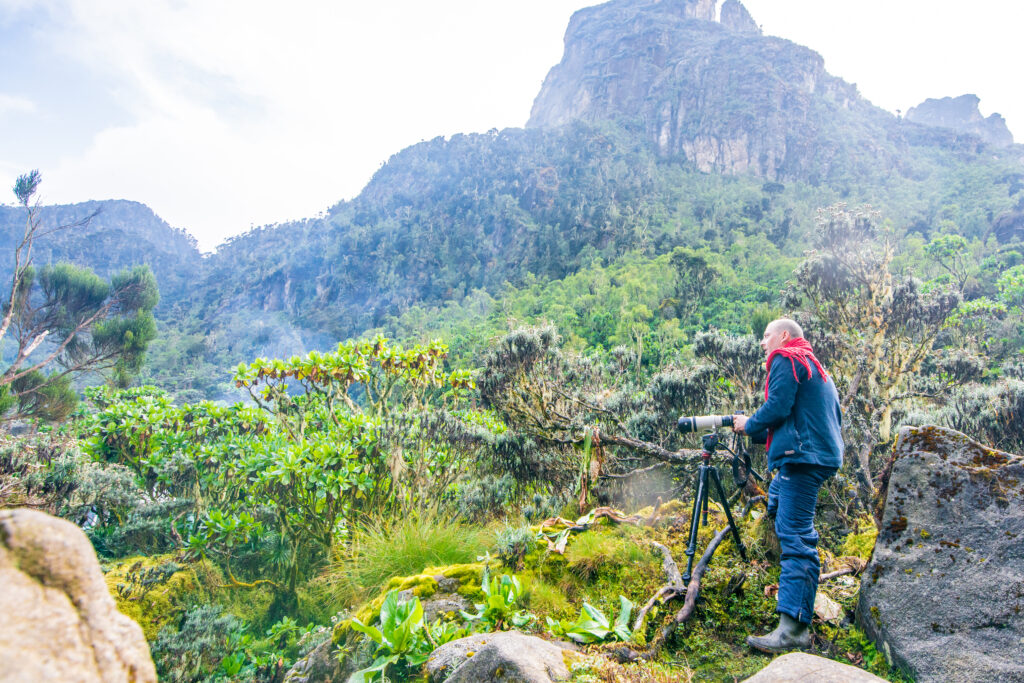 The 3-Day Rwenzori Trek to Sine Camp on the Kilembe Trail is built around that unhurrying. Where the 2-Day Sine Camp Trek reaches the same destination with the momentum of a single sustained push — ascent on Day 1, morning above camp and descent on Day 2 — the three-day version does something fundamentally different. It gives you a full second day at Sine Camp itself: a day for exploring the Erica forest above the huts without a summit to chase, for sitting at the edge of the camp clearing as the cloud builds and shifts around the upper ridges, for walking to Enock’s Falls a second time with the ease of someone who has already earned the place, and for discovering what the Rwenzori reveals to the traveler who is not in a hurry.
The difference between two days and three days on this mountain is not distance. It is depth. The Rwenzori Mountains National Park — Africa’s third highest massif, a UNESCO World Heritage Site, a range so biologically complex and botanically unusual that it has no true equivalent on the continent — is a place that rewards the patient visitor with a richness that the driven visitor misses entirely. 3 days Rwenzori trek to Sine/Kalama Camp with Enock’s Falls gives the forest time to show you what it is. And what it is, as guests routinely discover on the morning of Day 2, is considerably more extraordinary than anything they had prepared themselves to encounter.
At Gorilla Safaris, this three-day programme is arranged privately for every group. Your own certified mountain guide. Your own porter team. Your own schedule, set around your pace and your particular interest — whether that is birding, botany, photography, or the simple discipline of being still in a place that most of the world will never find on a map. Whether you are a family with older children for whom the Rwenzori represents an unforgettable physical and natural history education, a couple looking for the kind of shared wildness that the standard East Africa circuit cannot provide, a solo traveler seeking expert company in extraordinary country, or a group of friends for whom a proper mountain adventure with two nights in the forest is exactly the right conversation to have — this itinerary was designed for the way you travel.
- Day 1 — Kilembe Trailhead to Sine Camp: Transfer from Kasese to Kilembe | UWA ranger briefing | Trek through evergreen montane forest | Blue monkeys, Colobus, and Horned Chameleon | Enock’s Falls trail lunch | Bamboo zone ascent | Arrival at Sine Camp (2,596 m) | Hot dinner in the Erica forest
- Day 2 — Full Day at Sine Camp — Exploration, Wildlife and Rest: Morning guided walk into the upper Erica forest | Giant Erica trees and sphagnum bogs | Optional extension toward Kalalama Camp (3,134 m) | Birding and wildlife observation | Afternoon at leisure | Return to Enock’s Falls option | Second night at Sine Camp
- Day 3 — Sine Camp — Morning Walk and Full Descent to Kilembe: Early birding from camp | Guided morning walk | Full descent via Kilembe Trail | Enock’s Falls revisited | Return to Kilembe trailhead | Trekking certificate | Onward transfer
Total Distance: Approximately 20–26 km across 3 days (Day 1: 8–10 km ascent; Day 2: 4–8 km exploration walks; Day 3: 7–9 km descent)
Highest Point: Sine Camp, 2,596 m above sea level (optional Day 2 extension to Kalalama Camp: 3,134 m)
Difficulty: Moderate — suitable for fit adults and children aged 10+; no technical mountaineering required
Trek Style: Fully private, guide-led, porter-supported — pace and programme shaped entirely around your group
3-Day Sine Camp Trek — Itinerary at a Glance
Day 1 — The Forest Takes You: Kilembe to Sine Camp
Morning: The Trailhead and the Briefing
The drive from Kasese to Kilembe village takes approximately twenty-five minutes on a road that narrows consistently as the copper-belt foothills close in and the Rwenzori’s ridgelines become impossible to ignore overhead. The Uganda Wildlife Authority ranger station at Kilembe is where the formalities are completed — permits checked, the ranger escort assigned, the three-day programe confirmed. Your private guide handles all of this with practiced ease: efficient, unhurried, personal. By the time the briefing is complete, the trail ahead feels like an invitation rather than an undertaking.
The group checks day packs, confirms that trekking poles are adjusted and accessible, and takes a moment to register the air — noticeably cooler than Kasese town, already carrying the particular clean freshness of proximity to a large, wet, ancient forested mass. The porter team, who have been loading the camp equipment and food supplies since before arrival, fall into position ahead on the trail. And then the forest begins.
The Lower Montane Forest — Life in Every Direction
The Kilembe Trail enters evergreen montane forest within the first hundred metres of the trailhead, the canopy closing overhead with the sudden completeness of a curtain being drawn. The transition is immediate and total: from the warm, open air of the copper-belt foothills to the cool, enclosed, ancient world of the Rwenzori’s lower forest in the space of a single minute’s walking. Every surface that can carry life does: tree trunks colonised by orchids and ferns, fallen logs upholstered in mosses of multiple textures, the understorey dense with wild ginger, tree ferns, and climbing plants that use the established trees as architecture.
The cicadas are the first overwhelming experience for most first-time visitors — a wall of sustained, layered sound so complete that it takes twenty minutes to stop actively registering it and allow it to recede into the background of the forest’s general voice. Once that adjustment happens, the subtler sounds emerge: water over stone in the first stream crossing, the hollow percussion of a woodpecker somewhere in the mid-canopy, and — if the forest is disposed toward generosity — the deep, resonant croak of the Rwenzori Turaco, that impossibly coloured bird whose presence in the lower forest is more reliably heard than seen.
Blue monkeys appear in the canopy within the first thirty minutes in the majority of trekking days on the Kilembe Trail. Cercopithecus mitis — alert, unhurried, accustomed to the occasional human group passing below — watches from the mid-canopy with a composure that speaks of complete familiarity. Black-and-white Colobus monkeys — Colobus guereza, those spectacular long-limbed acrobats with their dramatic white mantles — are less certain but regularly encountered in the lower forest, their movement through the upper canopy more dynamic and less measured than the blue monkey’s considered observation. L’Hoest’s monkeys, the rarest and most culturally significant primate on the Kilembe Trail — a species of deep symbolic importance in Bakonzo culture — inhabits the deeper forest sections and rewards the patient observer with a sighting that the experienced guide treats as genuinely special, regardless of how many times they have seen it before.
The undergrowth harbours its own extraordinary catalogue. The Rwenzori Horned Chameleon — Trioceros johnstoni, a reptile of multiple prominent horns and a prehistoric silhouette that seems to belong to a different geological era — inhabits the shrubs and low branches of the lower forest zone. Your guide knows the specific plants and positions where they are most frequently found, and the moment of locating one — often motionless, its lateral compression rendering it almost perfectly invisible until the guide’s finger points to precisely the right patch of leaf — is one of those small, crystalline wildlife experiences that the Rwenzori produces with a consistency that larger, more famous parks cannot match.
Midday: Enock’s Falls
The trail climbs steadily through the forest’s middle section — crossing multiple streams on log bridges and stepping stones, the gradient consistent rather than severe — before arriving at Enock’s Falls, the cascade named for one of the Kilembe Trail’s founding local guides and the most beloved natural feature on the Sine Camp route. The falls drop over dark, moss-upholstered rock into a pool enclosed by the entrance of the bamboo zone — the bamboo canes visible at the edge of the pool, their tips feathering into the spray above the waterline.
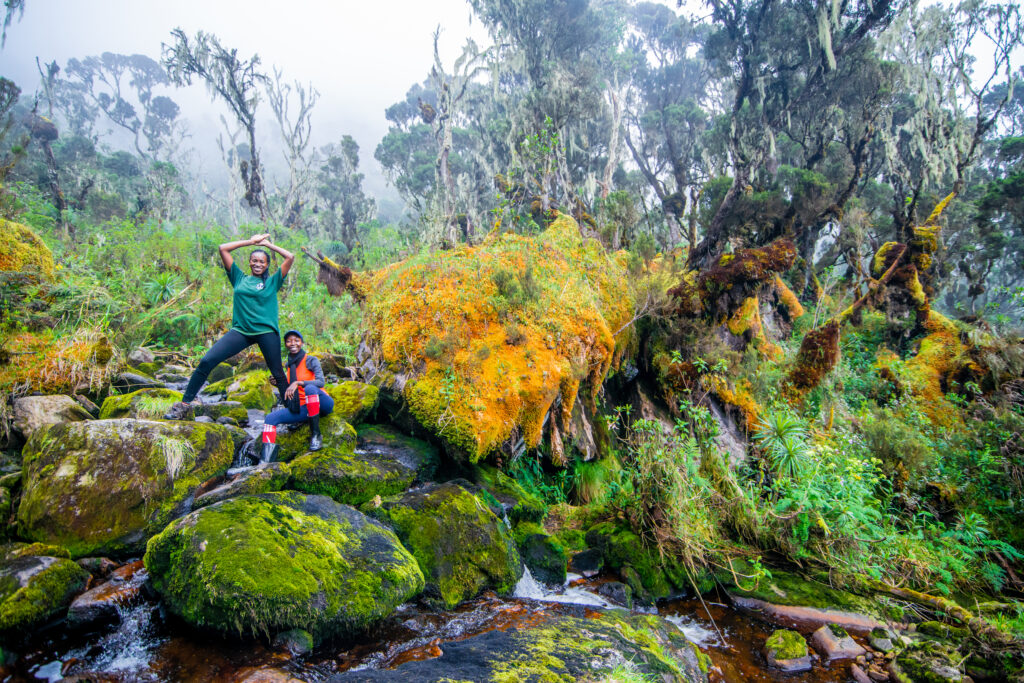
The sound of the falls announces itself several minutes before the pool comes into view — a deepening in the forest’s water voice, growing from the low murmur of small stream crossings to something fuller and more insistent. The light at the pool is a specific quality of this enclosed, spray-filled space: silver-green, diffuse, making the water appear almost luminous against the dark rock behind it. This is where the trail lunch is taken — food prepared by the camp cook team who have moved ahead of the hiking group to establish Sine Camp — and where most trekkers take their first long rest of the day, the combination of physical effort, extraordinary scenery, and cold spray making the prospect of moving on genuinely difficult to embrace.
On the three-day programme, Enock’s Falls holds a particular place in the itinerary’s architecture: visited three times in total — once on the ascent (Day 1), optionally again on a Day 2 afternoon excursion from Sine Camp, and once more on the return descent (Day 3). Each encounter is different. Each time, the falls look like something that has been there forever and was put there specifically for this moment.
The Bamboo Zone and the Approach to Sine Camp
Above Enock’s Falls, the evergreen forest gives way to bamboo — Arundinaria alpina, the Rwenzori’s high-altitude bamboo, growing in stands dense enough to create their own enclosed world. The light inside the bamboo is diffuse and geometric, filtered through thousands of parallel canes into long strips of greenish-gold. The sound environment shifts register: the cicadas fade as the bamboo’s own percussion — hollow, rhythmic, stem against stem in the breeze — takes precedence. This is the most physically demanding section of the day, the gradient steepening through the cane, the rooted trail requiring consistent attention underfoot.
Trekking poles earn their full value here — providing stability on the rooted and occasionally muddy trail surface and reducing the cumulative load on the knees that sustained ascent through forest terrain imposes. Your guide moves at the group’s pace, reading the energy and fitness of each person with the practised awareness of someone who has done this many times and understands that arriving at Sine Camp with something in reserve is more important than arriving quickly.
The bamboo thins. The first Erica trees appear — early sentinels of the upper forest, their trunks already beginning to accumulate the extraordinary depth of moss and lichen that defines the Erica zone above. The trail levels briefly. A narrow ridge opens ahead. And Sine Camp appears: a cluster of well-maintained wooden huts at 2,596 metres, set in the Erica grove on a forested ridge with the valley below visible through gaps in the trees and the upper mountain invisible above — hidden in its cloud, patient, fully present.
The First Evening at Sine Camp
The first evening at Sine Camp is the moment when the three-day programme reveals its essential character. There is no urgency. The descent is tomorrow, but tomorrow is not today. The guide brews tea from the camp kitchen. The porter team settles into the camp routine with the quiet efficiency of people who have done this many times in this specific place. The forest around the camp shifts register as the light fades: daytime birds giving way to the Rwenzori Nightjar, whose churring call begins from the Erica scrub above the camp as the last light leaves the valley below.
The temperature drops sharply after dark. Down to 10°C, sometimes lower, the cold arriving with the particular conviction of a mountain night rather than a valley chill. Layers appear. The cook produces a proper hot dinner — substantial and well-seasoned, eaten with the appetite that a full day of forest walking invariably generates. Conversation at the camp table is the kind that physical effort and unusual surroundings tend to produce: easy, unhurried, honest. The mountain listens without contributing, which is exactly right.
Overnight: Sine Camp (2,596 m) — twin-share wooden mountain huts with sleeping mats and blankets provided. All meals prepared by your dedicated camp cook. Drinking water purified and available throughout.
Day 2 — The Gift of Staying: A Full Day at Sine Camp
Dawn — The Camp Before Anyone Else is Properly Awake
Day 2 of 3 days Rwenzori trek to Sine/Kalalama Camp morning at Sine Camp is the heart of the 3-day Rwenzori Trekking to Sine/Kalama Camp & Enock’s Falls programme and the experience that guests most consistently describe as the thing they were least prepared for. Rising early — tea is ready before the light is fully committed — and walking out of the hut into the Erica grove in the pre-dawn silence is an encounter with the forest at its most concentrated. The bird chorus at Sine Camp before first light is among the most remarkable soundscapes in Rwenzori Mountains National Park: dense, layered, every endemic species in the camp zone contributing to a sonic architecture that has no equivalent in any lowland environment and that most people, in their lives, will never hear.
The Rwenzori Turaco — audible since before dawn, its deep croaking resonance carrying through the Erica trees with authoritative clarity — is typically visible within fifty metres of the camp in the first grey light. The Archer’s Robin-Chat, one of the most sought-after endemic species in the Albertine Rift, sings from dense cover near the camp’s water source with the particular liquid quality of a bird that has had millions of years to perfect its vocalism without competition from recorded music. The Rwenzori Double-collared Sunbird works the Erica flowers at eye level in a display of jewel-like iridescence that no camera setting fully captures. And somewhere in the canopy above the camp, the Cinnamon-chested Bee-eater calls with the bright, carrying note of a species that seems constitutionally incapable of subtlety. For guests with a serious interest in birds, this morning at Sine Camp is one of the premier birding experiences available anywhere in Uganda — comparable, in its endemic density and its accessibility, to the finest birding moments in Bwindi Impenetrable Forest.
The Morning Walk — Into the Upper Erica Forest
After breakfast, the day’s main guided walk ascends into the upper Erica forest above Sine Camp. This is the walk that the 2-day Rwenzori trek/hike to Sine camp glimpses briefly before the descent begins — the 3-day Rwenzori trek to Sine Camp gives it the time it deserves. The trail above camp climbs through increasingly spectacular Erica woodland: trees growing to eight and ten metres in twisted, lichen-encrusted forms that seem shaped by something more deliberate than biology, their trunks invisible beneath cushions of sphagnum moss so deep that pressing a hand against the bark produces a yield of five centimetres before anything firm is felt. The ground between the trees is equally extraordinary — a continuous carpet of sphagnum and sedge that springs and sinks beneath each step, the forest floor elastic and soft and improbably alive.
The first giant Senecio plants appear at the upper edge of the morning walk zone — those extraordinary succulent trees of the Rwenzori’s higher altitudes, their rosettes of large leaves spiralling in perfect mathematical symmetry from a thick central stem, their dead lower leaves forming an insulating skirt around the growing point. Seeing a giant Senecio for the first time produces in most observers a specific kind of arrested attention — the plant is simply too strange, too precisely itself, to process quickly. It looks designed for a different planet and delivered to this one, and the Rwenzori seems to understand this and to take a quiet satisfaction in the reaction it provokes.
Optional Extension: Kalalama Camp (3,134 m)
For guests who want to go higher on Day 2 — who have found their legs on the mountain and are ready to see more of what lies above the Erica tree line — your guide can lead an extension from the morning walk toward Kalalama Camp at 3,134 metres. This optional push adds approximately two hours of ascent and descent to the morning programme and reaches the lower margin of the open alpine heath, where the Erica woodland begins to thin and the sky becomes a larger element of the landscape than it has been at any point since the trailhead. The views from the Kalalama zone on a clear morning — down the forested Kilembe Trail corridor to the Kasese plains and, in exceptional conditions, across to the western Rwenzori ridge-lines — are among the finest available on a short Kilembe Trail trekking expedition without committing to a Samalira overnight. The extension is assessed on the morning by your guide in consultation with the group, based on weather, fitness, and individual inclination; it is always optional, never expected.
Afternoon — The Freedom of Having Nowhere to Be
The afternoon of Day 2 at Sine Camp is the programme’s gift to the traveler who has spent the rest of their trip somewhere slightly ahead of themselves. The guide is available but not directing. The camp is comfortable. The forest is immediately outside the hut door. Whatever the afternoon calls for — a slow second walk down to Enock’s Falls and back, an hour with binoculars in the camp clearing, a long rest in the hut with a book and the sound of the mountain outside, a photography session in the extraordinary late-afternoon light that filters through the Erica canopy in the hour before it fades — the programme accommodates it without comment.
For families, the afternoon often becomes the most distinctive part of the whole trip: children exploring the forest immediately around the camp with a curiosity that the urgency of the ascent day didn’t permit, finding the small and extraordinary things that the Rwenzori’s forest floor offers to anyone who looks with patience — endemic frogs in the moss, chameleons in the understorey, the slow architectural logic of a lichen colony on a fallen branch that has been growing since before anyone alive was born. For couples, the afternoon at Sine Camp has a particular quality of intimacy — the shared space of a camp in the forest, the absence of screens and agendas, the mountain providing all the necessary conversation.
The Second Evening
The second evening at Sine Camp has a different quality from the first. The forest is familiar now — not less extraordinary, but known. The camp feels like a place that belongs to the group rather than a destination they have arrived at. The cook produces another substantial hot dinner. The temperature drops again, the cold no longer a surprise but simply part of the camp’s character. The Nightjar returns to its Erica scrub above the huts. The stars, on clear nights, fill the gaps in the Erica canopy with a density that requires the complete absence of any artificial light to produce, and which produces, when you look up at it, a silence of a different kind — not the absence of sound, but the presence of scale.
Second overnight: Sine Camp (2,596 m). Same accommodation as Night 1. Full dinner and breakfast provided.
Day 3 — The Long Walk Home: Sine Camp to Kilembe
One More Morning in the Erica Grove
Day 3 begins as Day 2 did: tea before the light, birdsong before the tea, and the Erica grove doing whatever it does in the early hours, which is considerably more than most people expect from a forest at dawn. The morning walk before the descent begins is shorter and more meditative than Day 2’s exploration — a final circuit of the camp zone, a last look at the view down the valley, a last encounter with the Turaco in its customary perch above the camp clearing — but it carries a weight that comes specifically from being the last one. The forest does not acknowledge departure. The mountain is indifferent to schedule. This is, paradoxically, what makes leaving feel significant.
The Descent Through Three Worlds
The descent from Sine Camp reverses the Day 1 ascent route, but the experience is transformed by direction, accumulated knowledge, and the particular quality of a body moving downhill after two nights at altitude. The bamboo zone, descended rather than climbed, opens its views downward: the Kasese valley far below, the cultivated foothills of the Rwenzori buffer zone, and — on clear mornings — the distant shimmer of the Ugandan rift valley plains. The bamboo’s sound is the same, but heard from a slightly different angle of movement, and the light through the canes in the morning — lower sun, longer shadows — creates a quality of illumination that the afternoon ascent missed entirely.
Re-entering the lower montane forest on the descent produces the particular sensory reinstatement that returning to a known place after time away always creates: the cicadas at their sustained volume, the orchids on the same trunks as two days ago, the streams at the same crossings with the same cold and the same sound. Blue monkeys are sometimes encountered on the descent, on the same trails and in the same sections as the ascent — the same animals, or at least the same family groups, occupying the same canopy territory with the same composure they showed two days earlier, as if no time has passed at all, as if the forest operates on a schedule entirely its own.
Enock’s Falls for the Last Time — and the Return to the Valley
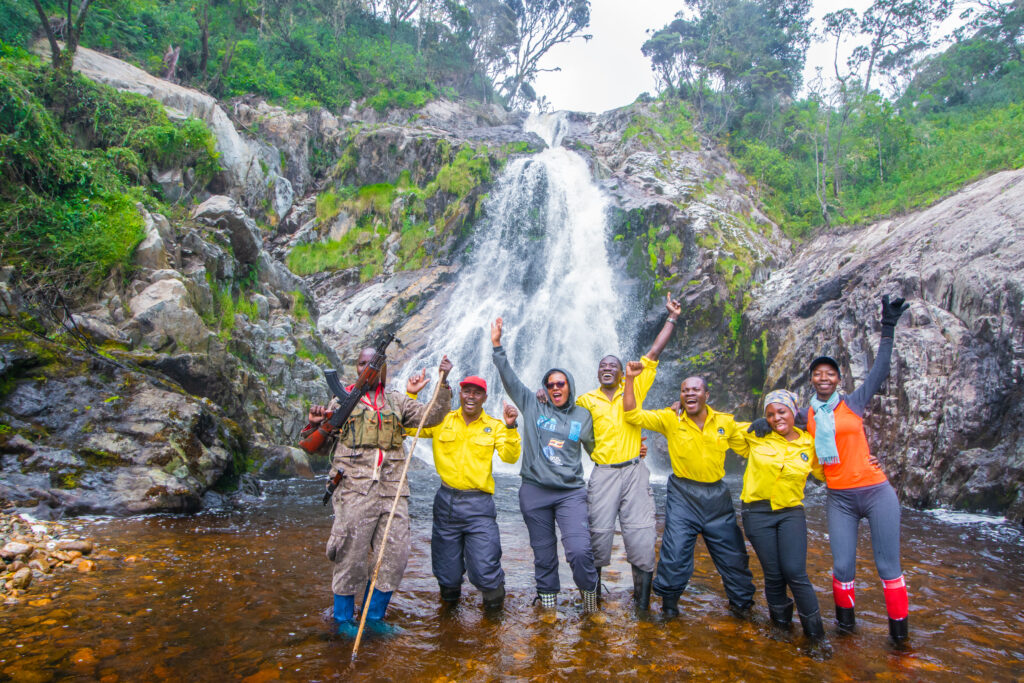 The falls, encountered for the third time on the Day 3 descent, close the trek’s relationship with its most enduring landmark. Approached from above — the top of the cascade visible from the trail before the pool appears — they look different from every previous encounter: the drop fully visible, the bamboo framing the water from a higher angle, the sound arriving from below rather than ahead. Most groups pause here for a proper rest: boots off, feet in the water, the cold of the pool absolute and welcome after the descent’s accumulated warmth. The falls ask nothing and provide everything, as they always have.
The trail from Enock’s Falls to the Kilembe trailhead is the final section of descent — the forest giving way to the lower boundary vegetation, the cicadas maintaining their wall of sound until the very last moment, and then the trailhead clearing appearing ahead with the particular quality of the endpoint: familiar, simple, and somehow smaller than it was three days ago.
Completion and Onward
At the Uganda Wildlife Authority Kilembe ranger station, the park register is signed and trekking certificates are issued — formal acknowledgment from the UWA that a complete Kilembe Trail has been undertaken and completed. Your private guide presents them with the understated ceremony that the achievement deserves. And then your dedicated vehicle is there: clean clothes from the day bag, cold drinks from the cooler box, the driver ready, the road back to Kasese and the world below open and waiting.
The afternoon and evening of Day 3 are shaped entirely by your wider itinerary. Kasese overnight, connecting onward in the morning. A drive east to Queen Elizabeth National Park for a late afternoon game drive. North toward Murchison Falls. Or — for guests whose three days on the Kilembe Trail formed the final chapter of a Bwindi-and-Rwenzori Uganda circuit — the particular, complete satisfaction of a journey that delivered exactly what was promised and considerably more besides. Your Gorilla Safaris team manages every transition between the mountain and wherever you are going next.
What the 3-Day Sine Camp Trek Reveals
Sine Camp — The Rwenzori’s Finest Short-Trek Base
At 2,596 metres, Sine Camp is positioned at one of the Kilembe Trail’s most botanically rich and most dramatically situated overnight points. The camp sits on a narrow ridge in a grove of ancient Erica trees, with views down the forested Kilembe Trail corridor to the valley below and the upper mountain — still higher, still cloud-wrapped — above. Unlike camps that are simply way points on the way to somewhere else, Sine Camp rewards extended stays: the forest immediately around the huts is extraordinarily biodiverse, the birding is exceptional in every direction, the morning and evening light through the Erica canopy is genuinely photographic, and the quality of silence — complete, mountain-altitude silence — makes Sine Camp, for most guests, the most peaceful place they have ever slept.
Enock’s Falls — The Kilembe Trail’s Most Beloved Landmark
Encountered on the ascent, optionally again in the afternoon of Day 2, and on the descent of Day 3, Enock’s Falls is the Kilembe Trail’s most frequently photographed and most inadequately photographed feature. The cascade drops over dark, moss-covered rock into a bamboo-fringed pool at approximately 2,100 metres — a location that manages to be simultaneously dramatic and intimate, the enclosed bamboo clearing creating a space that feels specifically designed for the experience of standing at a waterfall rather than simply passing one. The falls are named for an early local guide whose knowledge shaped the Kilembe Trail: an appropriate memorial for a man who spent his working life making it possible for others to stand at exactly this pool.
Kalalama Camp — The Optional High Point
The optional Day 2 extension to Kalalama Camp at 3,134 metres represents the highest point accessible on the 3-Day Sine Camp programme and provides a first encounter with the Rwenzori’s upper mountain zones. At 3,134 metres, the Erica forest is thinning and the open alpine heath is becoming the dominant landscape character — the sky a larger element, the views longer, the botanical character shifting from the enclosed woodland of Sine Camp to something more open and more exposed. Giant Senecio plants are reliably encountered on the Kalalama approach. For guests who complete the extension, it functions as a preview of what the longer Kilembe Trail programmes — the 4-day Mutinda Trek and beyond — offer in full.
The Bakonzo Cultural Landscape
The Kilembe Trail passes through and immediately above the Bakonzo people’s traditional mountain territory — a community whose relationship with the Rwenzori is generational, spiritual, and intimately ecological. The Bakonzo are the Rwenzori’s indigenous mountain people, who regard the mountain as a living entity of cultural and spiritual significance, whose traditional knowledge of the forest’s plants and animals informed the routes that modern trekking trails have followed, and whose guides were the first to take European explorers into the high country in the late nineteenth and early twentieth centuries. The Kilembe Trail’s founding guides — including Enock, for whom the falls are named — were Bakonzo men whose lifetime familiarity with this terrain made the trail what it is. Walking it in their footsteps, in the company of a Bakonzo guide whose family has been on this mountain for generations, gives the trek a human depth that purely ecological or topographic descriptions cannot capture.
Why Three Days at Sine Camp Changes the Quality of the Experience
The Case for Staying Longer at One Place
There is a prevailing assumption in adventure travel that more altitude means more experience — that the value of a mountain trek is measured primarily by how high it goes. The Rwenzori’s 3-day Rwenzori trek to Sine Camp & Enock’s Falls is a direct and thoughtful argument against that assumption. Sine Camp at 2,596 metres is not a compromise destination for those who cannot make it to Samalira or Mutinda. It is, in its own right, one of the finest overnight environments in East Africa: a camp in a grove of ancient Erica trees on a narrow forested ridge, with views down a valley that has been clothed in montane forest for millions of years, surrounded by the endemic birdlife of the Albertine Rift, and positioned at the precise altitude where the forest’s character changes from the botanical richness of the lower zones to the sculptural strangeness of the Erica belt above.
Day 2 of theRwenzori trek to Sine Camp is the feature that distinguishes the 3-day Rwenzori trek from the 2-day Rwenzori Trek to Sine Camp — transforms the camp from a destination into a base. From Sine Camp, guided walks explore the upper Erica forest above the huts, where ancient Erica trees of extraordinary size and form dominate a landscape cushioned throughout with sphagnum moss and threaded with the calls of endemic birds that exist nowhere else on earth. The trail to Kalalama Camp at 3,134 metres is accessible as an optional morning extension for physically ambitious guests, offering a glimpse into the mountain’s upper zones without the full commitment of a Samalira overnight. Enock’s Falls — visited on the ascent on Day 1 — can be revisited on the second afternoon with the ease of a short excursion from camp rather than a trail lunch stop, allowing the falls to be experienced at leisure rather than in transit. And the camp itself, in the hours between walks, is simply a place to be in the Rwenzori — which is, as most guests discover, entirely sufficient.
Who This Trek is For
The 3-Day Rwenzori Trekking to Sine Camp is particularly well-suited to families with children aged 10 to 14 — young enough to find the forest genuinely magical, old enough to handle the Day 1 ascent and the Day 2 exploration walks with genuine independence and engagement. The second day’s flexible programe means that children who want to push higher toward Kalalama can do so with the guide while other family members spend a gentler morning at the camp; families with different fitness levels within the group find this built-in flexibility invaluable. For older or less mobile adults who want a genuine mountain experience without the cumulative strain of a second consecutive ascent day, the 3-day Rwenzori Trek To Sine Camp is the most appropriate Kilembe Trail option: the ascent effort is concentrated on Day 1, and Days 2 and 3 involve exploration walks and descent that work with rather than against the body’s natural recovery rhythm.
Getting to the Kilembe Trail and Rwenzori Mountains National Park
From Kampala or Entebbe
The Kilembe trailhead sits approximately 380 kilometres west of Kampala — a drive of five to six hours on the Kampala–Mbarara–Kasese highway through some of Uganda’s most varied and beautiful landscapes: the rolling tea-growing hills of the southwest, the dry Mbarara cattle country, the dramatic escarpment descent into the western rift valley, and finally the Rwenzori’s own foothills pressing in on the last hour of the drive. Kilembe village — the former copper mining settlement where the Kilembe Trail begins — is a further 10 Kilometers south of Kasese town on a maintained road. Your dedicated Gorilla Safaris vehicle handles the full transfer, with a comfort stop en route. Many guests choose to overnight in Kasese the night before the trek begins, giving the early trailhead start a relaxed rather than rushed quality.
Domestic Flight to Kasese
Uganda Airlines operates domestic flights from Entebbe International Airport to Kasese Aerodrome, reducing the travel time to under an hour in the air. Your dedicated vehicle meets the flight on arrival and completes the short Kasese-to-Kilembe transfer. This option is particularly practical for guests arriving from Rwanda after a gorilla trekking safari in Volcanoes National Park, where crossing into Uganda and reaching the Rwenzori without surrendering a full day to road travel gives the Sine Camp trek the maximum possible time on the mountain.
The Route from Bwindi Impenetrable National Park
The most naturally complete itinerary combines the 3-Day Sine Camp Trek with gorilla trekking in Bwindi Impenetrable National Park — Uganda’s most celebrated wildlife experience — as either a preceding or following chapter. Bwindi’s main trekking sectors at Buhoma and Rushaga are approximately three hours from Kasese by road, passing through the spectacular highland scenery of southwestern Uganda and along the northern boundary of Queen Elizabeth National Park. Many guests build a morning game drive or boat cruise on the Kazinga Channel into the transfer day, arriving in Kasese in the afternoon for a comfortable overnight before the Kilembe trailhead start the following morning. Your Gorilla Safaris team manages every step of the transition seamlessly.
The Rwenzori Mountains — Understanding What You Are Entering
Rwenzori Mountains National Park protects a massif of extraordinary geological antiquity — a block mountain pushed upward by tectonic forces over hundreds of millions of years rather than built by volcanic activity like Kilimanjaro or the Virunga volcanoes. The range extends approximately 120 kilometers along the Uganda-DRC border and rises from the western arm of the East African Rift Valley to a maximum elevation of 5,109 metres at Margherita Peak, the continent’s third highest point.
The six major massifs that compose the Rwenzori range are Mount Stanley (5,109 m, carrying Margherita, Albert, and Alexandra peaks), Mount Speke (4,890 m, carrying Vittorio Emanuele Peak), Mount Baker (4,843 m, carrying Edward Peak), Mount Emin (4,798 m), Mount Gessi (4,715 m), and Mount Luigi di Savoia (4,627 m). The Kilembe Trail ascends through the southern flanks of the range, crossing the vegetation zones below these higher massifs and passing through country that the six major peaks look down upon from their permanent cloud cover above. The Sine Camp zone — at 2,596 metres in the lower Erica forest — sits deep within the mountain’s protected ecology, well above the park’s buffer zone and within one of the most biodiverse mountain environments in Africa.
The Rwenzori carries five distinct vegetation zones stacked vertically between its base and its glaciated summits: the lower montane forest (1,800–2,500 m), the bamboo zone (2,500–3,000 m), the Hagenia-Hypericum woodland (on the Central Circuit’s Bujuku Valley), the Erica heath (3,000–4,000 m), and the afro-alpine zone (above 4,000 m). The 3-Day Rwenzori trek to Sine Camp Trek passes through the first three of these zones on the Day 1 ascent, and the morning walk above camp on Day 2 reaches the lower margin of the fourth — the Erica heath — giving guests a complete vertical botanical journey across 800 metres of elevation gain.
What the 3-Day Sine Camp Trek Reveals
Sine Camp — The Rwenzori’s Finest Short-Trek Base
At 2,596 metres, Sine Camp is positioned at one of the Kilembe Trail’s most botanically rich and most dramatically situated overnight points. The camp sits on a narrow ridge in a grove of ancient Erica trees, with views down the forested Kilembe Trail corridor to the valley below and the upper mountain — still higher, still cloud-wrapped — above. Unlike camps that are simply waypoints on the way to somewhere else, Sine Camp rewards extended stays: the forest immediately around the huts is extraordinarily biodiverse, the birding is exceptional in every direction, the morning and evening light through the Erica canopy is genuinely photographic, and the quality of silence — complete, mountain-altitude silence — makes Sine Camp, for most guests, the most peaceful place they have ever slept.
Enock’s Falls — The Kilembe Trail’s Most Beloved Landmark
Encountered on the ascent, optionally again in the afternoon of Day 2, and on the descent of Day 3, Enock’s Falls is the Kilembe Trail’s most frequently photographed and most inadequately photographed feature. The cascade drops over dark, moss-covered rock into a bamboo-fringed pool at approximately 2,100 metres — a location that manages to be simultaneously dramatic and intimate, the enclosed bamboo clearing creating a space that feels specifically designed for the experience of standing at a waterfall rather than simply passing one. The falls are named for an early local guide whose knowledge shaped the Kilembe Trail: an appropriate memorial for a man who spent his working life making it possible for others to stand at exactly this pool.
Kalalama Camp — The Optional High Point
The optional Day 2 extension to Kalalama Camp at 3,134 metres represents the highest point accessible on the 3-Day Sine Camp programme and provides a first encounter with the Rwenzori’s upper mountain zones. At 3,134 metres, the Erica forest is thinning and the open alpine heath is becoming the dominant landscape character — the sky a larger element, the views longer, the botanical character shifting from the enclosed woodland of Sine Camp to something more open and more exposed. Giant Senecio plants are reliably encountered on the Kalalama approach. For guests who complete the extension, it functions as a preview of what the longer Kilembe Trail programmes — the 4-day Mutinda Trek and beyond — offer in full.
The Bakonzo Cultural Landscape
The Kilembe Trail passes through and immediately above the Bakonzo people’s traditional mountain territory — a community whose relationship with the Rwenzori is generational, spiritual, and intimately ecological. The Bakonzo are the Rwenzori’s indigenous mountain people, who regard the mountain as a living entity of cultural and spiritual significance, whose traditional knowledge of the forest’s plants and animals informed the routes that modern trekking trails have followed, and whose guides were the first to take European explorers into the high country in the late nineteenth and early twentieth centuries. The Kilembe Trail’s founding guides — including Enock, for whom the falls are named — were Bakonzo men whose lifetime familiarity with this terrain made the trail what it is. Walking it in their footsteps, in the company of a Bakonzo guide whose family has been on this mountain for generations, gives the trek a human depth that purely ecological or topographic descriptions cannot capture.
Related Rwenzori Mountain Trekking Itineraries from Gorilla Safaris
The 3-Day Rwenzori Trek To Sine Camp sits within a complete range of Kilembe Trail and Rwenzori trekking programmes that Gorilla Safaris designs and arranges. Understanding where it sits within that range helps guests choose the version that best matches their time, fitness, and ambition.
The 2-Day Rwenzori Trek to Sine Camp covers the same route in a more concentrated format: ascent on Day 1, morning exploration above camp and descent on Day 2. It is ideal for guests with limited time who still want a genuine Rwenzori mountain experience. The 3-Day Sine and Samalira Camp Trek adds a second ascent day that pushes from Sine Camp to Samalira at 3,150 metres, spending the second night significantly higher and in a more exposed, more alpine environment. For guests who want the Kilembe Trail’s finest accessible high-altitude camp, the 4-Day Mutinda Lookout Trek ascends from Sine and Samalira to Mutinda Camp at 3,700 metres and the extraordinary Mutinda Lookout at 3,975 metres — the highest point reachable on a short Kilembe Trail Rwenzori trek. And for the complete Rwenzori experience, the 7-Day Days Rwenzori trekking Central Circuit traverses all five vegetation zones and reaches the glaciated summits of the range’s highest massifs.
For guests whose Rwenzori trek forms part of a broader Uganda itinerary, the 12 days Rwenzori trek & Gorilla Trekking and the 10-Day Rwanda and Uganda Safari both incorporate Rwenzori trekking as a natural extension of their primate and wildlife programmes.
What to Pack for the 3-Day Rwenzori Sine Camp Trek
Waterproof Hiking Boots — The Foundation of Every Good Day
Three days on the Kilembe Trail, including two nights at 2,596 metres and the optional Kalalama extension to 3,134 metres, requires waterproof, ankle-supporting hiking boots that have been properly broken in before departure. This is not a suggestion. The Kilembe Trail is wet in every season — the lower montane forest holds moisture year-round, the bamboo zone’s soil is rarely fully firm, and the Erica forest around Sine Camp sits in permanent cloud moisture that saturates the ground surface consistently. Trail runners do not provide sufficient ankle support for the rooted, uneven terrain. New boots produce blisters that define the experience in entirely the wrong way. Properly fitted, thoroughly broken-in, genuinely waterproof mountain boots are the single most important item on the Sine Camp packing list. Gaiters are recommended and available for hire through Gorilla Safaris.
Layering System — Warm Enough for Camp Nights, Breathable for Trail Days
The temperature range across three days on the Sine Camp programme is significant: from the warm, humid air of the lower forest on the Day 1 ascent (often 22°C–26°C at trailhead level) to the cool, still nights at Sine Camp (8°C–14°C) and the potentially cold early mornings above camp on Day 2. The recommended layering system includes: a moisture-wicking base layer in merino wool or synthetic (never cotton), a mid-layer fleece or lightweight down jacket for camp evenings and cold mornings, and a waterproof shell jacket with a sealed hood for the trail and for the Rwenzori’s characteristic afternoon rain. Waterproof trousers complete the outer layer and are particularly important for the bamboo zone descent in wet conditions. A warm hat and light gloves are recommended for the Sine Camp nights and early mornings.
Trekking Poles
Trekking poles are strongly recommended for the full three-day programme. They provide essential stability on the rooted bamboo zone sections of the ascent and significantly reduce knee load on the Day 3 descent — which, at 8–9 kilometres of sustained downhill through varying terrain, is the single most physically demanding sustained section of the trek for the lower body. Poles are available for hire through Gorilla Safaris — please advise our team at the time of booking so they are ready at the Kilembe trailhead.
Daypack Contents for Three Days
Your porter team carries all group camp equipment and food supplies. Each trekker is responsible for their personal daypack, which should contain: 2–3 litres of water (refillable from purified mountain sources), high-energy trail snacks for between-meal energy on the ascent, high-SPF sunscreen and lip balm (UV radiation increases measurably above 2,000 m, including through cloud cover), insect repellent for the lower forest sections, all personal medications including prescription items and any altitude-specific medicines, a camera with additional batteries or a charging bank (no mains electricity at Sine Camp or on the trail), a headtorch with spare batteries, a lightweight rain cover for the daypack, and a small personal dry bag for electronics, documents, and anything that cannot get wet. A complete, itemised gear list is provided to all guests at the time of booking.
What’s Included in Your 3-Day Sine Camp Trek
Your Gorilla Safaris Sine Camp Trek is arranged as a complete, supported private expedition. Every element has been confirmed before your arrival in Uganda, so that the mountain is the only thing requiring your attention from the first step at Kilembe trail to the last at the same place, three days later.
- All Uganda Wildlife Authority (UWA) park entry fees and Kilembe Trail trekking permits for all 3 days
- Professional, UWA-certified private mountain guide for the full 3-day programme
- Dedicated UWA armed ranger escort throughout all 3 days on the trail
- Experienced porter team carrying all group camping equipment, food supplies, and shared loads
- All meals on the mountain: packed trail lunch Day 1, hot dinner Day 1, full breakfast and guided-walk snacks Day 2, hot dinner Day 2, full breakfast Day 3, packed trail lunch for the Day 3 descent
- Drinking water and electrolyte supplements provided throughout
- 2 nights mountain accommodation at Sine Camp (2,596 m) — twin-share wooden mountain huts with sleeping mats and blankets provided
- Basic first-aid kit and emergency evacuation protocol on all days
- UWA trekking certificate on completion of the 3-day programme
- Private vehicle transfers between Kasese town and the Kilembe trailhead, both directions
- All government taxes and statutory levies
- Detailed pre-departure gear list, trail briefing document, and programme information
What’s Not Included
For complete planning transparency, the following items fall outside the trek package and should be factored into your preparations.
- International flights to and from Uganda (Entebbe International Airport)
- Uganda tourist visa — apply via the official online e-visa portal before travel
- Comprehensive travel and medical insurance including emergency mountain evacuation — mandatory for all Rwenzori trekking guests, non-negotiable
- Personal trekking equipment: waterproof boots, gaiters, trekking poles, waterproof jacket and trousers, warm layers — a complete gear list is provided at booking; selected items available for hire through Gorilla Safaris
- Guide and porter gratuities — suggested amounts provided in your pre-departure information
- Beverages beyond the included purified drinking water (beer, soft drinks, specialty coffee)
- Hotel accommodation in Kasese before or after the trek
- Any activities, transfers, or meals not described in this itinerary
- Personal expenditure and souvenirs
Best Time to Trek the Rwenzori Mountains to Sine Camp
June to August — The Most Reliable Window
Uganda’s long dry season from June through August is the Kilembe Trail’s most consistently rewarding season. Trail surfaces are at their firmest, stream crossings at their most manageable, and the chance of clear afternoons at Sine Camp — with the valley visible below and the upper ridges occasionally showing through the cloud above — is at its annual highest. This is the peak season for Uganda travel generally, and trekking permits and porter teams fill in advance for the June–August window. Booking four to six months ahead is strongly recommended for departures in this period, particularly for groups requiring larger porter teams and specific accommodation configurations.
December to February — The Short Dry Season and the Quieter Alternative
December through February offers conditions comparable to the peak season with considerably fewer trekkers on the trail. Permits are more readily available, the porter teams less stretched, and the atmosphere on the Kilembe Trail more intimate and solitary. The Christmas and New Year period at Sine Camp — cold, clear-skied on the best nights, the forest around the camp utterly quiet in the way that only a mountain forest far from any human settlement achieves — is an experience that a growing number of Gorilla Safaris guests specifically return to Uganda for. Combined with gorilla trekking in Bwindi over the same school holiday period, the December–January window produces some of the finest Uganda itineraries we arrange.
March to May — Rain, Richness, and the Forest at Its Most Alive
The long rains of March to May bring the Kilembe Trail into its most dramatically beautiful state. Enock’s Falls runs at its annual peak volume — the pool fuller, the cascade wider, the sound that announces its arrival from further down the trail. The forest is at its most saturated and most vivid green. The moss on the Erica trees around Sine Camp glistens at a depth of colour that the dry season cannot replicate. The trails are muddier, the bamboo zone’s stream crossings higher, and the Day 2 exploration walks above camp wetter — but for trekkers with proper waterproof kit and a genuine appreciation for the Rwenzori in its most expressive and atmospheric state, the long rains period is not a compromise. It is a specific and extraordinary choice. Birdlife peaks during this period, with migrants joining the resident endemic assemblage for the season’s richest species counts.
September and October — Green, Comfortable, and Ideal for Families
The September–October window sits between Uganda’s two rain seasons and offers a particularly pleasant balance of conditions: the vegetation freshly green from the short rains that end in October, trail surfaces firming as the dry weather establishes, and temperatures throughout the ascent and camp programme comfortable for guests of all ages. For families with school-age children whose October half-term creates the travel window, this period is our most common recommendation for the 3-Day Rwenzori Trek to Sine Camp programme — the camp’s flexibility, the moderate-length walking days, and the accessible altitude make it the most family-appropriate of all the Kilembe Trail short trek options, and September–October its most family-appropriate season.
Frequently Asked Questions — 3 Days Rwenzori Trek to Sine Camp
What is the 3-Day Rwenzori Trek to Sine Camp?
The 3-Day Rwenzori Trek to Sine Camp is a privately guided trekking expedition on the Kilembe Trail in Rwenzori Mountains National Park, Uganda. The route ascends from the Kilembe trailhead through evergreen montane forest, past Enock’s Falls, through the bamboo zone, and into the lower Erica forest to reach Sine Camp at 2,596 metres above sea level on Day 1. Day 2 is spent entirely at and above Sine Camp, with a guided morning walk into the upper Erica forest and an optional extension toward Kalalama Camp at 3,134 metres. Day 3 completes the descent back to the Kilembe trailhead. The programme is distinguished from the 2-day Rwenzori trekking to Sine camp version of the same route by the inclusion of a full exploration day at Sine Camp, which transforms the camp from a destination into a base for understanding the Rwenzori’s mid-mountain ecology.
How does the 3-Day Sine Camp Trek differ from the 2-Day version?
The 2-Day Sine Camp Trek reaches Sine Camp on Day 1, explores the forest above the camp briefly in the early morning of Day 2, and descends to Kilembe the same day. The 3-Day version adds an entirely separate full-day exploration programme on Day 2: a proper guided morning walk into the upper Erica forest, the option of extending to Kalalama Camp at 3,134 metres, an afternoon of unrestricted exploration from the camp, and a second night at Sine before the Day 3 descent. The difference is significant: two nights at Sine Camp allows the forest to reveal aspects of its character — in particular its birdlife, its botanical detail, and its atmosphere across different times of day and different light conditions — that a single overnight visit cannot access. For guests with the time available, the 3-day programme consistently produces a deeper and more lasting connection to the mountain.
How difficult is the 3-Day Rwenzori Trek to Sine Camp?
The 3-Day Rwenzori Trek to Sine Camp Trek is graded moderate. The principal physical challenge is Day 1’s ascent of approximately 950 metres over 8–10 kilometres through three vegetation zones, typically taking 5–7 hours of active hiking with rest stops. Day 2 involves shorter guided walks — 4–8 kilometres depending on whether the optional Kalalama extension is taken — with no sustained uphill gradient beyond the morning walk above camp. Day 3’s descent of approximately 7–9 kilometres takes 4–5 hours. No technical mountaineering skills or specialist climbing equipment are required at any point. Children aged 10 and above with reasonable physical fitness complete the programme regularly, as do adults of all ages who walk regularly and have invested in appropriate footwear and equipment.
What is Enock’s Falls and why is it significant to the Kilembe Trail?
Enock’s Falls is a multi-tiered waterfall on the Kilembe Trail in Rwenzori Mountains National Park, located at approximately 2,100 metres above sea level — 300 metres below Sine Camp and within the bamboo zone that marks the transition between the lower montane forest and the upper Erica woodland. The falls are named for one of the Kilembe Trail’s founding local guides, a Bakonzo man whose lifetime knowledge of the terrain contributed to the establishment of the route that modern trekkers follow. The cascade drops over dark, moss-covered rock into a bamboo-fringed pool whose enclosed setting creates a specific quality of light and sound that most visitors describe as among the most beautiful they have encountered anywhere in Africa. On the 3-Day Rwenzori Trekking to Sine Camp programme, Enock’s Falls is encountered up to three times: on the Day 1 ascent trail lunch stop, optionally on a Day 2 afternoon excursion from camp, and on the Day 3 descent.
What wildlife can I expect on the 3-Day Sine Camp Trek?
The Kilembe Trail to Sine Camp passes through the Rwenzori’s most biodiverse lower mountain zones, supporting wildlife across multiple taxa. Primates: blue monkeys are reliably encountered in the lower montane forest canopy; black-and-white Colobus monkeys are regularly present; L’Hoest’s monkey — a culturally significant species in Bakonzo tradition — is occasionally seen in deeper forest sections. Birds: Rwenzori Mountains National Park records 217 species, of which over 70 are Albertine Rift endemics. Key species on the Sine Camp route include the Rwenzori Turaco, Archer’s Robin-Chat, Rwenzori Double-collared Sunbird, Cinnamon-chested Bee-eater, Handsome Francolin, and Rwenzori Nightjar. Reptiles: the Rwenzori Horned Chameleon is a regular encounter in the lower forest undergrowth. Mammals: giant forest hog signs are common around Sine Camp; leopard signs are occasionally recorded on the upper trail. Your private guide acts as a trained naturalist throughout all three days.
Is the 3-Day Sine Camp Trek suitable for families with children?
Yes. The 3-Day Rwenzori Trekking To Sine Camp programme is one of the most family-friendly options on the Kilembe Trail, for two specific structural reasons. First, the physical effort is concentrated on Day 1, with Days 2 and 3 involving shorter, more flexible walks that accommodate the varying energy levels of different family members. Second, the full Day 2 exploration programme can be adapted to individual interests: children who want to push to Kalalama Camp can do so with the guide while other family members spend a gentler morning at Sine; photographers can pursue the forest light while non-photographers rest at the camp; birders can spend the morning hours in the clearing while others explore the trail to Enock’s Falls. The recommended minimum age is 10 years for children who are fit and motivated. Many families describe the second day at Sine Camp as the most memorable element of their entire Uganda trip.
Can I extend the 3-Day Sine Camp Trek to go higher?
Yes. The optional Kalalama Camp extension on Day 2 reaches 3,134 metres and provides a genuine taste of the Rwenzori’s upper mountain character within the 3-day Rwenzori trekk to Sine Camp. For guests who want to go significantly higher and spend a night above 3,000 metres, the 3-Day Sine and Samalira Camp Trek is the most appropriate programme: it adds a full second-day ascent from Sine Camp to Samalira at approximately 3,150 metres, spending the second night considerably higher. The 4-Day Mutinda Lookout Trek extends further, reaching Mutinda Camp at 3,700 metres and the Mutinda Lookout at 3,975 metres — the highest point on a short Kilembe Trail programme.
What do I need to carry in my daypack for the 3-Day Sine Camp Trek?
Your porter team carries all shared camp equipment and food. Your personal daypack for each of the three days should contain: 2–3 litres of water (refillable from purified mountain sources at Enock’s Falls and at camp), high-energy trail snacks, high-SPF sunscreen and lip balm (UV intensity is significant above 2,000 m even in cloud), insect repellent for the lower forest, personal medications including any prescription items, a camera with additional power sources (no mains electricity at camp), a headtorch with spare batteries, a lightweight rain cover for the daypack, and a small dry bag for electronics and documents. The minimum essential clothing items — waterproof jacket, mid-layer, and a warm hat — should always be in the daypack even if the morning is warm and clear. Mountain weather changes without notice. A complete gear list is sent to all guests at booking.
Do I need a permit or guide to trek the Kilembe Trail?
Yes. All trekking in Rwenzori Mountains National Park requires a Uganda Wildlife Authority park entry permit, a UWA-registered and certified private guide, and a UWA ranger escort for every day on the trail. These requirements are mandatory for all trekkers without exception. When you book through Gorilla Safaris, every permit, park fee, guide certification, ranger arrangement, and porter registration is confirmed and paid for in advance of your arrival at the Kilembe ranger station.
What is the best time of year to do the 3-Day Sine Camp Trek in the Rwenzori?
The June to August long dry season offers the most consistently reliable trail conditions, firmest ground, and best chances of clear weather at Sine Camp. The December to February short dry season provides similar conditions with fewer trekkers. The March to May long rains produce the most dramatically beautiful forest conditions — Enock’s Falls at full volume, the Erica trees at their most moss-saturated, birdlife at its most diverse — for well-equipped trekkers who embrace the mountain’s wet character. September and October are ideal for families, with green conditions, manageable trails, and comfortable temperatures throughout the programme.
How do I get to Kilembe from Entebbe or Kampala?
Kilembe is approximately 380 kilometres west of Kampala — a five-to-six-hour drive on the main western highway — or under an hour by Uganda Airlines domestic flight from Entebbe to Kasese Aerodrome, with a short road transfer to the trailhead on arrival. For guests combining the Sine Camp trek with gorilla trekking in Bwindi, the Bwindi-to-Kasese transfer takes approximately three hours through the Queen Elizabeth National Park corridor. All transfers are handled by your Gorilla Safaris dedicated vehicle and experienced driver.