5-day Rwenzori Trekking to Weismann Peak: Treks the Rwenzori Mountains to Weismann’s Peak (4,620 m) on Mount Luigi Di Savoia in 5 days via the Kilembe Trail with views of Mount Baker, Mount Stanley, & Mount Speke. This trek is expert-guided and includes huts, porters, and all meals.
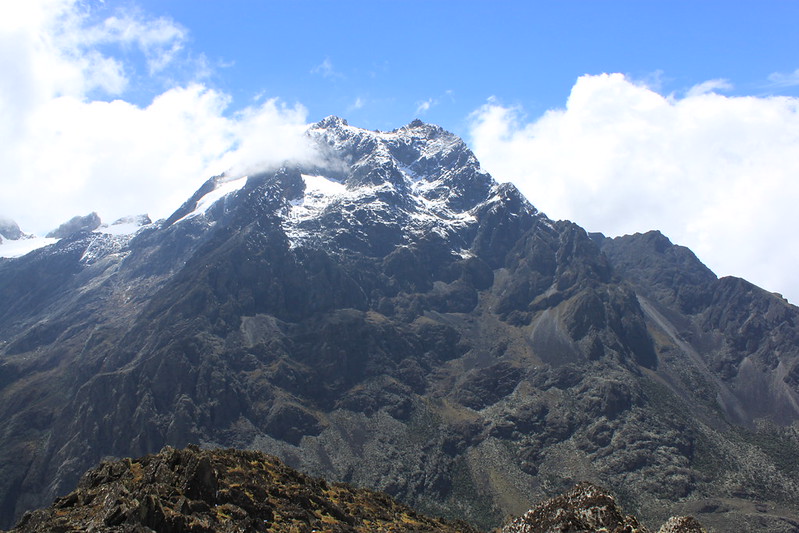 Weismann’s Peak, at 4,620 meters, is the highest point of Mount Gessi—and the summit that marks the outer reach of this 5-day Rwenzori trekking expedition from the Kilembe trailhead. It is a summit that rewards effort with perspective: from the bare rocks at the top, the twin lakes of Kitandara shimmer far below, the glaciated flanks of Mount Stanley and Mount Baker fill the northern horizon, and the distant plains of the Albertine Rift stretch away toward the Congo. This is not a view that can be purchased or curated. It must be walked to, meter by meter, through 5 of the most extraordinary ecological zones on earth.
This 5-day Rwenzori trekking itinerary follows the Kilembe Trail from the trailhead village of Kyanjuki through Afro-montane forest, bamboo groves, high heather moorland, and the surreal alpine zone of giant plants before the final ascent to Weismann’s Peak (4,620) and the long, satisfying descent that brings you back to the world below. Every guide is experienced on this specific trail. Every porter is local, properly compensated, and selected for their knowledge of the mountain’s moods. Every hut along the route has been assessed for comfort and safety. Nothing about this journey is left to chance—because at 4,620 meters, in the cloud forests of the Mountains of the Moon, chance is not a companion you want.
Expedition Overview
Feature | Details |
Destination | Rwenzori Mountains National Park, Western Uganda |
Trail | Kilembe Trail (via Sine Hut, Guy Yeoman, Kitandara Lakes, Freshfield Pass) |
Summit | Weismann’s Peak, 4,620 m (Mount Gessi Massif) |
Duration | 5 Days / 4 Nights on the mountain (+ transfer days) |
Start / End Point | Kyanjuki Village, Kilembe (1,450 m) — 12 km from Kasese Town |
Total Ascent | Approximately 3,170 m cumulative ascent |
Fitness Level | Good to high fitness required. No technical climbing. Prior multi-day trekking experience strongly recommended. |
Group Size | Solo trekkers, couples, small groups (2–12 persons). Private departures are available on any date. |
Best Season | December–February and June–August (drier windows) |
Accommodation (on mountain) | Mountain huts and wilderness camping at designated sites |
Itinerary at a Glance
- Day 1 — Kampala / Entebbe → Kasese / Kilembe | Trailhead Briefing & Overnight
- Day 2 — Kyanjuki (1,450 m) → Sine Hut (2,596 m) | Through the Afro-montane Forest
- Day 3 — Sine Hut (2,596 m) → Guy Yeoman Camp (3,505 m) | Into the Heather Zone
- Day 4 — Guy Yeoman Camp (3,505 m) → Kitandara Lakes Camp (4,023 m) | The Alpine World
- Day 5 — Kitandara Lakes (4,023 m) → Summit Weismann’s Peak (4,620 m) → Freshfield Pass (4,011 m)
- Day 6 — Freshfield Pass (4,011 m) → Nyabitaba → Kilembe | The Long Descent
- Day 7 — Kilembe / Kasese → Kampala / Entebbe | Departure or Onward Transfer
Note: Day 1 and Day 7 are transfer days and are included here as context for your full journey logistics. The five trekking days are Days 2 through 6. The itinerary can be adjusted for those beginning the trek directly from Kasese without an Entebbe or Kampala origin.
Daily Elevation Profile
Day | From | To | Gain/Loss | Duration |
Day 1 | Kyanjuki / Kilembe (1,450 m) | Sine Hut (2,596 m) | 1,146 m | ~5–6 hrs |
Day 2 | Sine Hut (2,596 m) | Guy Yeoman Camp (3,505 m) | 909 m | ~5–6 hrs |
Day 3 | Guy Yeoman Camp (3,505 m) | Kitandara Lakes Camp (4,023 m) | 518 m | ~4–5 hrs |
Day 4 | Kitandara Lakes Camp (4,023 m) | Summit Weismann’s Peak (4,620 m) → Freshfield Pass (4,011 m) | ↑597 m ↓612 m | ~7–8 hrs |
Day 5 | Freshfield Pass (4,011 m) | Nyabitaba / Kilembe (1,450 m) | ↓2,561 m | ~7–8 hrs |
How to Get to the Rwenzori Mountains
The Kilembe trailhead for the Weismann’s Peak route lies at Kyanjuki village, twelve kilometres from Kasese town in western Uganda. Kasese is the gateway town for all Kilembe Trail expeditions, and the journey there from Kampala or Entebbe is as much a part of the Rwenzori experience as the mountain itself.
By Road from Kampala or Entebbe
The drive from Kampala to Kasese covers approximately 395 kilometres via the Mbarara highway, passing through the rolling hills of central Uganda before descending into the flat plains of the Albertine Rift, with the Rwenzori range becoming gradually—then suddenly—dominant on the western horizon. The journey takes between five and six hours in your private vehicle, and you typically complete it on the day before trekking begins. Gorilla Safaris arranges all road transfers in well-maintained, fully equipped 4×4 vehicles with experienced drivers who know this route in every season.
By Domestic Flight to Kasese
Charter flights from Entebbe International Airport to Kasese Airstrip reduce the road journey to approximately one hour of flying. This option is preferred by those combining the Rwenzori trek with a safari at Queen Elizabeth National Park or a gorilla trek at Bwindi Impenetrable Forest, both of which lie within reasonable reach of Kasese. Gorilla Safaris coordinates all charter bookings and seamlessly links them with your ground arrangements.
The Kilembe Trailhead
From Kasese, your dedicated vehicle carries you the final twelve kilometers to the Trekkers’ Hostel in Kyanjuki, which serves as the official base for Kilembe Trail expeditions. Here you complete your Uganda Wildlife Authority registration, meet your private guide and porter team, and receive a final briefing on the route and mountain conditions. Equipment checks, weight distribution for porter loads, and any last-minute gear adjustments are handled with care and without rush. The mountain waits with the patience of something ten million years old. There is no need to hurry the beginning.
Day-by-Day Expedition Narrative
Arrival: The Transfer — Kampala to Kasese, the World Below
The day begins in Kampala or Entebbe, where your private vehicle and driver are ready at the agreed hour. The city falls away quickly once the western highway opens up, and the journey settles into the quiet rhythm of long-distance travel through the African interior: the tea estates of Masaka, the papyrus swamps of the lakes region, and the gradual narrowing of the sky as the western mountains begin their presence on the horizon.
Kasese arrives in the late afternoon—a town that sits in the shadow of one of the most extraordinary mountain ranges on earth with admirable matter-of-factness, as if the six-thousand-meter peaks looming to the west are simply part of the daily weather. Check in to your pre-arranged accommodation—Kasese Safari Lodge or the comfortable Trekkers’ Hostel at Kyanjuki are the standard choices, depending on your preference for town or trailhead. Your guide meets you for an evening briefing over dinner: the route, the daily distances, what the mountain has been doing lately, and what to expect when dawn comes tomorrow. Early bed. The alarm is set before the birds.
Day 1: Kyanjuki (1,450 m) to Sine Hut (2,596 m) — The Forest Welcomes You
The trek begins with the particular clarity that only very early mornings carry. By nine o’clock—ideally earlier—the Kyanjuki valley is already warm, the air carrying the thick scent of forest soil and distant water. Your guide leads the way through the last fields of Kyanjuki village, where local children watch the departing trekkers with an accustomed curiosity, and the trail tips upward into the Afro-montane forest that covers the lower flanks of the Rwenzori.
The first two kilometers to the Uganda Wildlife Authority ranger post at 1,727 meters takes approximately one hour—a gradual warm-up through tall forest where the tree canopy closes overhead and the noise of the world below retreats. The rangers complete the formalities efficiently, and the real climb begins: a sustained, rewarding ascent through a forest of extraordinary biological richness. Blue monkeys alarm call from the branches above. Black-and-white colobus, sometimes in troops of fifteen to twenty animals, swing through the canopy in spectacular display. The rare L’Hoest monkey—sacred in the culture of the Bakonzo people as an emblem of the Omusinga, their traditional king—appears occasionally at the forest edge with a dignified diffidence.
Moss and lichen hang in long curtains from the branches, filtering the light into something green and soft. Bamboo thickets appear on the steeper sections, their hollow joints clicking in the breeze. Fungi in improbable colours carpet the exposed roots. Enock’s Falls—heard before seen—announces the approach to Sine Hut with a clean, cold sound that is entirely welcome after five hours of climbing.
Sine Hut sits at 2,596 meters on a narrow ridge between tall forest trees, a wooden structure of genuine mountain practicality that somehow manages to feel like shelter in the fullest sense of the word. The falls are two hundred meters away. The valley drops away below. The first day’s 1,146 meters of ascent sits satisfyingly in the legs, and dinner—prepared by your cook from provisions carried by the porter team — is eaten with the appetite that mountains produce. Sleep comes easily here, at the edge of the alpine world.
Day 2: Sine Hut (2,596 m) to Guy Yeoman Camp (3,505 m) — The Bog and the Heather
The forest at Sine Hut is still dark when the day begins. Morning tea arrives at the hut with the punctuality that good mountain guides understand as essential. The trail descends briefly from Sine into the valley below — a counterintuitive beginning that takes some mental adjustment — before reaching the Kichuchu Bridge, where the Mubuku River runs cold and fast beneath a wooden crossing draped in mist.
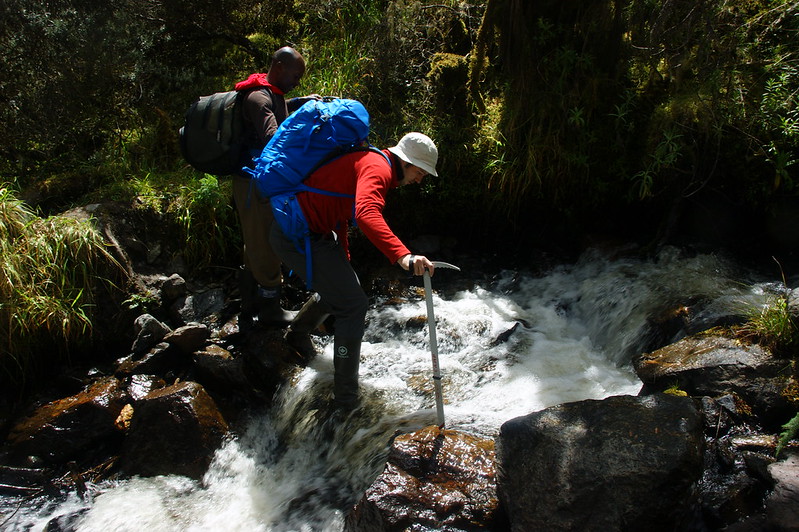
Beyond Kichuchu, the character of the Rwenzori reveals itself with increasing drama. The bamboo forest gives way to something stranger: a zone of giant heather where the plants that most of the world knows as small moorland shrubs grow here to the height of three meters, their branches coated in white lichen, their forms bent into the shape of years of wind and cloud. The trail works through this heather zone with increasing difficulty — not in terms of technical challenge, but in terms of terrain. The bog arrives. The Rwenzori bog is, among trekking circles, something of a legend: cold, dark, deep in places, and virtually unavoidable. The best footwear and the most experienced guide cannot guarantee dry feet here. What they can guarantee is that the bog is crossed with as much dignity as the mountain permits, which is frequently not very much.
The Portal Peaks—elegant rock towers visible from the Kichuchu rock shelter—frame the view to the north. Then the bog gives way to the upper heather and groundsel zone, and Guy Yeoman Camp appears on the slope ahead: a collection of huts at 3,505 meters positioned to capture, on clear evenings, the extraordinary sight of Mount Baker’s southern face catching the last light. Dinner at Guy Yeoman is a different kind of meal from Sine—quieter, more considered, eaten in the knowledge that the alpine world has now fully arrived. The temperature drops with authority after dark. Sleeping bags earn their specifications tonight.
Day 3: Guy Yeoman Camp (3,505 m) to Kitandara Lakes Camp (4,023 m) — Into the Alpine
The trail from Guy Yeoman drops to cross the Mubuku River at Bujongolo Rock Shelter—a geological overhang that sheltered the Italian expedition of 1906, one of the earliest comprehensive surveys of the Rwenzori range. The historical weight of the place is palpable in the quiet, the shelter walls darkened by decades of campfire smoke, the rock worn smooth by the hands of those who rested here before you.
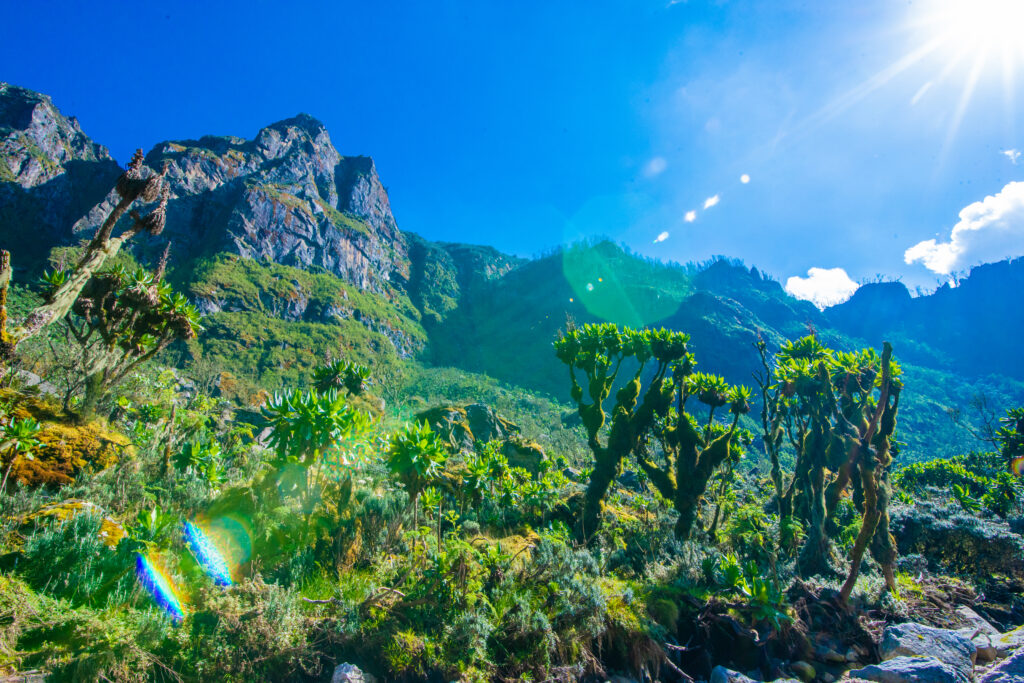
Beyond Bujongolo, the mountain opens. The vegetation shifts again—groundsel now, the extraordinary giant Senecio that the Rwenzori specializes in, their cabbage-like rosettes on tall, cork-barked trunks creating a simultaneously familiar landscape and entirely alien. The trail ascends steeply through tussock grass and bog, crosses the lower Freshfield Pass, and then follows a long descending traverse to the Kitandara Lakes.
The lakes appear below with the sudden drama of great natural features: two high-altitude bodies of water at 4,023 meters, their surfaces the color of pewter under the afternoon cloud, their shores fringed with lobelia and sedge. The view from the trail as you approach—Mount Stanley to the north, Mount Baker to the east, Weismann’s Peak rising above the south wall of the valley, and the lakes themselves in the foreground—is the kind of composition that photographers travel specifically to capture. Kitandara Lakes Camp, positioned on a rise above the water, is the expedition’s most dramatically sited overnight stop. The huts here are simple and wind-tested. The silence, once the porters have settled and the cooking fire is lit, is the particular silence of high altitudes: complete, uninterrupted, ancient.
Day 4: Kitandara Lakes (4,023 m) → Summit Weismann’s Peak (4,620 m) → Freshfield Pass (4,011 m) — The Summit
This day is the day the mountain demands its full attention. An early departure from Kitandara—in the pre-dawn dark, headtorches lighting the trail, breath visible in the cold air—follows the south shore of the upper lake before the route ascends steeply through the magical groundsel gully, where the giant senecios line the path like sentinels, their forms made stranger still in the torchlight.
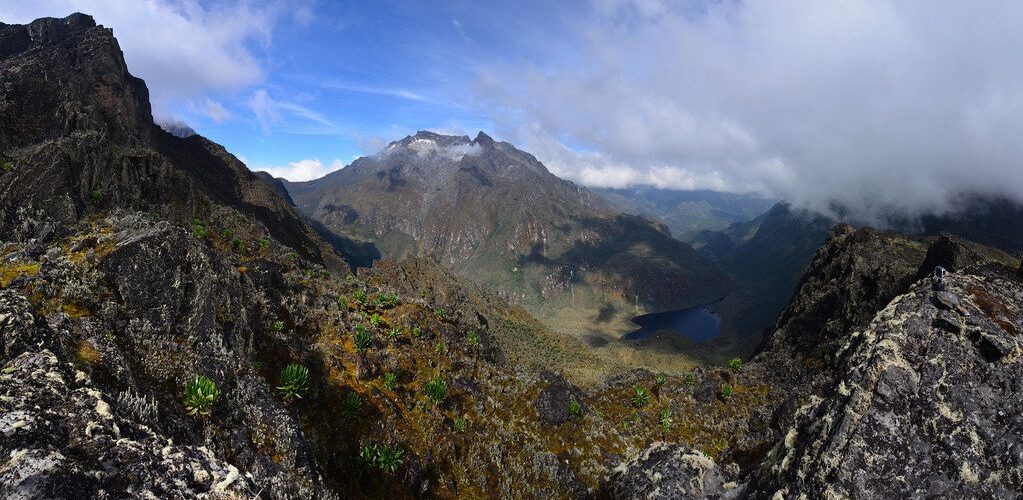
The route climbs through the bog above Kitandara, traversing to the south side of the lake and gaining height steadily through exposed rock and tussock before the gradient eases briefly and the bare upper slopes of Weismann’s Peak come into view. The final approach to the summit requires careful route-finding in poor visibility—which is why your private guide, with genuine experience on this specific mountain, is not merely a comfort but an essential safety asset.
At 4,620 meters, Weismann’s Peak delivers. On clear mornings—and the Rwenzori offers them occasionally, characteristically, and without warning—the view encompasses the entire central Rwenzori: the glaciers of Margherita Peak on Mount Stanley, the rock buttresses of Mount Baker, the Kitandara twin lakes laid out below like mirrors in the valley floor, and the green plains of the Congo visible at the western horizon. The summit certificate is earned here, in the cold and the altitude and the absolute privilege of standing on one of central Africa’s most remote high points.
The descent returns via the Freshfield Pass—a wilderness camping site at 4,011 meters where the evening’s accommodation is established while the summit team is still on the mountain. The pass itself offers panoramic views across both the Ugandan and Congo sides of the range, and the camp here has the quality of a truly remote night—no settlements visible, no sound but wind and the distant movement of wildlife in the heather below. The evening meal is the most earned of the five nights, and the sleep that follows it is the deepest.
Day 5: Freshfield Pass (4,011 m) to Nyabitaba to Kilembe — The Long Descent
The final day on the mountain is one of the longest in terms of distance, but the descent carries its own reward: the forest comes back, level by level, with increasing warmth and complexity. The route drops from Freshfield Pass through Guy Yeoman — where a brief rest and the last of the altitude food can be consumed — then the long traverse to Kichuchu and the final descent through the bamboo and Afro-montane zones to Nyabitaba or, if the pace and energy permit, all the way to Nyakalengija and Kilembe in a single push.
The Kilembe valley, receiving you back after five days on the mountain, feels extraordinarily sensory. The warmth is physical. The smell of vegetation and soil at lower altitude, after days of cold and rock and heather, is one of those stimuli that arrives with unexpected intensity. Hot showers at the Trekkers’ Hostel are not an indulgence; they are a ceremony. Your guide arranges the return of hired equipment, settles the porter accounts, and ensures that every member of the team is properly compensated. The mountain has been climbed. The descent is complete. The private vehicle north or south is arranged, waiting.
Departure: Kilembe / Kasese to Kampala — The Return
The return transfer from Kasese to Kampala or Entebbe follows the same western highway that brought you west, but everything looks different from the return direction—partly the light, partly the direction of travel, and mostly the simple alteration in perspective that five days at altitude produces. Trekkers who have climbed Weismann’s Peak tend to be quiet on the drive home, not from exhaustion but from the particular introspection that genuine physical achievement produces.
Those continuing their Uganda journey — to gorilla trekking at Bwindi Impenetrable Forest, to the wildlife of Queen Elizabeth National Park, or to the crater lakes of Fort Portal — transfer directly from Kasese the next morning, leaving Rwenzori behind them and the next chapter of Uganda already beginning.
The Five Vegetation Zones of the Rwenzori
Part of what makes the Weismann’s Peak route so compelling for trekkers and naturalists alike is the sequential trail through five distinct ecological zones, each with its own character, its own plant communities, and its own atmospheric quality. To trek the Rwenzori is, in botanical terms, to climb through five different worlds.
Zone 1: Afro-montane Forest (1,450 – 2,500 m)
The lower flanks of the Kilembe Trail are clothed in dense montane forest where podocarpus, hagenia, and hypericum trees grow to considerable height, their branches wreathed in moss and lichen. This is the zone of blue monkeys, colobus, and an extraordinary variety of forest birds, including the Rwenzori turaco, whose crimson wings flash suddenly through the green. The forest floor is dark and cool, and the trail rises through it with a pleasant, sustained gradient that serves as the body’s introduction to what lies above.
Zone 2: Bamboo and Hagenia Forest (2,500 – 3,000 m)
Above the Afro-montane forest, bamboo appears in dense thickets that line the trail on both sides, their hollow stems clicking in the wind. The Hagenia tree—ancient, gnarled, covered in beard-like lichen—dominates the upper sections of this zone, creating an atmosphere of deep time and botanical strangeness. Giant tree ferns appear here, their fronds unfurling to several meters, and the ground is carpeted in moss so thick it springs underfoot.
Zone 3: Giant Heather and Moss (3,000 – 3,500 m)
The heather zone is where the Rwenzori begins its most distinctive performance. Erica arborea and related species grow here to heights of three meters and beyond, their white lichen-covered branches creating a tunnel of strange beauty along the trail. The bog dominates. The mist arrives early and lingers late. Orchids and everlastings appear among the heather roots, adding unexpected delicacy to the rough terrain. This is the zone most likely to test both patience and waterproofing.
Zone 4: Giant Lobelia and Groundsel (3,500 – 4,300 m)
The alpine zone above the heather is the Rwenzori’s signature landscape: the world of the giant lobelia and giant groundsel (Senecio), plants that grow here to scales that feel improbable. Dendrosenecio johnstonii, the giant groundsel, reaches four to five meters in height, its cabbage rosette perched atop a thick, cork-barked trunk. Giant lobelias stand like candelabra beside the trail, their blue-grey flower spikes surrounded by water-retaining leaf bracts. To walk through this zone is to understand why early explorers described the Rwenzori as otherworldly.
Zone 5: Afro-alpine Rock and Ice (above 4,300 m)
Above the vegetation, the mountain becomes rock and, on the highest peaks, permanent glacier ice. The bare upper slopes of Weismann’s Peak are this zone in concentrated form: exposed rock, sparse cushion plants in the sheltered crevices, the absolute clarity of altitude where the air is thinner and the sky is a shade of blue that exists nowhere lower. The summit experience here is inseparable from this landscape — stark, exposed, magnificent, and profoundly deserved.
The Six Massifs of the Rwenzori Mountains
The Rwenzori range is composed of six major massifs, each with multiple peaks, each with its own character and significance in the geology and ecology of the range. The five-day Weismann’s Peak route passes within sight of several of these massifs, and understanding them adds a dimension of geography to the trekking experience.
Mount Stanley — The Roof of Uganda (5,109 m)
The highest massif in the range and the third highest in Africa, Mount Stanley carries the glaciated summit of Margherita Peak at 5,109 metres — the highest point in Uganda and the Democratic Republic of Congo simultaneously. The peak is visible from several points on the Weismann’s route, its ice-capped crown emerging above the cloud on clear mornings. The full Margherita Peak expedition from the Kilembe trailhead requires eight to ten days and basic mountaineering skill.
Mount Speke (4,890 m)
Named after the British explorer John Hanning Speke, who was the first European to identify Lake Victoria as the source of the Nile, Mount Speke is the second highest massif in the Rwenzori with its summit Vittorio Emanuele Peak at 4,890 metres. Its flanks are visible from the upper sections of the Kilembe Trail.
Mount Baker (4,843 m)
Named for Sir Samuel Baker, Mount Baker’s dramatic southern face is the dominant visual presence from Guy Yeoman Camp and the Kitandara Lakes area. Its twin summits — Edward Peak and Semper Peak — are a defining feature of the mid-altitude panorama on the Weismann’s route and are achievable as an extension for strong trekking parties with additional days.
Mount Gessi (4,715 m) — Home of Weismann’s Peak
Weismann’s Peak at 4,620 metres is the lower of Mount Gessi’s two summits (Iolanda Peak, at 4,715 m, is the higher). The five-day Kilembe route targets Weismann’s Peak as its summit objective, making Mount Gessi the centrepiece of this particular expedition. Gessi was named for Romolo Gessi, an Italian explorer who circumnavigated Lake Albert in the 1870s.
Mount Emin (4,798 m)
Named for Eduard Schnitzer, known as Emin Pasha, this massif lies to the south of the main trekking routes and requires a more extended expedition to visit. Its slopes are rarely visited, which gives it the quality of genuine remoteness that appeals to experienced Rwenzori mountaineers.
Mount Luigi di Savoia (4,627 m)
Named for Prince Luigi Amedeo of Savoia, who led the landmark 1906 Italian expedition that first comprehensively mapped the Rwenzori, this massif was the most thoroughly documented of the range during that historic expedition. Its lower summit Sella Peak sits at 4,627 metres — marginally higher than Weismann’s Peak — and requires a separate route from the central circuit.
Best Time to Trek Weismann’s Peak
The Rwenzori Mountains carry an honest reputation for rainfall. The range sits in a position on the western Ugandan border that catches moisture from both the Congo Basin and the East African weather systems, and the result is a range that is wet for much of the year. This is precisely what has created the extraordinary botanical world of the mountain — but it also means that timing your trek thoughtfully matters considerably.
Best Season: June to August
The period from June through August represents the most reliably drier window for Rwenzori trekking. Summit days see a higher proportion of clear mornings, the bog sections are at their most manageable, and the photographic conditions in the alpine zones are at their best. This is peak season, and advance planning is essential for porter and guide availability. The trade-off — lighter than expected at a mountain this extraordinary — is that the Rwenzori remains far less crowded than comparable trekking destinations in East Africa even in its busiest months.
Second Season: December to February
The December to February window offers the second-most reliable dry period on the Rwenzori. Days are warm by mountain standards, the vegetation is green but not waterlogged, and the summit views on clear mornings are exceptional. Christmas and New Year expeditions require early booking. January and February often offer the best overall combination of conditions and availability.
The Wet Seasons: March–May and September–November
The long rains from March through May and the shorter rains of September through November bring heavier precipitation and more challenging conditions on the mountain. The bog deepens considerably, the heather zone becomes genuinely waterlogged, and summit views are more likely to be cloud-obscured. The mountain is still trekked during these periods — the Rwenzori is always beautiful, regardless of condition — but the effort-to-reward ratio is more demanding. Gorilla Safaris provides current mountain condition updates for all confirmed bookings and will advise on any forecast-related adjustments to departure timing.
Attractions on and Around the Rwenzori
Wildlife on the Kilembe Trail
The lower forest sections of the Kilembe Trail are among the more productive primate habitats in western Uganda. Black-and-white colobus in troops of fifteen to twenty individuals are regularly encountered in the canopy above the trail. Blue monkeys call from the undergrowth. The L’Hoest monkey, culturally significant to the Bakonzo people of the Rwenzori foothills, makes occasional appearances at the forest edge. Chimpanzees have been heard — and occasionally seen — in the deep forest above Kyanjuki. In the alpine zone, the Rwenzori duiker and the Rwenzori otter are present but rarely observed, moving with a discretion appropriate to their environment.
Rwenzori Birds — Over 200 Species
The Rwenzori Mountains host a bird community of outstanding significance, with over 200 species recorded within the park. Many are Albertine Rift endemics — species found nowhere else on earth. The Rwenzori turaco, with its crimson wing patches and emerald body, is the star. The handsome francolin, the strange-tailed widowbird, and the African green broadbill are among the forest specialities. In the alpine zone, the scarlet-tufted malachite sunbird feeds from lobelia flowers at 4,000 metres with a nonchalance that seems poorly suited to the conditions.
Kitandara Lakes
The twin lakes of Kitandara at 4,023 metres are among the most beautiful bodies of water in East Africa — not for their scale, which is modest, but for their setting. Surrounded by giant lobelia and groundsel, reflected by the slopes of Mount Stanley and Baker, and utterly silent in the early morning, these lakes represent the Rwenzori’s alpine world at its most serene. Swimming is cold in the extreme but remembered fondly.
Enock’s Falls
Located two hundred meters from Sine Hut, Enock’s Falls is a clean, accessible waterfall on Day 2 of the trek—a natural landmark that serves as both a photographic opportunity and a marker of progress. The sound of the falls carries for some distance before the source comes into view, and the mist from the drop keeps the surrounding vegetation in a permanent state of luminous freshness.
Fort Portal and the Crater Lakes
Trekkers returning from the Rwenzori who have additional days in western Uganda frequently extend to Fort Portal, a highland town of considerable charm situated ninety minutes north of Kasese. The Ndali-Kasenda Crater Lakes — a chain of deep, green-walled volcanic lakes in the hills above Fort Portal — make for a beautiful and restorative afternoon after the intensity of high-altitude trekking. Fort Portal is also the gateway to Kibale Forest National Park and its renowned chimpanzee tracking programme.
What to Pack: Gear for the Rwenzori
The Rwenzori is a mountain that takes gear seriously. The combination of rain, bog, cold, altitude, and the sustained physical demand of five days of trekking means that preparation is not optional — it is the difference between a transcendent experience and a miserable one. The following guidance reflects the specific requirements of the Kilembe Trail to Weismann’s Peak and the experience of many seasons on this particular mountain.
Waterproofing — Non-Negotiable
A high-quality, fully seam-sealed waterproof jacket and waterproof trousers are the most important items you will carry. Gore-Tex or equivalent membrane technology is the standard; anything less will not hold against sustained Rwenzori rainfall. Waterproof gaiters — either knee-length or thigh-length for the bog sections — protect your boots and lower trousers from the worst of the mire. Waterproof gloves and a waterproof hat cover are equally important. Every item in your pack should be stored in waterproof stuff sacks or dry bags within your main pack.
Footwear
Mid-weight or heavyweight hiking boots with full ankle support and a sticky rubber sole are the correct choice for the Kilembe Trail. Waterproofing (Gore-Tex lining) is strongly recommended. The bog sections and the exposed rocky upper sections above Kitandara both require a boot with reliable grip and lateral stability. Break in your boots thoroughly before the trek — new boots on the Rwenzori produce blisters with remarkable efficiency. Lightweight camp shoes or sandals provide essential relief at the huts in the evenings.
Layering System
The temperature range across the five days spans from tropical warmth at the Kilembe trailhead to near-freezing conditions at Freshfield Pass. A properly considered layering system—moisture-wicking base layer, insulating mid-layer (fleece or down jacket), and waterproof outer shell—handles this range without requiring excessive bulk. Down jackets compress well and are the preferred insulation for summit day and the cold evenings at Kitandara and Freshfield. A warm hat and buff neck gaiter address the heat loss from exposed skin at altitude.
Sleeping Equipment
A sleeping bag rated to minus-five degrees Celsius (-5°C) is the minimum appropriate specification for the Weismann’s Peak route. The nights at Kitandara (4,023 m) and Freshfield Pass (4,011 m) are genuinely cold, and a sleeping bag that is merely adequate at sea level will prove insufficient at altitude. A sleeping bag liner adds several degrees of warmth and can be used alone at the lower huts where temperatures are milder. A compact sleeping mat is provided at the mountain huts, but a lightweight foam sit mat for rest stops on the trail is a personal comfort worth carrying.
Trekking Poles
Adjustable trekking poles are strongly recommended for the Rwenzori, particularly for the descent sections and the bog crossings where stability is periodically critical. The poles distribute effort across the upper body during ascent and significantly reduce knee load on long descents. Rubber tips rather than metal points perform better on the wooden boardwalks and rock sections of the trail.
Other Essentials
High-SPF sunscreen and UV-protective sunglasses are required for the upper alpine zones where UV exposure at altitude is considerable. A headtorch with spare batteries is essential for the summit day early start and for navigating hut interiors at night. A lightweight first aid kit should include altitude sickness medication (discuss Diamox with a travel health clinic before departure), blister treatment, rehydration sachets, and anti-inflammatory analgesics. A camera with a telephoto lens captures the wildlife of the lower forest; a wide-angle lens serves the alpine landscapes. Portable power banks and solar chargers are useful but remember: the mountain does not have electricity, and the weight of devices adds up on steep terrain.
What’s Included in Your Weismann’s Peak Expedition
A Gorilla Safaris Rwenzori expedition is designed to remove every logistical decision from your shoulders before the trek begins. By the time you step onto the trail at Kyanjuki, every element of the following five days has been confirmed, paid, and arranged:
- All Uganda Wildlife Authority park entrance fees for the duration of your trek
- Certified Rwenzori mountain guide (private, English-speaking, experienced on the Kilembe Trail)
- Personal porter for your trekking pack (up to 15 kg carried on your behalf)
- Cook for all mountain meals — breakfast, packed lunch, and hot dinner at each overnight camp
- All food and provisions for the five trekking days on the mountain
- Accommodation in mountain huts at Sine, Guy Yeoman, Kitandara, and Freshfield Pass
- Equipment duffel bag for porter loads and dry storage on the mountain
- Private road transfer Kampala/Entebbe to Kasese/Kilembe (return)
- Pre-trek accommodation at Trekkers’ Hostel or Kasese Safari Lodge (Night 0)
- Post-trek hot shower and refreshments at Kilembe
- All rescue fund contributions and mandatory mountain safety levies
- Gorilla Safaris 24/7 emergency support throughout the expedition
What’s Not Included
The following items are outside the standard expedition package and should be budgeted for separately:
- International flights to and from Uganda
- Uganda tourist visa (USD 50 per person, available online or on arrival for most nationalities)
- Comprehensive travel and medical evacuation insurance (required — the mountain demands it)
- Hired trekking equipment (waterproof jacket, sleeping bag, poles, gaiters — available for hire at Kilembe for those without their own)
- Personal snacks, energy bars, and hydration supplements for the trail
- Alcoholic beverages throughout the expedition
- Gratuities for guides, porters, and cook (warmly appreciated and a meaningful contribution to local livelihoods)
- Any medical expenses including altitude sickness treatment
- Optional extensions: gorilla trekking permit at Bwindi, chimpanzee tracking at Kibale, Queen Elizabeth safari additions
Related Rwenzori Mountain Trekking Itineraries
The Weismann’s Peak expedition sits within a broader family of Rwenzori trekking programs, each calibrated to different ambitions, fitness levels, and available time. Gorilla Safaris designs and operates the full range:
3-Day Samalira Falls Trek: An accessible introduction to the Rwenzori for trekkers with limited time, reaching the spectacular Samalira Falls on the lower mountain through dense Afro-montane forest. No high-altitude camping.
4-Day Mutinda Lookout / Waterfalls Circuit: A more demanding short option that reaches the Mutinda Lookout or completes a circuit of the lower waterfall zone, suitable for fit trekkers who want a taste of the heather zone without the commitment of a full summit expedition.
5-Day Weismann’s Peak (This Trekking Itinerary): The optimal balance of ambition and accessibility on the Kilembe Trail — reaching a significant summit with views of the entire central Rwenzori in five days.
7-Day Mount Baker & Weismann’s: An extended expedition that combines the Weismann’s Peak summit with an ascent of Mount Baker’s Edward Peak, providing a comprehensive experience of the range’s central massifs and two glacier-adjacent summits.
8-Day Margherita Peak Expedition: The flagship Rwenzori expedition — the ascent of Margherita Peak at 5,109 meters, requiring crampons, ice axe, and a guide with glacial terrain experience. Uganda’s highest achievable summit. See our Rwenzori Mountain strekking page for full details.
10-Day Four High Peaks of the Rwenzori: The grand traverse of the range, combining four of the highest summits across a ten-day expedition for serious mountaineers seeking the full Rwenzori experience.
Many trekkers combine a Rwenzori expedition with gorilla trekking at Bwindi Impenetrable Forest for a Uganda journey that balances extreme wilderness with the intimacy of a mountain gorilla encounter. The two experiences are separated by approximately three hours of road travel from Kasese to Bwindi—seamlessly connected within a single Gorilla Safaris itinerary.
Frequently Asked Questions — 5-Day Rwenzori Trekking to Weismann’s Peak
What is Weismann’s Peak and how high is it?
Weismann’s Peak stands at 4,620 metres above sea level and is the lower of two summits on Mount Gessi, one of the six major massifs of the Rwenzori Mountains in western Uganda. It is the highest point reached on the standard five-day Kilembe Trail expedition and offers panoramic views across the central Rwenzori, including the glaciated summits of Mount Stanley and Mount Baker, the twin Kitandara Lakes below, and on clear days, the plains extending toward the Congo. The peak is named in honor of August Weismann, a German evolutionary biologist, during the nomenclature of the range’s features in the early twentieth century.
How difficult is the 5-day Rwenzori trek to Weismann’s Peak?
The 5-day Rwenzori trek to Weismann’s Peak is rated as moderately strenuous to challenging. No technical climbing is required — the route is a trekking expedition rather than a mountaineering one — but the daily elevation gains are significant, the terrain is frequently wet and boggy, and the altitude at the summit (4,620 m) places a meaningful physiological demand on the body. Trekkers should be in good aerobic fitness with prior experience of multi-day hiking at altitude. Day 5, the summit day, is the most demanding both in terms of gradient and the early pre-dawn start required to maximise chances of clear summit conditions.
What is the Kilembe Trail and how does it differ from the Central Circuit?
The Kilembe Trail is one of the two main trekking routes through Rwenzori Mountains National Park. It begins at Kyanjuki village near Kilembe, twelve kilometres from Kasese town, and follows the Mubuku River valley through the lower forest before ascending via Sine Hut, Guy Yeoman Camp, and Kitandara Lakes to the upper mountain. The trail is generally considered more remote and slightly more challenging than the Central Circuit (which begins from Nyakalengija near Ibanda gate), with fewer trekkers on the route at any given time. The Kilembe Trail is the preferred starting point for the five-day Weismann’s Peak expedition and was fully upgraded following the 2016 national park restoration programme.
What are the mountain huts like on the Kilembe Trail?
The mountain huts on the Kilembe Trail — at Sine Hut, Guy Yeoman Camp, and Kitandara Lakes Camp — are wooden structures with sleeping platforms, basic kitchen facilities, and covered areas for cooking and eating. They are not luxury accommodation by any measure, but they are solid, weather-resistant, and deeply welcome after each day of trekking. Sleeping mats are available at the huts, though a personal sleeping bag of appropriate warmth rating is essential. At Freshfield Pass, accommodation is wilderness camping — tents are pitched by the porter team at the designated site. The huts are maintained under Uganda Wildlife Authority oversight and are regularly assessed for safety.
Do I need a guide for the Rwenzori Kilembe Trail?
A certified mountain guide is mandatory for all trekking within Rwenzori Mountains National Park, and this requirement is enforced at the park gate. Beyond the legal requirement, a guide is an essential safety asset on a route that includes route-finding through the bog, weather assessment in a range known for rapid condition changes, and first response knowledge in the event of altitude-related medical issues. The guides provided by Gorilla Safaris are experienced specifically on the Kilembe Trail and have detailed knowledge of the mountain’s terrain, weather patterns, and wildlife.
What is the altitude sickness risk on the Weismann’s Peak route?
Altitude sickness is a genuine consideration on the five-day Weismann’s Peak route, which reaches 4,620 meters at its highest point. The itinerary is designed with appropriate acclimatization in mind—the daily elevation gains are moderate enough to allow the body to adjust incrementally—but individual responses to altitude vary significantly regardless of fitness level. Symptoms of mild acute mountain sickness (headache, nausea, fatigue, disturbed sleep) are common above 3,500 meters. Gorilla Safaris strongly recommends consulting a travel health clinic before departure to discuss the prophylactic use of Acetazolamide (Diamox) and to understand the signs and appropriate responses to altitude illness. Guides are trained to recognise symptoms and will descend with any trekker showing serious signs of altitude-related distress.
Can I hire trekking equipment at Kilembe?
A range of basic trekking equipment — including waterproof jackets, sleeping bags, trekking poles, gaiters, and rain trousers — is available for hire at the Trekkers’ Hostel in Kyanjuki, Kilembe. The quality and condition of hired equipment varies, and Gorilla Safaris recommends bringing personal waterproofing (jacket and trousers) as a non-negotiable item regardless of what is available for hire, given the Rwenzori’s rainfall characteristics. Sleeping bags for hire are available but should be supplemented with a personal liner for the colder high-altitude nights.
How do I get to Kilembe from Kampala?
Kilembe is located twelve kilometers from Kasese town in western Uganda, and the transfer from Kampala covers approximately 395 kilometers via the western highway through Masindi and Mbarara, taking between five and six hours in a private vehicle. Gorilla Safaris arranges all road transfers in well-maintained 4×4 safari vehicles as part of the expedition package. Charter flights from Entebbe to Kasese Airstrip are also available for those who prefer to minimize road time, reducing the journey to approximately one hour of flying.
What wildlife might I see on the 5-day Rwenzori trek?
The lower forest sections of the Kilembe Trail offer the best wildlife viewing on the route. Black-and-white colobus monkeys in troops of fifteen to twenty individuals are regularly encountered in the canopy above the trail. Blue monkeys and the culturally significant L’Hoest monkey are also present. Chimpanzees inhabit the deep forest above Kyanjuki and are occasionally heard. The Rwenzori turaco — a spectacular bird with crimson wings — is among the most commonly seen avian species in the montane forest zone. In the alpine zone above 4,000 metres, the scarlet-tufted malachite sunbird feeds from giant lobelia flowers in a setting that seems incompatible with life of any kind. The Rwenzori duiker and Rwenzori otter are present in the park but rarely observed.
Can I combine the Rwenzori trek with gorilla trekking at Bwindi?
Combining the Rwenzori Weismann’s Peak expedition with mountain gorilla trekking at Bwindi Impenetrable Forest is one of the most compelling Uganda safari combinations available. The two destinations are separated by approximately three hours of driving from Kasese to Bwindi, making a direct transfer entirely practical at the end of the trekking program. Gorilla Safaris designs combined Rwenzori-and-Bwindi itineraries as a standard offering, handling the gorilla trekking permit arrangement, all accommodation reservations, and the seamless transfer between the two locations. Many guests add Queen Elizabeth National Park or a chimpanzee tracking day at Kibale Forest to create a comprehensive western Uganda circuit.
How many porters will I have on the Rwenzori trek?
Each trekker on a Gorilla Safaris Rwenzori expedition is assigned one personal porter who carries the trekking pack (up to 15 kilograms) for the duration of the five days on the mountain. Additional porters carry the cooking and camp equipment and the guide’s equipment. For groups, the ratio of porters to trekkers typically runs at approximately two porters per trekker when group equipment is included. The Rwenzori porters are local Bakonzo people with exceptional knowledge of the mountain and an extraordinary capacity for carrying heavy loads on challenging terrain. They are compensated fairly and in accordance with the guidelines established by the Uganda Wildlife Authority and the local porter welfare initiative supported by Gorilla Safaris.
What should I eat and drink on the Rwenzori trek?
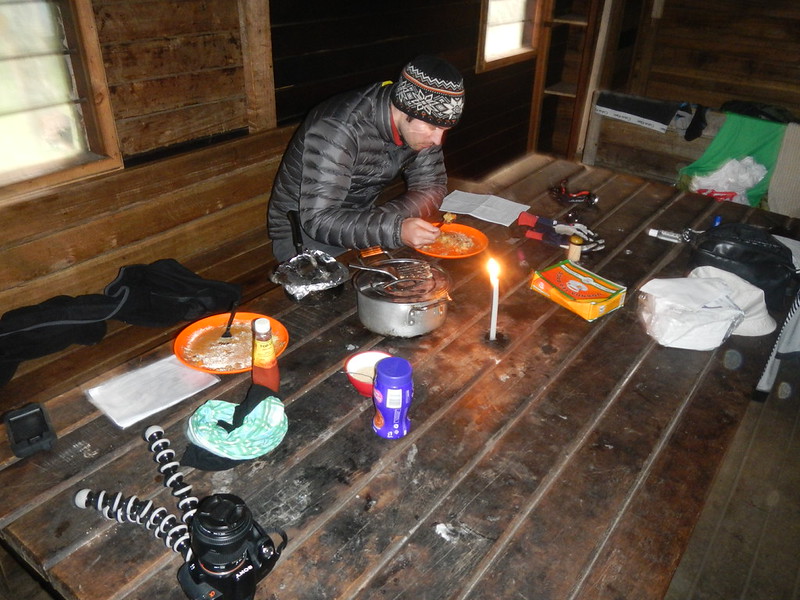
All meals on the mountain are prepared by your dedicated cook from provisions carried by the porter team. Breakfasts are typically hot — porridge, eggs, chapati, or maize-based dishes — and substantial enough for the climbing day ahead. Packed lunches are carried on the trail and consumed at suitable rest points. Evening dinners are hot, generous, and varied within the constraints of mountain cooking: rice, pasta, vegetables, beans, lentils, and protein carried from the valley below. Hot drinks—tea, coffee, hot chocolate—are available at all overnight camps and are an essential comfort in the cold evenings at altitude. Drinking water is sourced from mountain streams and purified; additional hydration tablets or a personal filter bottle provide extra reassurance.