Two Mountains. One Trail. Seven Days on the Southern Rwenzori.
There is a view from Mutinda Lookout at 3,975 meters that the Kilembe Trail keeps in reserve for those who have earned the altitude to reach it. To the north, Mount Baker’s Edward Peak rises in a mass of dark rock and ice, the fourth highest summit in the Rwenzori range, its Semper and Edward Glaciers visible in the morning light as white patches on the upper massif. To the northeast, the distinctive rocky profile of Weismann’s Peak on Mount Luigi di Savoia marks the southern end of the range’s formidable spine. Two mountains. Both accessible from the same trail. Both are achievable on a single 7-day Mount Baker (Edward Peak) & Weismann’s Peak Rwenzori Trek. And both, from this specific viewpoint, appear not as distant objectives but as near, attainable things that the remaining days of the trek will systematically approach.
The 7-day Mount Baker and Weismann’s Peak expedition via the Kilembe Trail is a compressed, demanding, and deeply rewarding dual-summit Rwenzori trekking expedition on the Rwenzori’s wildest approach route. The Kilembe Trail enters the mountain from the southwest, through the former copper-mining valley below Kasese, and it climbs with the directness of a route that does not indulge in scenic diversions when there is altitude to gain. The trail is less frequented than the Central Circuit trail, the huts are more remote, and the landscape above the bamboo zone has a quality of raw, unmanaged wilderness that distinguishes it immediately from the northern approaches.
The 7-day Rwenzori Trek to Edward Peak on Mount Baker & Weismann’s Peak achieves both summits in a program that is direct and purposeful rather than leisurely. There is no dedicated acclimatization day in this schedule: the altitude progression from Sine Hut through Mutinda to Hunwick’s Camp and Lake Kopello provides a measured approach that serves as the acclimatization strategy, along with the Mutinda Lookout ascent on Day 3 as the trekking expedition’s acclimatization stimulus.
For trekkers whose ambition extends beyond Baker and Weismann’s to Africa’s third highest summit, the 8-day Rwenzori Trek to Margherita Peak via Kilembe Trail continues the Kilembe approach to Mount Stanley. But for those who want the southern Rwenzori’s two finest non-glaciated summits in a single, committed week of mountain trekking, this program delivers exactly that.
Trek Overview—7 Days Mount Baker & Weismann’s Peak
The 7-Day Mount Baker and Weismann’s Peak Trek Expedition via the Kilembe Trail is a point-to-point traverse of the southern Rwenzori massif, ascending from the Kilembe trailhead below Kasese at 1,586 meters and climbing through the Kilembe Trail’s full vegetation sequence before the dual summit days on Days 6 and 7, followed by the descent to the trailhead on Day 7’s afternoon or Day 8’s morning, depending on summit timing.
The 7-day Mount Baker & Weismann’s Peak Trek’s hut sequence follows the Kilembe corridor: Sine Hut at 2,596 meters, Mutinda Camp at 3,688 meters, Hunwick’s Camp at 3,927 meters, and Lake Kopello Camp at 4,190 meters. Edward Peak on Mount Baker at 4,843 meters is the Day 6 objective. Weismann’s Peak on Mount Luigi di Savoia at 4,620 meters is the Day 7 Rwenzori trekking expedition objective, with descent to the trailhead on the same day or the following morning. The total altitude gain from the trailhead to the higher summit is 3,257 meters.
The 7-day Rwenzori Trek to Mount Baker & Weismann’s Peak includes a private certified mountain guide, a personal porter carrying your main load of up to 15 kilograms, and an armed Uganda Wildlife Authority ranger escort. Your package includes all park entrance and hut fees, mountain meals and hot drinks, and private vehicle transfers between Kasese and the Kilembe trailhead. Pre- and post-trek accommodation in Kasese is arranged as part of your Rwenzori trekking expedition program.
Itinerary at a Glance
- Kasese | Transfer to Kilembe | Registration | Kilembe to Sine Hut (2,596m)
- Sine Hut | Bamboo Zone | Kalalama Camp | Mutinda Camp (3,688m)
- Mutinda Camp | Mutinda Lookout Ascent (3,975m) | Return to Mutinda | Rest
- Mutinda Camp | Giant Moorland Traverse | Hunwick’s Camp (3,927m)
- Hunwick’s Camp | High Valley | Lake Kopello Camp (4,190m) | Summit Briefing
- Mount Baker Summit Day | Edward Peak (4,843m) | Return to High Camp
- Weismann’s Peak (4,620m) | Full Descent via Kilembe | Return to Kasese
Day-by-Day Narrative
Day 1: The Kilembe Entry — Trailhead to Sine Hut
Elevation: 1,586m → 2,596m | Altitude Change: +1,010m | Distance: ~7km | Trekking Time: 4–5 hours
The Kilembe trailhead begins at the end of the road from Kasese, a twenty-minute drive along the Nyamwamba River valley that passes through the rusting infrastructure of the former copper mine and delivers the vehicle to the Uganda Wildlife Authority gate at the mountain’s edge. The contrast between the copper valley below and the dense montane forest above is immediate and complete, and the registration formalities—completed while your private guide assembles the mountain team of porter and armed ranger—are the last piece of bureaucracy that the program will require.
The trail enters the forest zone above the gate with the directness that characterizes the entire Kilembe route. There are no gentle introductory sections here; the gradient is real from the first few hundred meters, and the tree canopy closes overhead with an immediacy that signals the transition from valley to mountain world more emphatically than any signpost. Rwenzori turacos move through the upper canopy in brief, vivid flashes. The three-horned chameleon, endemic to this mountain and found nowhere else on earth, occupies the trailside vegetation with its characteristic ancient deliberateness. The sound of Enock’s Falls, visible from the trail as a white column dropping through volcanic rock, announces Sine Hut’s proximity in the late afternoon.
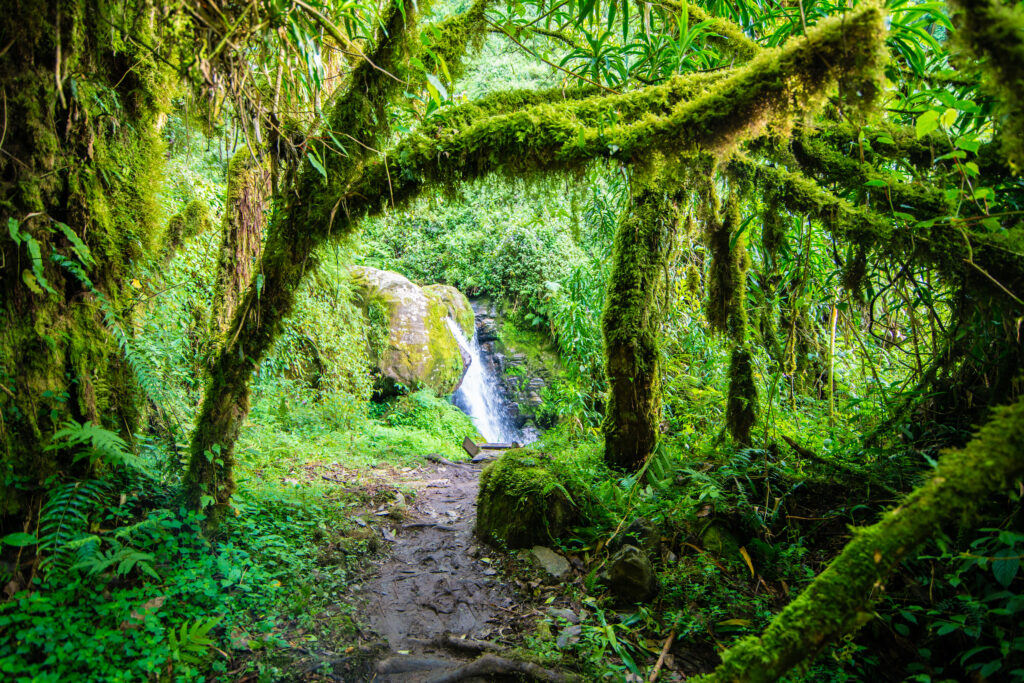
Sine Hut, at 2,596 meters, sits on a narrow ridge between tall forest trees with a veranda overlooking the falls and the Kilembe Valley below. The first mountain night is cool and quiet, and the evening meal prepared by your guide team at the hut’s cooking facilities is the first in a sequence of mountain dinners that the altitude and effort will make taste better than they have any right to. Sleep comes early. Tomorrow, the bamboo.
Day 2: The Cathedral of Bamboo — Sine Hut to Mutinda Camp
Elevation: 2,596m → 3,688m | Altitude Change: +1,092m | Distance: ~6km | Trekking Time: 5–6 hours
The bamboo zone above Sine Hut is the Kilembe Trail’s most demanding single vegetational environment and one of its most visually striking. The culms rise to height on either side of a trail that is steep, often muddy, and entirely enclosed within the bamboo’s filtering canopy. The light inside the bamboo stand is green and diffuse, the temperature cooler than the forest below, and the sound of the bamboo in the wind overhead is a soft, continuous percussion that the body learns to use as a metronome for the upward pace. The seven-day schedule requires a pace that is purposeful here rather than leisurely, and your private guide manages the group’s movement with the experience of someone who has read this gradient many times.
Kalalama Camp at 3,147 meters provides the day’s natural midpoint, a brief rest stop where the valley below has opened into the first broad view of the approach and the heather zone above has made its first appearance on the upper ridgeline. The hot drink here, produced from the guide team’s thermos, is one of the morning’s reliable pleasures. The trail from Kalalama first enters the Hagenia-Hypericum woodland, where moss-draped Hagenia trees, covered in bryophytes and old man’s beard lichen, create a dark, enclosed woodland that the afternoon light turns gold in the occasional clearings.
Mutinda Camp, at 3,688 meters, arrives in the late afternoon in a position of broad panoramic authority. The Kilembe Valley is visible below. The upper moorland and the ridgeline of the central massif are visible above. The day’s climb of over 1,000 meters is the program’s largest single altitude gain, and it arrives in the body as a familiar mountain tiredness: satisfying, honest, and entirely appropriate. The evening briefing for Day 3’s Mutinda Lookout acclimatization ascent is conducted over dinner as the first stars appear above the camp.
Day 3: The Lookout and the View — Mutinda Lookout Acclimatisation Ascent
Elevation: 3,688m | Ascent to 3,975m | Return to 3,688m | Altitude Change: +287m gain anreturn | Distance: ~5km round trip | Trekking Time: 3–4 hours active, then rest
The Mutinda Lookout ascent on Day 3 is the 7-day Mount Baker & Weismann’s Peak Rwenzori trek’s acclimatization investment, and the view from 3,975 meters is its first great geographic revelation: both summit objectives are simultaneously visible, placed in their full spatial context by the elevation and the clarity that the morning often brings before the clouds build from the west. Mount Baker’s Edward Peak addresses the northern skyline with the solid authority of Africa’s fourth-highest Rwenzori summit. Weismann’s Peak on the Mount Luigi di Savoia ridge is identifiable to the northeast as a distinctive rocky profile above the upper Kilembe moorland. Your private guide identifies both summits and the approach terrain that the remaining days will cross.
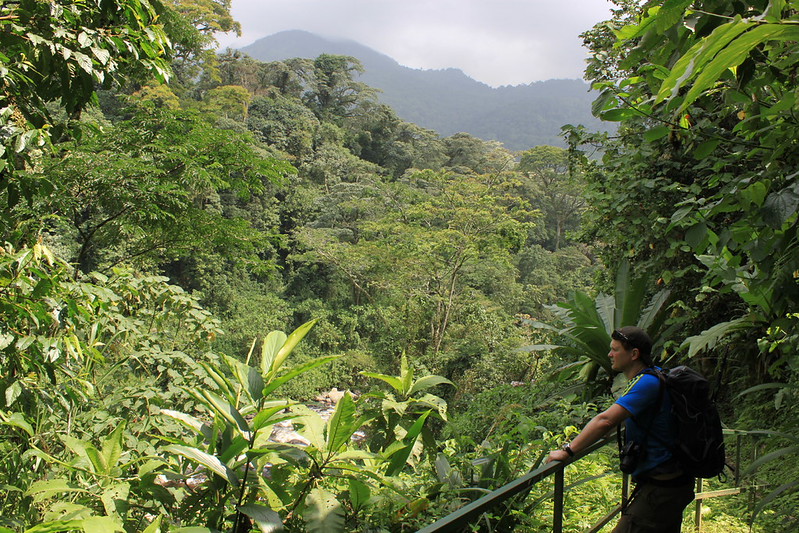
The ascent to the Lookout follows a rocky trail above the heather zone and into the first open moorland of the program. The giant lobelias and groundsels begin to appear at the upper edges of the heather, their architectural forms announcing the botanical world that Days 4 and 5 will traverse in full. The altitude at the Lookout—3,975 meters—is high enough to provide a genuine physiological stimulus: the erythropoietin signal that triggers red blood cell production above 3,000 meters is active here, and the two to three hours spent above 3,700 meters on the round trip provide a meaningful acclimatization contribution before returning to Mutinda for lunch and the afternoon rest.
The afternoon at Mutinda after the lookout returns is the program’s recovery window. A substantial lunch, adequate hydration, and two to three hours of horizontal rest before the evening briefing allow the body to consolidate the morning’s altitude exposure. The Day 4 program, moving to Hunwick’s Camp through the full afro-alpine moorland, is previewed in the guide’s evening briefing, and the anticipation of the giant groundsel zone that tomorrow will deliver in its full expression closes the day with a productive focus.
Day 4: The Giant World — Mutinda to Hunwick’s Camp
Elevation: 3,688m → 3,927m | Altitude Change: +239m net | Distance: ~8km | Trekking Time: 5–6 hours
Day 4 of the 7-day Mount Baker & Weismann’s Peak Rwenzori trek delivers the Kilembe Trail’s most compelling landscape, and the altitude gain, modest by comparison with the first two days, belies the richness of what the trail crosses above 3,700 meters. The afro-alpine moorland above Mutinda is the Rwenzori in its most botanically distinctive expression: the giant groundsels of the species Dendrosenecio adnivalis stand as individual trees across the valley floor and hillsides, their thick succulent trunks rising to five and six meters before expanding into crowns that trap the cloud moisture and release it in slow, continuous drips. The giant lobelias, Lobelia wollastonii, erupt from the moorland in their dense architectural rosettes, each one a living record of decades of growth at high altitude.
Walking through dense stands of these plants in the particular silence of the upper Kilembe moorland, with the cloud moving through the groundsel crowns and the cold air carrying the mineral smell of high-altitude water, is the experience that most trekkers on this route identify as the program’s most arresting single encounter. The plants are not merely scenic; they are functionally extraordinary, adapted to conditions of cold, moisture, and low oxygen that would challenge most vegetation. Being among them, at altitude, in the cloud, has a quality of entering a different ecological world that no amount of prior reading quite prepares you for.
Hunwick’s Camp, at 3,927 meters, occupies a position of exposed, dramatic grandeur on the Kilembe Trail, with Mount Baker’s massif and glacier fields visible above to the north on clear afternoons. The camp’s veranda, where the guide team produces hot drinks with reliable efficiency, commands the full sweep of the southern Rwenzori in both directions along the range. The evening at Hunwick’s is cold — the temperature dropping toward freezing after dark — and the sleeping bag is the evening’s most appreciated feature. Tomorrow, the move to Lake Kopello and the eve of the Baker summit occur.
Day 5: The High Lake — Hunwick’s Camp to Lake Kopello
Elevation: 3,927m → 4,190m | Altitude Change: +263m | Distance: ~5km | Trekking Time: 4–5 hours
The fifth day is the 7-day Rwenzori trek to Mount Baker & Weismann Peak’s final positioning stage before the consecutive summit days, and the move from Hunwick’s to Lake Kopello at 4,190 meters places the group above 4,000 meters for the first time in the program. The altitude above 4,000 meters announces itself with a new and unmistakable clarity: the breathing is more deliberately managed, the heart works harder at the same pace, and the body communicates the altitude with a precision that all the lower-mountain acclimatization work has been preparing it to manage.
The trail from Hunwick’s traverses the upper Kilembe Valley in a rocky crossing that requires careful footwork and continuous attention, with the Baker massif growing in definition above the trail as the route approaches the high lake basin. The landscape above 4,000 meters on the Kilembe Trail is spare and elemental: bare rock, moorland remnants at the lower edges, and the enormous sky above that the equatorial altitude makes vivid. Lake Kopello Camp, at 4,190 meters, sits beside a dark, cold tarn in a rocky bowl below the final approach ridges to both Baker and Luigi di Savoia, and the camp’s position—severe, exposed, and beautiful in the way that high mountain camps always are—is its own preparation for the summit days ahead.
The comprehensive summit briefing at Lake Kopello covers both peaks in sequence: Baker’s Edward Peak on Day 6, approached in the pre-dawn with a 03:00 departure, and Weismann’s Peak on Day 7, tackled in the same pre-dawn format but from a different approach line. Your private guide reviews the exact route, the layer management strategy for the pre-dawn cold, the emergency protocols, and the descent options based on summit timing. Dinner at 17:30. Sleep at 18:30. The alarm is set for 03:00.
Day 6: Mount Baker Summit — Edward Peak at 4,843 Metres
Elevation: 4,190m → 4,843m → high camp | Altitude Change: +653m gain / return descent | Distance: ~10km | Trekking Time: 8–10 hours
The pre-dawn at Lake Kopello at 4,190 meters is the coldest moment the program has produced. The temperature sits between minus three and minus eight degrees Celsius, and the headtorch beam at 03:00 picks out the frost on the camp ground, the frozen surface of the tarn, and the faces of the team assembling in the darkness for the Baker ascent. Your guide has hot tea ready, and the briefness of the morning routine: boots, layers, gaiters, poles, and daypack is the efficiency of a team that has done this before and knows that the summit window requires departure at the committed time.
The approach to Edward Peak on Mount Baker from Lake Kopello moves northward through the upper Kilembe valley before climbing through the rocky terrain that approaches the Baker massif from the south and east. As you approach from this angle, the Baker massif comes into view in stages as you gain altitude: first the lower rocky buttresses, then the broader ridge system, and finally the upper massif, where the Semper and Edward Glaciers flank the summit terrain in their current, diminished but still imposing state. The glaciers of Mount Baker have retreated significantly over the past century, and the moraines of their historical extent are visible as curved ridges of deposited rock that frame the current ice fields in a geological record of retreat.
Edward Peak, at 4,843 meters, is the summit of Mount Baker, the fourth highest peak in the Rwenzori range, named for King Edward VII of Great Britain in the naming convention of Luigi Amadeo’s 1906 expedition. The summit offers the program’s first full panoramic view from above 4,800 meters: Mount Stanley’s glaciated massif to the northwest; the Kitandara Valley below to the west; Weismann’s Peak and the Luigi di Savoia ridge visible to the south as tomorrow’s objective; and the DRC’s forest horizon beyond the range’s western ridgeline. The summit cairn on Baker is a straightforward place: cold, rocky, and exposed, with the full weight of the altitude and the achievement of having reached it.
The descent from Edward Peak returns the group to the high camp or positions them for the Weismann approach on Day 7. Your guide manages the descent timing and overnight position based on the group’s condition and the light available. The evening, wherever it is spent above 3,900 meters, carries the earned satisfaction of the program’s first summit and the awareness that the second is twelve hours away.
Day 7: Weismann’s Peak and the Return-Summit at 4,620m and Full Descent
Elevation: High camp ~4,000m → 4,620m → 1,586m | Altitude Change: +620m gain / ~2,600m descent | Distance: ~18ktotal | Trekking Time: 10–12 hours
The final day of the seven-day program is the most demanding on paper and the most satisfying in experience. Weismann’s Peak at 4,620 meters, the higher summit of Mount Luigi di Savoia, is approached in the pre-dawn with the same 03:00 departure protocol as Baker the day before, and the body, now five nights at altitude above 3,600 meters and one summit complete, moves through the morning preparation with a confidence that the program’s progressive altitude structure has produced.
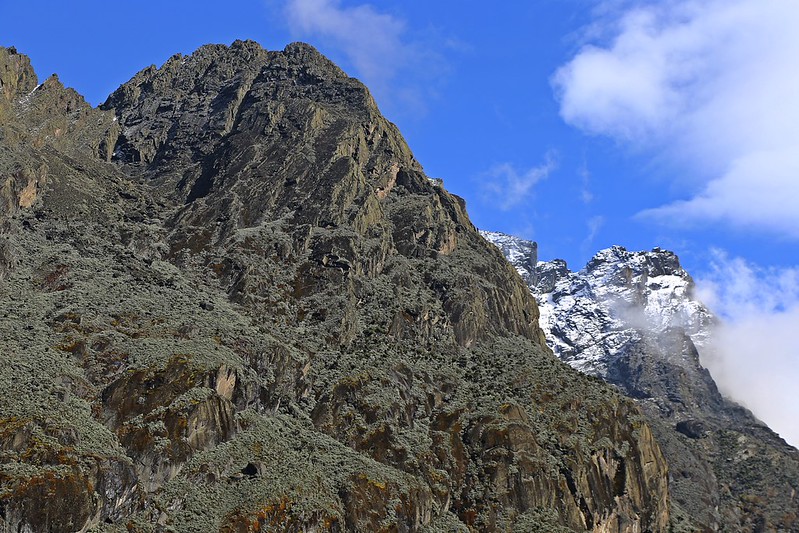
The approach to Weismann’s Peak from the Lake Kopello area follows the Luigi di Savoia ridge system, ascending through the rocky upper mountain terrain in conditions that the preceding days have made familiar. The altitude of the approach, above 4,000 meters throughout the final ascent section, demands the same deliberate breathing and measured pace as Baker, and your private guide manages the group’s movement with the same unhurried certainty. Weismann’s Peak, the sixth highest summit in the Rwenzori range, is a different mountain from Baker in character: less massive, more defined in its rocky summit ridge, and positioned in a way that provides a different angular view of the range.
The summit of Weismann’s Peak at 4,620 meters is the program’s completion point, and the view from it closes the dual-summit narrative with perfect geographic logic. Mount Baker’s Edward Peak is visible to the north, climbed yesterday. Mount Stanley’s glacier system extends further north in the range’s full glaciated grandeur. The DRC lies to the west, Uganda to the east. And the Kilembe Trail, the route that has delivered seven days of mountain experience of extraordinary variety and challenge, descends to the south in the direction of Kasese and the valley world below.
The descent from Weismann’s Peak is the programme’s longest single descent, dropping through the full Kilembe Trail vegetation sequence from the Luigi di Savoia approaches to the trailhead at 1,586 metres. The giant groundsels, the heather, the bamboo, and the montane forest are traversed in reverse order, and the body, descending from two summits in two days, experiences the altitude reduction as a gradual physical relief that manifests as warmth, easier breathing, and the particular satisfaction of earned return. The Kilembe UWA gate receives the group in the late afternoon or early evening, where the dual summit certificates are issued and the vehicle is waiting for the drive back to Kasese.
What’s Included
The 7-day Mount Baker and Weismann’s Peak program via the Kilembe Trail is managed as a fully inclusive expedition from your arrival in Kasese. Pre- and post-trek accommodation in Kasese on a bed-and-breakfast basis; all six nights of mountain hut and camp accommodation on the Kilembe Trail (Sine Hut, two nights at Mutinda Camp, Hunwick’s Camp, Lake Kopello Camp, and a high camp above for the dual summit sequence); a private certified mountain guide throughout all seven days; a personal porter carrying your main load of up to 15 kilograms; an armed Uganda Wildlife Authority ranger escort; all UWA park entrance and camp fees; all mountain meals from Day 1 dinner through Day 7 lunch; hot drinks at every camp; all private vehicle transfers between Kasese and the Kilembe trailhead; and a comprehensive pre-departure equipment and fitness guide are all included.
What’s Not Included
International flights, personal trekking equipment (waterproof hiking boots, trekking poles, sleeping bag rated to minus ten degrees Celsius, full layering system, waterproof gloves, warm hat, gaiters, and headtorch with spare batteries), personal medical items including altitude medication, alcoholic beverages, personal snacks, gratuities for the guide and porter team, laundry, and travel insurance covering emergency evacuation are not included. A detailed equipment sourcing guide is provided with booking confirmation.
Best Time to Trek the 7-Day Baker and Weismann Programme
The Kilembe Trail operates in the Rwenzori’s year-round rain environment, and the seven-day compressed schedule places a premium on the seasonal window chosen. Because the program has no dedicated acclimatization rest day, summit-day conditions are more directly dependent on the season than on the eight-day version of the same program.
The primary window of June through August offers the most reliable summit-day conditions: driest trails on the bamboo and lower forest sections, highest probability of clear visibility from both Edward Peak and Weismann’s summit ridgelines, and the most stable high-camp conditions at Hunwick’s and Lake Kopello. This is the window where the seven-day program’s compressed schedule is most likely to deliver clear summits on both days 6 and 7 and where booking through Gorilla Safaris at least four to six months in advance is strongly recommended.
December through February provides a secondary window with excellent summit visibility potential and significantly lower visitor numbers. The high camps are colder in this period, and frost on the upper approach rocks requires additional care on both summit mornings. Trekkers who prioritize solitude find this window offers the mountain in its most private and atmospheric condition.
The wet seasons of March to May and September to November bring elevated rainfall, reduced summit visibility, and the bamboo section at its most challenging. The program is entirely operational year-round with experienced guides, but trekkers with date flexibility are strongly advised to target the June-August or December-February windows for the best dual-summit probability on the compressed seven-day schedule.
Fitness and Preparation
The 7-day Baker and Weismann Peak trek is classified as a strenuous high-altitude multi-summit program and is designed for trekkers with good cardiovascular fitness and prior multi-day mountain trekking experience. The compressed schedule, two consecutive summit days above 4,600 meters without a dedicated rest day in the approach, requires that the body arrive at the Kilembe trailhead in the best possible prepared state.
The standard preparation includes a minimum of six months of sustained aerobic training, with multi-day trekking excursions building to three-day mountain programs in the final months. Prior experience above 3,000 metres is a significant advantage. Trekkers without prior high-altitude experience are directed toward the
Frequently Asked Questions: 7-Day Mount Baker and Weismann’s Peak Trek via Kilembe Trail
What is the difference between the 7-day and 8-day Baker and Weismann programmes?
The 8-day Baker and Weismann programme includes a dedicated acclimatisation rest day at Mutinda Camp on Day 3, separate from the Mutinda Lookout acclimatisation ascent. This provides 24 additional hours of altitude adaptation at 3,688 metres before the progression to Hunwick’s and Lake Kopello, and produces meaningfully better preparation for the consecutive summit days. The 7-day programme replaces this dedicated rest day with the Mutinda Lookout ascent serving as the sole acclimatisation stimulus. For trekkers without prior high-altitude experience, the 8-day programme is the Gorilla Safaris recommendation.
How high are Edward Peak and Weismann’s Peak?
Edward Peak is the summit of Mount Baker at 4,843 metres above sea level, the fourth highest peak in the Rwenzori Mountains. Weismann’s Peak is the higher summit of Mount Luigi di Savoia at 4,620 metres, the sixth highest peak in the range. Together they constitute a dual-summit programme spanning from 4,620 to 4,843 metres, well above the altitude where physiological preparation and acclimatisation strategy determine summit success rates.
Does the Baker and Weismann trek require glacier equipment?
No glacier equipment is required for either Edward Peak on Mount Baker or Weismann’s Peak on Mount Luigi di Savoia on the standard Kilembe Trail approach. Both peaks are accessed via rocky ridge and high moorland terrain. Crampons and ice axe are not part of the seven-day programme’s equipment. Waterproof boots with Vibram sole and ankle support, trekking poles, and full cold-weather layering for minus three to minus eight degree conditions at the high camps are the essential equipment requirements.
What huts are used on the 7-day Kilembe Trail programme?
The programme uses UWA camp huts along the Kilembe Trail: Sine Hut at 2,596 metres on Day 1, Mutinda Camp at 3,688 metres on Days 2 and 3, Hunwick’s Camp at 3,927 metres on Day 4, Lake Kopello Camp at 4,190 metres on Day 5, a high camp above 3,900 metres for Day 6 after the Baker summit, and a descent camp or return to Kasese on Day 7 after Weismann’s summit. All huts provide sleeping platforms, basic cooking facilities, and latrine blocks.
Is the 7-day Baker and Weismann programme suitable for beginners?
The 7-day programme is not recommended for trekkers without prior multi-day mountain trekking experience or prior altitude exposure above 3,000 metres. The compressed schedule and consecutive summit days above 4,600 metres require the physical preparation and altitude familiarity that a first-time mountain trekker has not yet developed. Beginners to high-altitude mountain trekking should consider the 8-day programme with its dedicated acclimatisation day, or build prior experience on shorter Rwenzori programmes before attempting the dual-summit format.
What is the Mutinda Lookout and why is it important on the 7-day programme?
Mutinda Lookout at 3,975 metres is a viewpoint above Mutinda Camp on the Kilembe Trail, reached by a return ascent of approximately 287 metres from the camp. It serves two functions on the 7-day programme: a panoramic viewpoint from which both Baker and Weismann’s Peak summit objectives are simultaneously visible in their full geographic context, and the programme’s primary acclimatisation stimulus, providing exposure to nearly 4,000 metres before the progression to Hunwick’s and Lake Kopello. The round trip ascent and the afternoon rest at Mutinda on Day 3 constitute the seven-day programme’s acclimatisation strategy.
Can I combine the Baker and Weismann trek with gorilla trekking in Uganda?
Yes. The Rwenzori Mountains and Bwindi Impenetrable Forest for gorilla trekking are both in western Uganda. The most popular combination follows the seven-day Kilembe programme with two gorilla trekking days at Bwindi, creating a ten-day western Uganda expedition. Queen Elizabeth National Park is also conveniently positioned between Kasese and Bwindi for travellers who want to add a game drive component to the western Uganda circuit.
What is the total altitude gain on the 7-day Baker and Weismann programme?
The programme gains approximately 3,257 metres from the Kilembe trailhead at 1,586 metres to Edward Peak’s summit at 4,843 metres. The Weismann’s Peak summit day adds a further ascent from high camp to 4,620 metres. Total trekking distance across the seven days is approximately 60 to 65 kilometres, with the summit day and descent day carrying the highest distance totals at approximately 10 and 18 kilometres respectively.
What is the best time to climb Mount Baker and Weismann’s Peak via the Kilembe Trail?
The primary trekking season of June through August offers the best conditions for the dual-summit programme: driest trails, highest summit visibility probability, and most stable high-camp conditions. December through February provides a secondary window with good summit prospects and lower visitor numbers but colder overnight temperatures at Hunwick’s and Lake Kopello. The programme operates year-round but the compressed seven-day schedule benefits most from the peak-season dry windows.
How do I get to the Kilembe trailhead from Kasese or Entebbe?
The Kilembe trailhead is approximately 14 kilometres from Kasese town along the Nyamwamba River road. Kasese is approximately 380 kilometres from Kampala and 430 kilometres from Entebbe International Airport, a five to seven-hour road journey depending on traffic. All transfers from Entebbe or Kampala to Kasese and from Kasese to the Kilembe trailhead are arranged by Gorilla Safaris in your private vehicle as part of the programme.